BABA Stock Jumps 5% as Alibaba’s Qwen AI Launch and Apple Deal Put $125 Resistance in Focus
Alibaba stock BABA jumps 5% as Qwen3.8 and Apple Intelligence fuel AI optimism, putting the key $125 resistance zone in focus.
Quick overview
- Alibaba shares surged to $120.84 after the preview of its new Qwen3.8-Max AI model and regulatory progress for Apple Intelligence in China.
- The Qwen3.8-Max model boasts 2.4 trillion parameters and aims to strengthen Alibaba's position in the competitive AI market.
- Investor optimism is bolstered by the partnership with Apple, which could integrate Qwen into its devices, providing access to a vast consumer base.
- Despite the positive developments, investors are advised to remain cautious due to the lack of independent benchmarks and the significant investments required for AI development.
Alibaba shares surged in overnight trading as investors reacted to a new flagship Qwen model and regulatory progress for Apple Intelligence in China.
BABA rose to $120.84 after closing Friday at $114.97, reversing the previous session’s 2.14% decline and placing the stock near its most important long-term technical resistance zone.
Alibaba Stock Rallies on Qwen3.8 Preview
The latest rally followed Alibaba’s preview of Qwen3.8-Max, the newest flagship model in its rapidly expanding artificial intelligence portfolio.
Alibaba says the model contains 2.4 trillion parameters and ranks behind only Anthropic’s Fable 5 among leading frontier systems. The Qwen3.8-Max-Preview version is already available through Alibaba’s Token Plan, Qoder, and QoderWork platforms, while the company says an open-weight release will follow.
However, investors should treat Alibaba’s performance claims cautiously.
The company has not yet released a complete model card, independent benchmark results, active-parameter details, or licensing terms. That means the claim that Qwen3.8 trails only Fable 5 remains Alibaba’s own assessment rather than a ranking verified by outside testing.
Even so, the launch reinforces Alibaba’s position in China’s increasingly competitive AI market.
The new model arrived shortly after Moonshot AI introduced its 2.8 trillion-parameter Kimi K3 system, highlighting the speed at which Chinese developers are moving into the frontier-model category.
For Alibaba, the commercial opportunity extends beyond model rankings. A stronger Qwen ecosystem could attract more developers and enterprises to Alibaba Cloud, increasing demand for computing infrastructure, model services, storage, and AI development tools.
Apple Intelligence Gives Qwen Its Biggest Consumer Endorsement
Investor optimism has also strengthened after Apple Intelligence was registered with China’s cyberspace regulator, clearing an important hurdle for its long-delayed introduction in the country.
Apple is working with Alibaba and Baidu to adapt its AI services to Chinese regulatory and technology requirements. Alibaba confirmed that Qwen will be integrated into Apple Intelligence across the iPhone, iPad, Mac, and Vision Pro operating systems in China.
The development gives Alibaba access to one of the world’s largest consumer-device ecosystems.
Qwen could help support text generation, image understanding, content creation, and other AI functions for millions of Apple users in China. It also gives Alibaba a major commercial endorsement as it attempts to establish Qwen as a leading foundation-model platform.
Apple selected Alibaba after assessing several Chinese AI providers. The partnership was initially confirmed in February 2025, but regulatory approval delayed the rollout.
The Chinese regulator has not announced a specific public launch date.
Nevertheless, the registration significantly increases the probability that Apple Intelligence will become available in China and creates a clearer path for Alibaba to monetize Qwen beyond enterprise cloud customers.
Alibaba Is Becoming More Than an E-Commerce Company
The Qwen and Apple developments support Alibaba’s effort to change how investors value the business.
Alibaba remains best known for Taobao, Tmall, international commerce, logistics, and digital services. However, management has made artificial intelligence and cloud infrastructure central to its next growth phase.
The company is building an integrated AI stack that includes foundation models, Alibaba Cloud infrastructure, developer platforms, and custom semiconductor technology.
Alibaba’s T-Head chip division has also reportedly opened its SAIL software platform to outside developers. The software is designed to support AI workloads on Alibaba’s Zhenwu processors and reduce China’s dependence on Nvidia’s CUDA ecosystem.
Replacing CUDA will be difficult because Nvidia has spent decades building its software and developer advantage. Still, Alibaba’s strategy shows that it is attempting to compete across the full AI technology stack rather than relying only on third-party chips.
That approach could provide Alibaba with greater control over costs and infrastructure while helping Chinese enterprises deploy AI despite US semiconductor restrictions.
AI Spending Could Pressure Alibaba’s Near-Term Profitability
Alibaba’s AI strategy also carries meaningful risks.
Developing frontier models, purchasing accelerators, building data centers, and producing custom chips require substantial investment. These expenses can place pressure on margins and free cash flow before the new products generate equivalent revenue.
Competition is also intense.
Alibaba faces domestic rivals including Baidu, Tencent, ByteDance, Moonshot AI, and DeepSeek, while OpenAI, Anthropic, Google, and Meta continue advancing models outside China.
Qwen3.8’s parameter count alone does not prove that it is more capable or efficient than competing systems. Investors will want to see independent benchmarks, enterprise adoption, API usage, and measurable cloud revenue before determining whether the model materially changes Alibaba’s earnings outlook.
The Apple partnership is strategically important, but its financial impact also remains unclear. Neither company has publicly disclosed the commercial terms or how revenue generated from the integration will be divided.
BABA Technical Analysis: Overnight Rally Puts $124-$125 Resistance in Focus
From a technical perspective, Alibaba’s 4-hour chart has improved considerably following the overnight move toward $120.84.
Before the rally, BABA was already trading above most short- and medium-term moving averages. The 10 EMA at $114.75, 20 EMA at $111.63, 20 SMA at $110.56, 30 EMA at $110.17, and 50 EMA at $110.61 were all showing buy signals.
The overnight advance has now carried the stock above the 100 EMA at $115.85, Hull Moving Average at $117.06, and 100 SMA at $118.51.
Holding above the $115-$118.50 area would confirm that these former resistance levels are becoming short-term support.
The next major test sits between $124.68 and $125.45, where the 200 EMA and 200 SMA are clustered. This is the most important technical resistance zone on the current 4-hour setup.
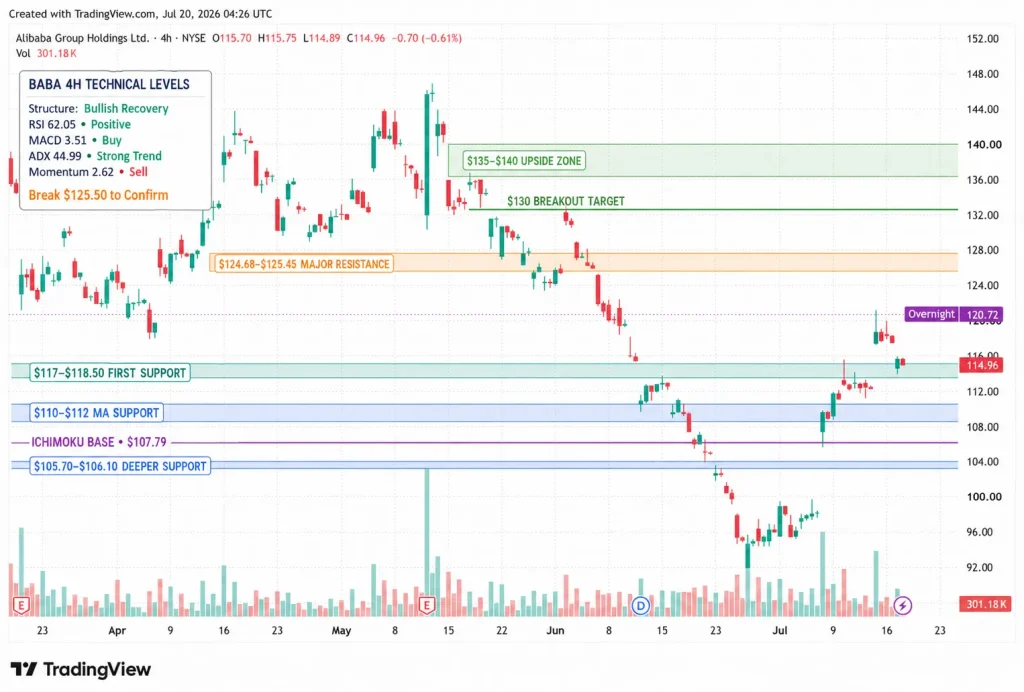
A sustained break above $125.50 could strengthen the recovery and open the way toward $130, followed by the $135-$140 region.
If the overnight rally fades, initial support sits around $117-$118.50. Below that, the next support band is located between $110 and $112, where the 20-, 30-, and 50-period averages are concentrated.
A break below $110 would weaken the short-term bullish structure and could expose the Ichimoku baseline near $107.79, followed by the 30 and 50 SMAs around $105.70-$106.10.
Momentum indicators remain constructive but not overextended. RSI stands at 62.05, indicating positive momentum without reaching overbought territory. MACD remains on a buy signal at 3.51, while the ADX reading of 44.99 suggests the recent trend has meaningful strength.
Momentum at 2.62 is still marked as a sell signal, however, showing that the rally needs continued buying pressure to confirm a durable breakout.
What Alibaba (BABA) Investors Should Watch Next
Alibaba’s overnight rally reflects growing confidence that the company can become a major AI platform rather than remaining primarily an e-commerce business.
Qwen3.8 expands Alibaba’s frontier-model ambitions, while the Apple Intelligence partnership could put its technology in front of millions of Chinese consumers.
The next step is execution.
Investors will want to see independent Qwen3.8 testing, a confirmed Apple Intelligence launch date, faster Alibaba Cloud growth, and evidence that AI investment is translating into higher revenue rather than only increased spending.
Technically, the move above $118.50 has improved the short-term outlook. However, BABA now faces a more significant test at $124-$125.50.
A confirmed breakout above that zone could signal a broader trend reversal. Failure to clear it may leave the stock consolidating between approximately $110 and $125 while the market waits for stronger evidence that Alibaba’s AI strategy is improving earnings.
- Check out our free forex signals
- Follow the top economic events on FX Leaders economic calendar
- Trade better, discover more Forex Trading Strategies
- Open a FREE Trading Account
- Read our latest reviews on: Avatrade, Exness, HFM and XM

Related Articles



Sidebar rates

Related Posts
 Save
Save