MU Stock Tests $850 Support as China Competition Overshadows Micron’s $1 Trillion Milestone
Micron stock MU tests $850 as China competition and AI spending fears overshadow its $1 trillion milestone and new auto deals.

Quick overview
- Micron Technology shares are stabilizing around the $850 level after a significant correction from a recent rally driven by AI demand.
- The company reported a fiscal third-quarter revenue of $41.46 billion, marking a 300% year-over-year increase, and expects continued momentum with a forecast of $50 billion in fourth-quarter revenue.
- Despite strong performance, investors are cautious about the sustainability of AI spending, leading to a more than 25% drop in Micron's stock from recent highs.
- Micron's new agreements with automotive suppliers aim to diversify its revenue streams, but the market remains focused on future AI infrastructure spending and competitive pressures.
Micron Technology shares are attempting to stabilize near the $850 level after a sharp correction erased part of the company’s spectacular AI-driven rally.
The memory-chip maker recently became one of the few semiconductor companies to surpass a $1 trillion market capitalization, reflecting booming demand for AI memory products. Yet despite record earnings and an increasingly diversified customer base, investors have shifted their focus toward whether today’s extraordinary AI spending cycle can continue.
Micron Hits $1 Trillion, but Investors Are Looking Beyond Record Results
Micron’s recent rally has been fueled by unprecedented demand for high-bandwidth memory (HBM), DRAM, and NAND products used in AI servers and hyperscale data centers.
The company delivered another blockbuster quarter, reporting fiscal third-quarter revenue of $41.46 billion, up more than 300% year over year, while adjusted gross margin climbed to 84.9%. Micron also generated approximately $25.4 billion in operating cash flow and $18 billion in free cash flow, highlighting the extraordinary profitability created by the current AI infrastructure boom.
Management expects momentum to continue, guiding for approximately $50 billion in fourth-quarter revenue and gross margins near 86%.
Those results briefly pushed Micron’s valuation above $1 trillion for the first time.
However, the celebration proved short-lived.
MU has fallen more than 25% from its recent highs as investors lock in profits across semiconductor stocks and reassess how long the industry’s record pricing environment can last.
Automotive AI Deals Expand Micron’s Growth Story
Micron also strengthened its long-term outlook by signing new Strategic Customer Agreements with several leading automotive suppliers, including Qualcomm, DENSO, Hyundai Mobis, Astemo, Visteon, HARMAN, and JOYNEXT.
The agreements secure long-term demand for Micron’s memory and storage products used in advanced driver-assistance systems, autonomous driving, digital cockpits, and AI-powered vehicles.
While automotive currently represents only about 11% of Micron’s revenue compared with approximately 61% from cloud and data-center customers, the agreements further diversify the business beyond traditional PCs and smartphones.
As vehicles become increasingly software-defined, memory requirements continue rising alongside onboard AI capabilities, making automotive one of Micron’s fastest-growing long-term markets.
The agreements also improve production planning and demand visibility, giving investors greater confidence that AI-related demand extends well beyond hyperscale data centers.
Why the MU Stock Is Still Falling
Despite Micron’s exceptional operating performance, investors are becoming more cautious toward the entire semiconductor sector.
The market’s biggest concern is no longer current earnings—it’s future AI spending.
Technology giants have invested hundreds of billions of dollars in AI infrastructure over the past two years, driving unprecedented demand for GPUs, networking equipment, servers, and memory chips. That spending has been one of Micron’s biggest growth drivers.
However, investors are beginning to question whether hyperscalers can maintain the same pace of capital expenditure indefinitely.
This week’s earnings from Alphabet and Intel are expected to provide important clues about future AI infrastructure spending, making them potential catalysts for Micron and the broader semiconductor sector.
The industry also faces increasing competitive pressure.
Chinese memory manufacturer CXMT continues expanding production capacity, while investors remain alert to any signs that additional global supply could eventually reduce memory pricing power.
For now, demand still exceeds supply, but the market is increasingly looking beyond today’s record profits toward what earnings could look like two or three years from now.
MU Technical Analysis: $840-$850 Support Becomes the Key Battleground
From a technical perspective, Micron’s 4-hour chart remains under pressure despite signs that the recent selloff may be losing momentum.
MU is trading below all major short- and medium-term moving averages, confirming that sellers remain in control of the near-term trend.
The first resistance zone sits between $900 and $910, where the 10 EMA, 10 SMA, and 100 EMA are clustered. Above that, a stronger resistance band between $933 and $941 includes the VWMA, 20 EMA, 20 SMA, and 100 SMA. A move through this area would significantly improve the short-term outlook.
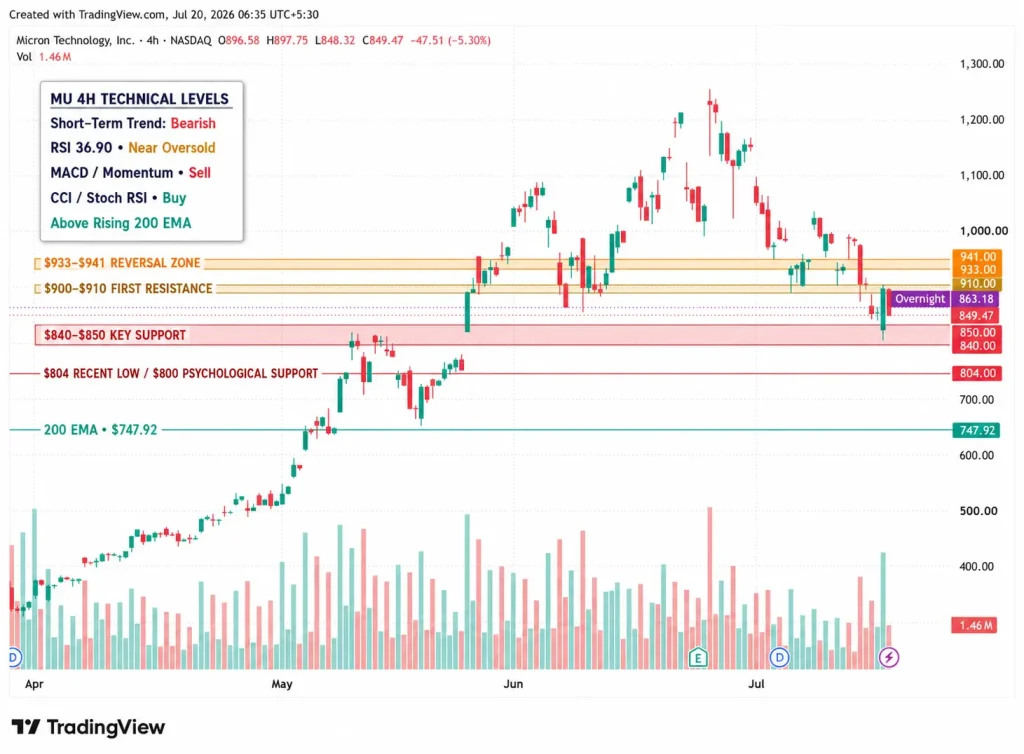
MU Chart 4H – Buyers Need to Reclaim $940 to Reverse the Short-Term Downtrend
The immediate support zone is $840-$850, with the Hull Moving Average near $843.74 suggesting buyers are attempting to establish a floor. If that area breaks, the next downside target sits near the recent low around $804, followed by the psychological $800 level.
Momentum indicators remain mixed. RSI has improved to 36.90, indicating selling pressure has eased but remains close to oversold territory. MACD and Momentum continue to flash sell signals, while the CCI and Stochastic RSI have shifted to buy signals, suggesting the recent decline may be becoming exhausted.
Although the short-term trend remains bearish, Micron continues trading above its rising 200 EMA near $747.92, indicating the broader long-term uptrend has not yet been broken.
What Micron Investors Should Watch Next
Micron remains one of the strongest long-term beneficiaries of artificial intelligence infrastructure spending.
Demand for HBM memory, AI servers, cloud computing, and intelligent vehicles continues supporting record revenue, exceptional margins, and powerful cash generation.
However, after an extraordinary rally, investors are becoming more selective.
The market is now focused less on how strong Micron’s current business is and more on whether AI spending can continue growing fast enough to justify today’s elevated valuations.
For now, the $840-$850 support zone becomes the most important technical level to watch. A recovery above $900 would suggest buyers are regaining confidence, while upcoming earnings from major hyperscalers could determine whether Micron’s next move is driven by another wave of AI optimism—or a broader semiconductor correction.
- Check out our free forex signals
- Follow the top economic events on FX Leaders economic calendar
- Trade better, discover more Forex Trading Strategies
- Open a FREE Trading Account
- Read our latest reviews on: Avatrade, Exness, HFM and XM

Related Articles



Sidebar rates

Related Posts
 Save
SaveAva

