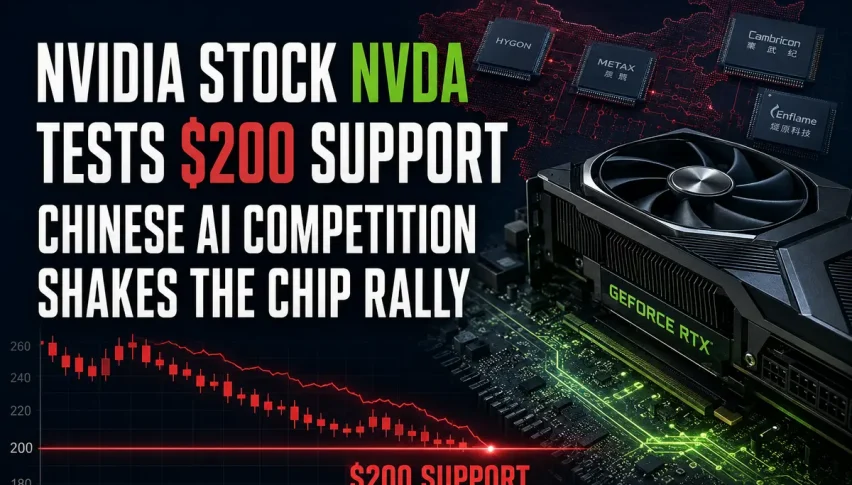
Nvidia Stock NVDA Tests $200 Support as Chinese AI Competition Shakes the Chip Rally
Nvidia stock NVDA tests $200 as China’s Kimi K3 model and AI spending concerns overshadow major physical AI deals in Japan.
Quick overview
- Nvidia shares are trying to stabilize above the $200 level after a recent decline due to semiconductor market pressures and concerns over AI valuations.
- The Philadelphia Semiconductor Index has entered a technical bear market, impacting Nvidia and other AI-linked chip companies as investors reassess growth expectations.
- Nvidia faces increasing competition from major customers developing custom chips, while also expanding its partnerships in Japan to enhance its AI infrastructure opportunities.
- Despite recent stock corrections, Nvidia's operating performance remains strong, with record revenue growth driven by demand for AI and accelerated computing.
Nvidia shares are attempting to stabilize above the psychological $200 level after another wave of semiconductor selling raised concerns about AI valuations, hyperscaler spending, and rapidly improving Chinese artificial intelligence models.
The stock closed at $202.81, down 2.21%, before recovering slightly to $203.54 in overnight trading.
Nvidia Stock Falls 2.2% as the AI Trade Loses Momentum
Nvidia remained under pressure as investors continued reducing exposure to some of the market’s strongest-performing semiconductor companies.
The Philadelphia Semiconductor Index fell approximately 10% during the week and entered a technical bear market after declining more than 20% from its June peak. Nvidia, Micron, Intel, and other AI-linked chip companies were among the stocks affected as investors questioned whether enormous AI investments can continue producing the growth required to support elevated valuations.
Nvidia has now fallen roughly 14% from its 2026 high, placing the stock in a technical correction despite continued demand for its AI accelerators, networking systems, and software.
The market’s concern is not that AI infrastructure demand has disappeared.
Instead, investors are becoming more selective after an extraordinary rally and are looking for evidence that technology companies can turn rapidly rising capital expenditure into equally strong revenue and profit growth.
Upcoming earnings from Alphabet, Microsoft, Amazon, and Meta could therefore become major catalysts for Nvidia.
If hyperscalers maintain or increase their AI infrastructure budgets, confidence in Nvidia’s growth outlook could recover quickly. Any suggestion that spending is slowing, however, could trigger another round of selling across the semiconductor sector.
Kimi K3 Revives Chinese AI Competition Concerns
The latest pressure also followed the release of Kimi K3, a large open artificial intelligence model developed by China’s Moonshot AI.
The model has been presented as one of the world’s largest open models, adding to evidence that Chinese developers are continuing to narrow the gap with leading US AI companies.
Its release contributed to investor concerns that lower-cost Chinese models could challenge the dominance of US developers and potentially change the economics of AI infrastructure.
For Nvidia, the implications are mixed.
A larger number of capable global AI models could increase overall demand for computing power. Training and operating increasingly sophisticated systems still require powerful accelerators, networking equipment, and software tools.
However, stronger Chinese AI ecosystems could also accelerate the development of domestic processors, alternative software platforms, and more efficient models that require fewer Nvidia GPUs.
China remains particularly important because US export controls restrict Nvidia’s ability to sell its most advanced chips into the market.
The central question for investors is therefore whether improving Chinese AI capabilities expand the global market for compute or strengthen rival hardware ecosystems that gradually reduce Nvidia’s influence.
Nvidia’s Largest Customers Are Also Building Rival Chips
Nvidia also faces increasing competition from some of its biggest customers.
Alphabet continues expanding its Tensor Processing Unit business, while Amazon, Microsoft, Meta, and other technology companies are developing custom accelerators for training and inference workloads.
OpenAI has also pursued custom-chip projects as AI developers attempt to reduce their reliance on Nvidia’s products and improve control over computing costs.
These internally designed processors are unlikely to replace Nvidia’s complete platform in the near term.
Nvidia’s advantage extends beyond GPUs to networking, systems, software libraries, developer tools, and its widely adopted CUDA ecosystem.
However, custom chips could capture a larger share of specific workloads, particularly inference tasks where customers can optimize hardware for their own models and data centers.
The risk is not necessarily that Nvidia loses its leadership position.
Instead, increased competition could gradually weaken its pricing power or reduce the percentage of hyperscaler capital spending directed toward Nvidia hardware.
Japan Deals Expand Nvidia’s Physical AI Opportunity
While investors focus on competition and spending risks, Nvidia continues expanding beyond traditional cloud data centers.
CEO Jensen Huang’s recent visit to Japan resulted in several partnerships covering national AI infrastructure, robotics, manufacturing, autonomous vehicles, and semiconductor supply chains.
Nvidia announced that it is working with Noetra to build what the company describes as the world’s first national infrastructure dedicated to physical AI.
The planned Vera Rubin AI factory will include 13,750 Vera CPUs and 27,500 Rubin GPUs, supporting AI applications across manufacturing, healthcare, logistics, telecommunications, and robotics.
Japan’s leading robotics and industrial companies are also building on Nvidia’s Cosmos, Isaac, Metropolis, and Jetson platforms.
Participants include Fanuc, Yaskawa, Kawasaki Heavy Industries, Fujitsu, Hitachi, NEC, Sony, SoftBank, Kubota, and other major manufacturers. These companies plan to use Nvidia technology to develop intelligent robots, autonomous machinery, digital twins, and factory automation systems.
The partnerships support Nvidia’s argument that the next stage of AI growth will extend beyond chatbots and cloud models into machines that interact with the physical world.
Factories, vehicles, warehouses, robots, and industrial systems could become a major new source of demand for Nvidia hardware and software.
Record Growth Continues Despite Market Concerns
Nvidia’s recent operating performance remains exceptionally strong.
The company reported record first-quarter revenue of $81.6 billion, an increase of 20% from the previous quarter, as demand for accelerated computing and AI infrastructure continued expanding.
Market estimates reportedly point to second-quarter revenue near $91 billion, representing growth of approximately 96% from the previous year.
Those projections show why many analysts remain positive despite the stock’s correction.
Nvidia continues benefiting from rising demand for AI training, inference, sovereign AI infrastructure, cloud computing, networking, robotics, and autonomous systems.
However, expectations are exceptionally high.
Strong earnings alone may no longer be enough to lift the stock if investors believe future growth is slowing or if capital expenditure rises faster than revenue.
NVDA Technical Analysis: $200 Becomes the Key Support Level
From a technical perspective, Nvidia’s 4-hour chart is mixed but increasingly fragile.
NVDA is trading below most short- and medium-term moving averages, leaving immediate resistance clustered between $204.50 and $207.60.
This area includes the 20 EMA, 20 SMA, 30 EMA, 50 EMA, 100 EMA, VWMA, Hull Moving Average, 10 EMA, and 10 SMA. The number of indicators concentrated in this range makes $205-$208 the first major recovery barrier.
Above that, the 100 SMA near $210.01 becomes the next resistance level. A sustained break above $210 would improve the short-term structure and suggest buyers are beginning to regain control.
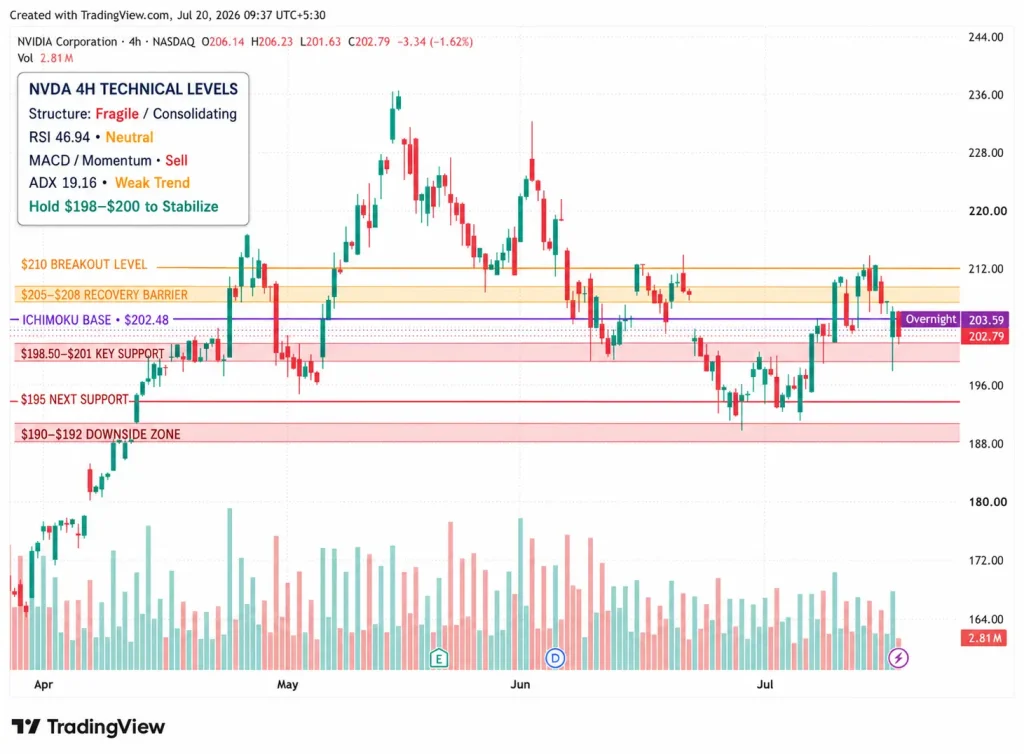
The immediate support zone sits between $198.50 and $201.
The 200 EMA at $200.58, 200 SMA at $198.68, and 30 SMA at $201.77 are all showing buy signals. The Ichimoku baseline near $202.48 also places the current price at an important technical inflection point.
If NVDA holds the $198-$200 area, the stock could continue consolidating before another attempt to reclaim $205-$210.
A decisive break below $198 would weaken the broader setup and could expose the stock to a deeper pullback toward $195, followed by the $190-$192 region.
Momentum indicators remain neutral overall but lean slightly bearish.
RSI stands at 46.94, showing neither overbought nor oversold conditions. Momentum and MACD are flashing sell signals, while the ADX at 19.16 indicates the current trend lacks strong directional conviction.
That suggests Nvidia is consolidating near major support rather than experiencing a confirmed breakdown.
What Investors Should Watch Next
Nvidia remains the dominant supplier of advanced AI computing infrastructure, but the market is beginning to evaluate its growth story more critically.
Chinese AI models, custom hyperscaler chips, export restrictions, and uncertainty over future capital expenditure all create risks to the company’s exceptional growth trajectory.
At the same time, Nvidia’s expansion into sovereign AI, industrial automation, robotics, and autonomous systems shows that its addressable market continues broadening beyond traditional data centers.
For now, the $198-$200 support zone is the most important technical level to watch.
A recovery above $205-$210 would strengthen the short-term outlook, while a break below $198 could signal that the broader semiconductor correction has further to run.
The next major direction for NVDA stock will likely depend on whether upcoming Big Tech earnings confirm that AI infrastructure spending remains strong enough to offset rising competitive and valuation concerns.
- Check out our free forex signals
- Follow the top economic events on FX Leaders economic calendar
- Trade better, discover more Forex Trading Strategies
- Open a FREE Trading Account
- Read our latest reviews on: Avatrade, Exness, HFM and XM

Related Articles



Sidebar rates

Related Posts
 Save
Save