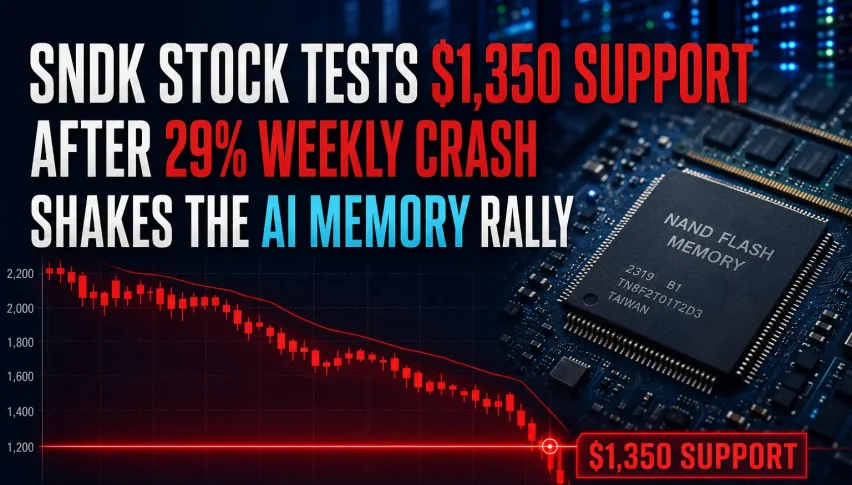
SNDK Stock Tests $1,350 Support After 29% Weekly Crash Shakes the AI Memory Rally
SanDisk stock SNDK tests $1,350 after a 29% weekly plunge as investors question AI spending, NAND pricing and elevated earnings expectations
Quick overview
- SanDisk shares are attempting to recover after a significant decline, closing at $1,354.82 before rebounding to $1,389.98.
- The stock remains nearly 30% below its level from a week earlier, raising concerns about the sustainability of AI infrastructure spending.
- SanDisk's recent earnings report showed record revenue and profits, but investors are wary of potential cyclicality and customer concentration risks.
- The upcoming earnings report on August 5 will be crucial in determining the stock's future trajectory amid ongoing market volatility.
SanDisk shares are attempting to recover in pre-market trading after one of the sharpest weekly declines among major semiconductor stocks.
SNDK closed Friday at $1,354.82, down 3.99%, before rebounding to $1,389.98 ahead of Monday’s opening bell.
Despite the early recovery, the stock remains nearly 30% below its level from one week earlier as investors reassess whether record NAND profits and artificial intelligence demand can justify the expectations built into SanDisk’s extraordinary 2026 rally.
SanDisk Stock Falls 29% as the Chip Rally Reverses
SanDisk was one of the biggest casualties of last week’s semiconductor selloff.
The stock fell approximately 26% during the week through July 17, according to LSEG data reported by Reuters, as investors reduced exposure to high-performing chip companies and questioned the sustainability of AI infrastructure spending. citeturn398396news53turn398396search14
The broader decline affected Nvidia, Micron, Intel, Marvell and semiconductor companies across Asia, despite continuing evidence of strong demand for AI computing and memory products.
SanDisk’s losses were particularly severe because the stock had entered the correction after an exceptional rally.
Shares remain several times higher than at the beginning of 2026, reflecting the rapid improvement in NAND pricing, data-center storage demand and company profitability. That performance left the stock vulnerable to aggressive profit-taking when sentiment toward the AI trade weakened.
The central question is now whether the decline represents a healthy valuation reset or the beginning of a deeper correction in memory stocks.
Record Earnings Explain SanDisk’s 2026 Rally
SanDisk’s operating performance has changed dramatically over the past year.
The company reported fiscal third-quarter revenue of $5.95 billion, up 97% from the previous quarter and substantially above its guidance range.
GAAP net income reached $3.62 billion, or $23.03 per diluted share, while adjusted earnings were $23.41 per share. Data-center revenue increased 233% sequentially as SanDisk shifted toward higher-value customers and benefited from stronger NAND pricing.
The results represented a major acceleration from SanDisk’s fiscal second-quarter outlook, when management had forecast third-quarter revenue between $4.40 billion and $4.80 billion and adjusted earnings of $12-$14 per share.
SanDisk also guided for fiscal fourth-quarter revenue of $7.75 billion to $8.25 billion, with adjusted earnings of $30-$33 per share.
Those numbers explain why investors began treating SanDisk as a major AI infrastructure beneficiary rather than a conventional consumer-storage company.
AI data centers require enormous amounts of fast, reliable storage to move datasets, retrieve model information and support inference workloads. That has increased demand for enterprise solid-state drives while limited supply has pushed NAND pricing sharply higher.
Long-Term Contracts Could Make SanDisk’s Earnings More Durable
SanDisk argues that its improving results reflect more than a temporary rise in spot memory prices.
Management has increasingly shifted sales toward long-term customer commitments, providing greater visibility into demand and pricing.
The company reported approximately $41.6 billion in remaining performance obligations, primarily tied to multi-year customer agreements.
That backlog may help SanDisk reduce some of the volatility traditionally associated with the NAND industry. Instead of relying entirely on short-term commodity pricing, a larger portion of future revenue could be supported by contracted volumes and customer commitments.
The company also benefits from its manufacturing partnership with Kioxia, which allows it to access advanced NAND production without carrying the full capital burden of independently building fabrication plants.
That structure could support stronger free cash flow if high pricing and data-center demand persist.
However, long-term agreements do not eliminate cyclicality.
Customer concentration remains meaningful, and the company’s earnings could still weaken if AI infrastructure spending slows, NAND supply expands too quickly or contract pricing resets lower.
Why SNDK Investors Still Fear a NAND Downturn
Memory markets have historically moved through sharp boom-and-bust cycles.
High prices encourage manufacturers to increase production. As new supply enters the market, shortages ease, pricing falls and producer margins can contract rapidly.
SanDisk’s recent gross margins and earnings are exceptionally strong, but investors are questioning how long those conditions can last.
The current valuation may look inexpensive when measured against analysts’ fiscal 2027 earnings estimates. However, those estimates already assume that profitability remains far above historical levels.
That means SanDisk could continue reporting strong earnings and still disappoint investors if NAND prices, data-center demand or future guidance fall short of elevated forecasts.
The next major clues may come from earnings reports by Alphabet and other hyperscale customers.
Continued increases in data-center capital expenditure would support demand for enterprise SSDs. Any indication that Big Tech companies are slowing infrastructure investment could place further pressure on SanDisk, Micron and other memory suppliers.
August Earnings Become the Next Major Catalyst
SanDisk is scheduled to report its fiscal fourth-quarter and full-year 2026 results on August 5, followed by an investor day on August 13.
The earnings release will give investors a clearer view of whether the company can deliver revenue near the $8 billion guidance midpoint and maintain gross margins close to current record levels.
Attention will also focus on:
- Data-center SSD demand
- NAND pricing trends
- Contract backlog conversion
- Fiscal 2027 earnings expectations
- Capital expenditure and supply growth
- Customer concentration
The investor day could be equally important because management will have an opportunity to explain how much of the current earnings improvement is structural rather than cyclical.
Until then, the stock may remain highly sensitive to semiconductor sentiment and AI spending commentary from SanDisk’s largest customers.
SNDK Technical Analysis: $1,350 Support Holds, but the Trend Remains Bearish
From a technical perspective, SanDisk’s 4-hour chart remains heavily damaged after the sharp weekly decline.
SNDK is trading below every major short- and medium-term moving average in the supplied setup. That confirms sellers remain in control despite the pre-market rebound toward $1,390.
The first major support zone sits near $1,350.
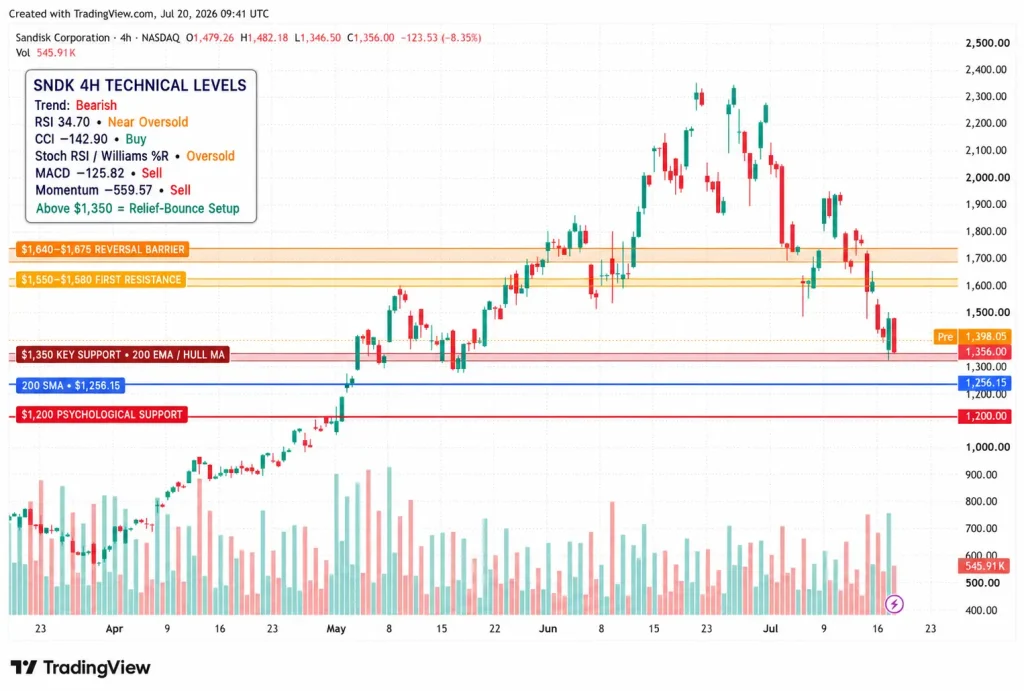
The 200 EMA at $1,352.63 and Hull Moving Average at $1,352.28 are both showing buy signals, placing the stock directly on an important technical floor.
Holding above this area could support a short-term relief rally.
If $1,350 breaks decisively, the next major support sits near the 200 SMA at $1,256.15. Below that, the psychological $1,200 level could become the next downside target.
On the upside, buyers face significant resistance.
The first recovery barrier is located around $1,550-$1,580, where the 10 EMA at $1,553.62 and 10 SMA at $1,577.20 are clustered.
A stronger rebound would need to clear $1,640-$1,675, which includes the VWMA at $1,642.16, 100 EMA at $1,649.21, 20 EMA at $1,665.72, and 20 SMA at $1,675.13.
Until SanDisk reclaims that area, any advance is likely to remain a relief bounce rather than a confirmed trend reversal.
Momentum indicators show that the selloff is stretched but has not clearly ended.
RSI stands at 34.70, close to oversold territory. The CCI at −142.90 is flashing a buy signal, while Stochastic RSI and Williams %R are also near deeply oversold levels.
However, MACD at −125.82 and Momentum at −559.57 remain on sell signals, confirming that bearish pressure is still active.
What’s Next for SanDisk Stock?
SanDisk’s fundamental outlook remains unusually strong for a memory-chip company.
AI data-center demand, higher NAND prices and multi-year customer commitments have produced record revenue, margins and earnings.
However, the stock’s 2026 rally had priced in a considerable amount of future success.
The recent correction shows that investors are no longer willing to overlook cyclical risks, customer concentration or uncertainty around the durability of Big Tech’s AI spending.
Technically, $1,350 is now the decisive level.
Holding that area could support a rebound toward $1,550-$1,580, while a break below it would expose the stronger 200-period support near $1,256.
For now, SanDisk remains a high-growth AI storage story inside an industry that has historically been highly cyclical. The August 5 earnings report will determine whether the recent selloff has created a more attractive valuation—or whether earnings expectations still need to move lower.
- Check out our free forex signals
- Follow the top economic events on FX Leaders economic calendar
- Trade better, discover more Forex Trading Strategies
- Open a FREE Trading Account
- Read our latest reviews on: Avatrade, Exness, HFM and XM

Related Articles



Sidebar rates

Related Posts
 Save
Save