SPCX Slides Below $125 Support as Starship Delay Puts SpaceX’s $1.8 Trillion Valuation Under Pressure
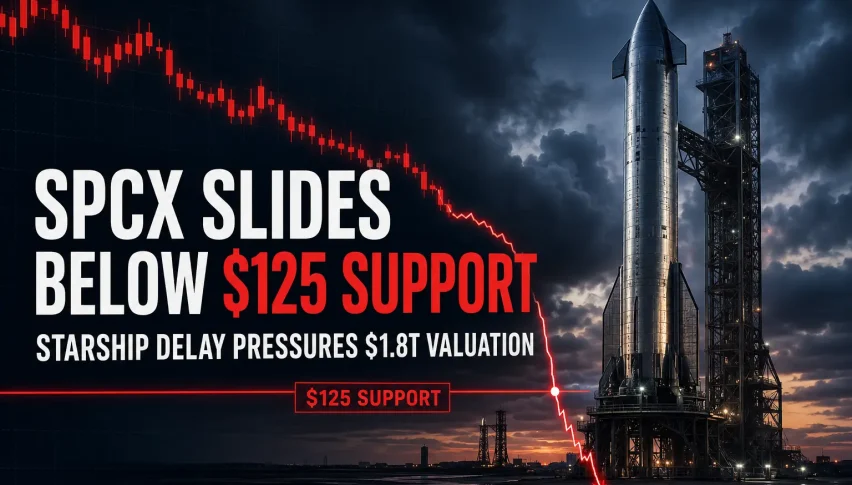
SpaceX stock SPCX falls below $125 as another Starship delay revives execution concerns despite growing AI, Starlink, and launch revenue.
Quick overview
- SpaceX shares fell over 5% following another delay in the Starship launch, raising investor concerns about the company's growth prospects.
- Despite the setback, SpaceX's operational performance remains strong, with 165 successful Falcon 9 launches in 2025 and ongoing revenue from Starlink and AI initiatives.
- The importance of the Starship program is underscored by analysts who view its success as critical to SpaceX's future valuation and growth opportunities.
- Investor sentiment is shifting as they weigh the company's ambitious plans against execution risks, particularly regarding the Starship's operational reliability.
SpaceX shares remained under pressure after another Starship launch delay reignited investor concerns that the company’s ambitious long-term growth story depends heavily on successful execution of its next-generation launch system.
SpaceX Stock Falls Below $125 as Starship Launch Slips Again
SpaceX shares fell more than 5% after the company postponed another attempt to launch Starship Flight 13 following last week’s automated launch abort.
The stock briefly traded below the important $125 support area after nearly $100 billion was erased from the company’s market value following the failed launch attempt. SpaceX has since confirmed it is targeting Thursday, July 23, for another launch, although CEO Elon Musk later suggested the attempt could take place on Friday.
While launch delays are common during Starship development, investors are increasingly sensitive following SpaceX’s blockbuster IPO and its rapid rise to one of the world’s most valuable listed companies.
The latest decline reflects a broader shift in sentiment as investors become less willing to overlook execution risks attached to highly valued growth companies.
Launch Business Continues Setting Industry Records
Despite the recent setback, SpaceX’s underlying operational performance remains exceptionally strong.
The company completed 165 Falcon 9 launches during 2025, averaging one orbital mission roughly every 2.2 days while maintaining a perfect mission success record.
Rapid booster reuse has dramatically lowered launch costs while strengthening SpaceX’s dominant position in the commercial launch market.
At the same time, Starlink continues generating recurring connectivity revenue, providing a stable cash-flow base that supports continued investment in Starship, artificial intelligence, and future exploration projects.
Those businesses remain the financial backbone of SpaceX while Starship progresses toward commercial operations.
Everything Depends on Starship
Perhaps no issue matters more to SpaceX’s long-term investment case than Starship.
Wall Street analysts have increasingly described the fully reusable rocket as the foundation supporting virtually every major growth opportunity available to the company.
Beyond lowering launch costs, Starship is expected to dramatically expand Starlink deployment, enable orbital AI infrastructure, increase commercial launch capacity, support NASA lunar missions, and eventually make interplanetary transportation commercially viable.
The importance of the vehicle was reinforced after multiple investment banks argued that SpaceX’s future valuation ultimately depends on whether Starship achieves rapid reusability and industrial-scale launch cadence.
Investors therefore interpreted the latest launch delay as more than an isolated engineering setback—it represents another reminder that SpaceX’s most ambitious projects still require flawless execution before they become meaningful financial contributors.
Starship Launch Delay Highlights Execution Risks
The latest launch attempt was aborted less than a second before liftoff after several Raptor engines failed to ignite, triggering an automatic shutdown.
SpaceX said it has modified Starship’s propulsion system to address the issue experienced during the previous attempt and has rescheduled the mission later this week.
Importantly, this was not viewed as a catastrophic failure.
Instead, the automated abort demonstrated the system’s safety mechanisms working exactly as intended.
Nevertheless, investors recognize that repeated delays can postpone future commercial deployment schedules and increase development costs for the estimated $15 billion Starship program.
AI Business Is Becoming a Second Growth Engine for SpaceX
While rockets continue attracting headlines, SpaceX is quietly building another business that could eventually rival its launch operations.
The company has begun monetizing unused AI computing capacity through large GPU leasing agreements with enterprise customers, creating an entirely new revenue stream alongside Starlink and launch services.
Recent reports suggest agreements with major AI developers could generate tens of billions of dollars in annual revenue while providing a bridge toward the company’s longer-term vision of orbital data centers.
The strategy also reduces reliance on launch revenue alone.
Instead of waiting years for orbital AI infrastructure to mature, SpaceX is already generating cash flow from computing assets deployed on Earth.
That diversification has become increasingly important as investors evaluate whether the company’s premium valuation can be justified beyond its traditional space business.
SPCX Technical Analysis: $125 Becomes the Immediate Support Zone
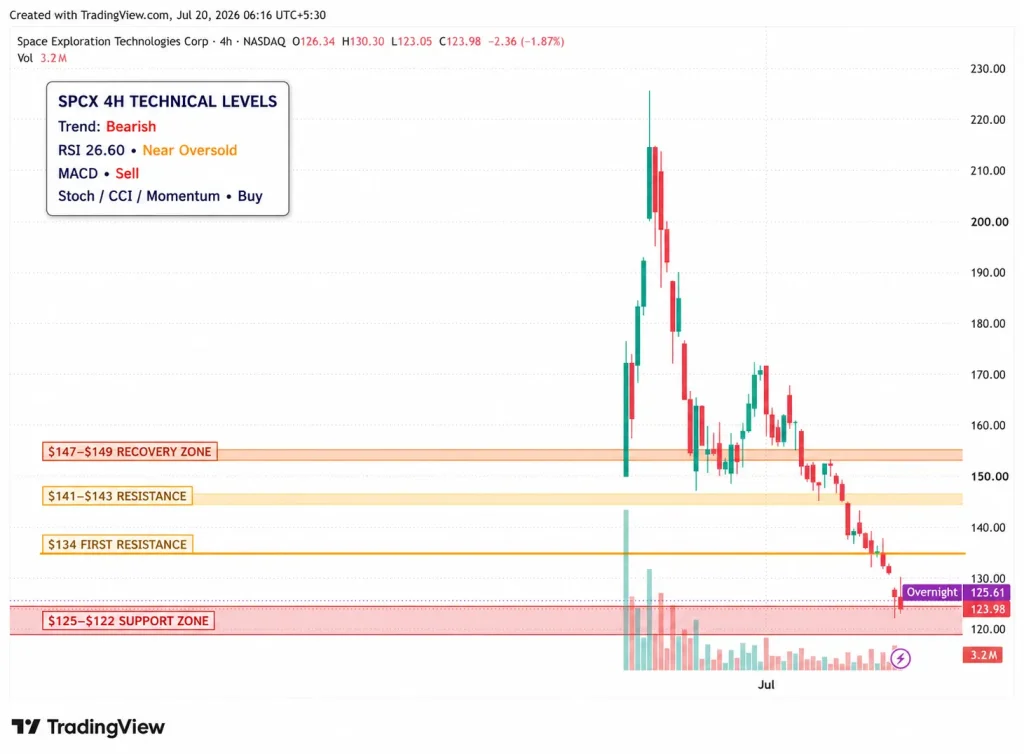
From a technical perspective, SpaceX’s 4-hour chart has weakened following last week’s sharp selloff.
SPCX is trading below every major short-term moving average. Immediate resistance begins at the 10 EMA and 10 SMA near $133.70, followed by the 20 EMA, 20 SMA and VWMA clustered around $141-$143. A stronger recovery would require buyers to reclaim the $147-$149 zone, where the 30 EMA and 30 SMA remain overhead.
Momentum indicators remain mixed. RSI has fallen to 26.60, approaching oversold territory, while MACD continues to flash a sell signal. However, Stochastic, CCI, and Momentum indicators have shifted to buy signals, suggesting downside momentum may be becoming exhausted even though the broader trend remains bearish.
The Hull Moving Average near $125.64 is now the first technical level investors should monitor.
A sustained break below the $125-$122 area could expose additional downside toward fresh post-IPO lows.
Conversely, a move back above $134 would represent the first indication that buyers are beginning to regain short-term control.
Upcoming Earnings Add Another Catalyst for SpaceX Traders
Investor attention is also beginning to shift toward SpaceX’s first quarterly earnings report as a publicly traded company.
Analysts expect significant revenue growth from Starlink, launch services, and the company’s expanding AI segment, although forecasts remain unusually wide given the limited public financial history available since the IPO.
Management commentary surrounding Starship development, AI infrastructure spending, compute monetization, and capital allocation may ultimately prove more important than the quarterly earnings themselves.
SPCX Investors Continue Balancing Opportunity Against Execution
Few companies possess growth opportunities comparable to SpaceX.
The company remains the dominant commercial launch provider, operates the world’s largest low-Earth-orbit satellite constellation, continues expanding into artificial intelligence infrastructure, and retains one of the strongest long-term visions in the global aerospace industry.
However, investors increasingly recognize that those opportunities depend on execution.
Every Starship milestone now carries significant implications not only for future launch economics but also for Starlink expansion, orbital AI infrastructure, lunar missions, and eventually Mars exploration.
Until Starship demonstrates consistent operational reliability, SpaceX shares are likely to remain highly sensitive to every launch update, engineering milestone, and schedule change, even as the company’s long-term growth story remains firmly intact.
- Check out our free forex signals
- Follow the top economic events on FX Leaders economic calendar
- Trade better, discover more Forex Trading Strategies
- Open a FREE Trading Account
- Read our latest reviews on: Avatrade, Exness, HFM and XM

Related Articles

Sidebar rates

Related Posts
 Save
SaveAva

