Bitcoin Slides to $65K as Tariff Shock and ETF Outflows Batter Sentiment, But Eyes $85K Recovery
A growing U.S. trade policy shock and ongoing institutional selling caused Bitcoin (BTC) to fall 4.2% during the last day to hover near $65K
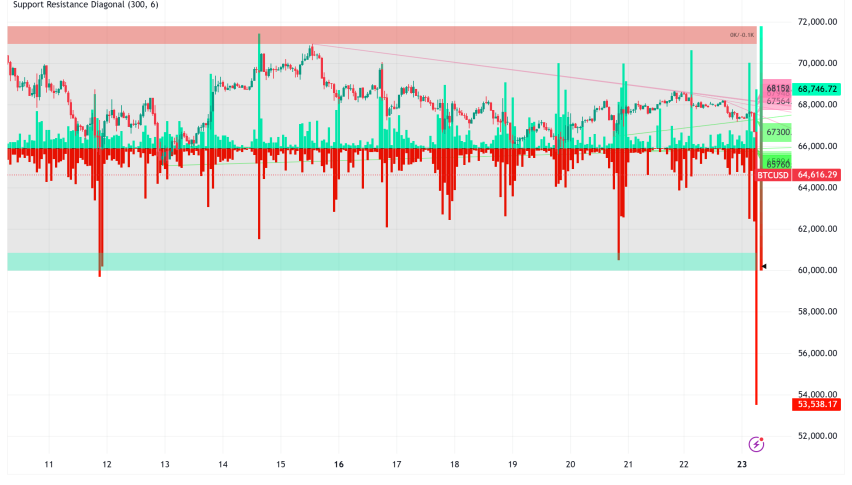
Quick overview
- Bitcoin fell 4.2% to around $65,000 due to U.S. trade policy shocks and institutional selling.
- Despite the decline, analysts predict a potential recovery with targets up to $85,000 by April.
- Recent data shows significant institutional outflows from Bitcoin ETFs, adding pressure to the market.
- Technical indicators suggest a critical support zone between $63,800 and $64,300, which could determine Bitcoin's near-term trajectory.
A growing U.S. trade policy shock and ongoing institutional selling caused Bitcoin BTC/USD to fall 4.2% during the last day to hover around $65,000. A quietly moving futures market and a number of historical indicators, however, are sustaining recovery prospects beneath the negative exterior; some analysts have set a target price of up to $85,000 by April.
Tariff Turbulence Sends Risk Assets Reeling
President Trump’s decision to increase the worldwide tariff rate to 15% on February 22, in defiance of a Supreme Court judgment, and to escalate trade tensions with China and other allies, was the main cause of Bitcoin’s most recent decline. The action immediately hurt financial markets’ willingness to take on risk.
Bitcoin is currently trading as a macro risk asset, as evidenced by its 89% connection with the tech-heavy QQQ ETF over the last 30 days. The research shows that when institutional investors left stocks, they also left cryptocurrency.
Bitcoin ETF Outflows Signal Continued Institutional Retreat
U.S. spot Bitcoin ETFs saw net outflows of $315.9 million for the week ending February 22, which added to the macro pressure. The IBIT of BlackRock, which is commonly regarded as the institutional benchmark, was responsible for $303.5 million of that outflow. In a market that primarily relied on ETF inflows as a bullish structural story in 2024 and 2025, persistent outflows pose a significant challenge that extends beyond emotion in the medium term.
BTC/USD Technical Outlook: Bearish, but a Floor May Be Near
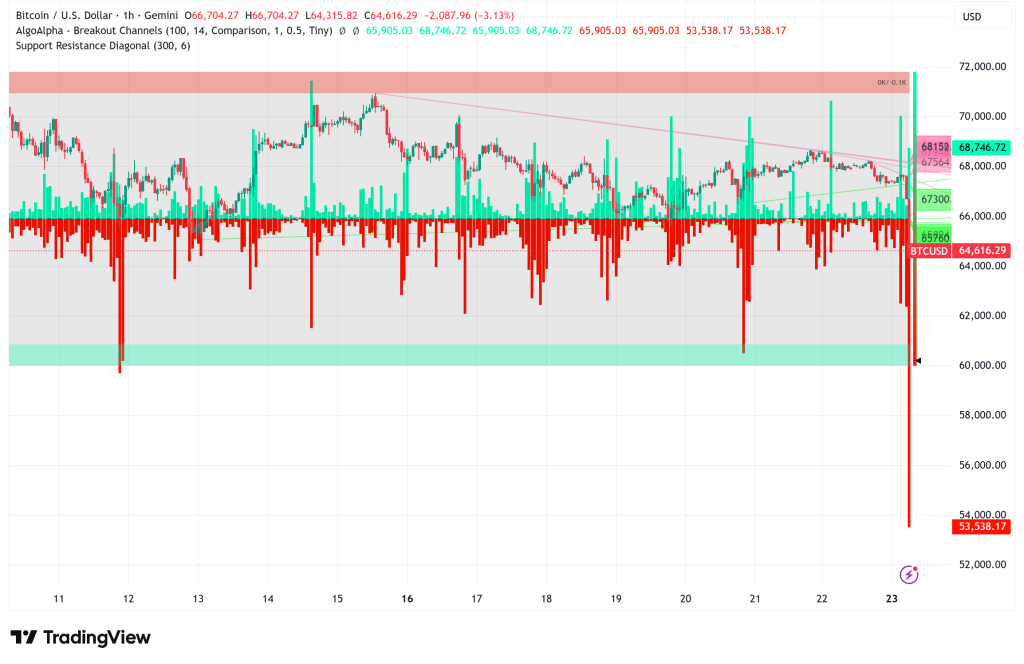
Technically speaking, Bitcoin made a fundamentally significant breach at $66,572, breaking below the crucial 78.6% Fibonacci retracement line. In the last day, trading volume increased by 20% to $21.8 billion, indicating that the sell-off was motivated by conviction rather than a low-liquidity decline.
Between $63,800 and $64,300, a dense on-chain volume cluster where around 150,000 BTC were previously accumulated, lies the next crucial battleground. The final significant line of defense before $60,000 is visible is this zone. A close hold above $63,800 maintains the structure, while a failure could result in a quick move toward the $60,000–$61,500 level. The weekly candle close on February 23 will be actively watched.
“Smart Money” Quietly Shifts Bullish — $85K in Sight?
Despite the short-term suffering, cautious hope is warranted. Non-commercial CME futures traders, including hedge funds and major speculators, have quickly liquidated net short positions, changing from around +1,000 contracts to about -1,600, according to CFTC Commitment of Traders data. Similar positioning changes preceded a 70% BTC gain in April 2025 and a 190% spike in 2023, according to analyst Tom McClellan.
The 200-week exponential moving average that Bitcoin is presently defending is close to $68,350; historically, this level has signaled significant bear market bottoms in 2015, 2018, and 2020. Given that the weekly RSI is in oversold territory, selling exhaustion may be on the horizon. By April, a strong recovery from this area might prepare a run toward the 100-week EMA close to $85,000.
Based on consistent monthly price performance since 2011, network economist Timothy Peterson projects an 88% chance that Bitcoin will trade higher by early 2027. The historical “average return” from this position is $122,000.
Bitcoin Price Prediction: Range-Bound Pain Before a Potential Recovery
The bear case Bitcoin may eventually reach $40,000 after a weekly closure below $63,800, which opens the way to $60,000–$61,500, and a deeper 40% fall that resembles 2022. Base case: As macro sentiment stabilizes, Bitcoin maintains the $63,800–$64,300 support cluster, consolidates, and launches a recovery toward $75,000–$85,000 over the ensuing weeks. Bull case: By 2026, oversold technicals, smart money positioning, and historical cycle data will all work together to push Bitcoin back toward $100,000+.
- Check out our free forex signals
- Follow the top economic events on FX Leaders economic calendar
- Trade better, discover more Forex Trading Strategies
- Open a FREE Trading Account
- Read our latest reviews on: Avatrade, Exness, HFM and XM

Related Articles



Sidebar rates

Related Posts
 Save
Save