USOIL Braces for $100 Volatility: Can WTI Defy the Fed’s Inflation Trap?
Crude oil is on everyone's mind right now, amidst global financial worries. On March 18, 2026, West Texas Intermediate (WTI)...
Quick overview
- Crude oil prices are currently fluctuating between $92 and $95, influenced by ongoing geopolitical tensions and the US-Iran conflict.
- A recent increase in US inventories provided temporary relief, but fears of supply disruptions in the Strait of Hormuz keep long-term prices elevated.
- The Federal Reserve's upcoming announcement on interest rates is critical, as higher rates could strengthen the dollar and reduce global crude demand.
- Traders are closely monitoring key price levels, with potential volatility expected around the FOMC press conference.
Crude oil is on everyone’s mind right now, amidst global financial worries. On March 18, 2026, West Texas Intermediate (WTI) is trading between $92 and $95, after pulling back slightly from Tuesday’s sharp price surge. Of course, prices have backed off a bit from the recent high of $119.62 – but don’t think they’ve forgotten the “war premium” that’s still factored in, every barrel. Given the ongoing US-Iran conflict now into its third week, the energy sector is caught in a tough spot between the risk of serious supply disruptions and a Federal Reserve that’s intensely focused on taming energy-driven inflation.
Today’s nearly 3% drop is being seen by many traders as just a pause before something bigger happens. Recent API data showed a 6.56 million barrel increase in US inventories, which provided some short-term relief. Nonetheless, the ongoing risk to the Strait of Hormuz – the world’s key oil chokepoint – keeps the long-term outlook for higher prices looking strong.
The Hormuz Standoff: Why $100 Oil is Just One Headline Away
It’s no secret that the main factor driving USOIL prices right now is the ongoing volatility in the Middle East. With about 15% to 20% of global oil shipments potentially at risk, any confirmed attack on tankers or energy sites could send WTI prices up by $3 to $5 in a snap. Some tankers have managed to make it through the Strait okay, but the fear factor is still keeping global supply tight.
These tensions are causing a big disconnect between what’s going on in the real oil market and what’s happening in trading. The U.S. Strategic Petroleum Reserve (SPR) and IEA stock releases are being talked up as a possible way to calm things down, but so far, their impact has mostly been psychological. Analysts point out that if the conflict gets worse, WTI could go above its previous high of $121 – and in a worst-case scenario, might even reach a staggering $200 per barrel.
On the other hand, a recent agreement between Iraq and Kurdish authorities to get their exports flowing through Turkey again has added a small but welcome supply boost – which is helping to keep prices below the $98 resistance level.
The FOMC Collision: Will Higher Rates Kill Crude Demand?
Everyone’s now fixed on the Federal Reserve’s 2:30 P.M. ET announcement – and for good reason. The Fed is in a bit of a pickle because rising energy prices are actually fueling the inflation it needs to curb. As a result, it’s a near-certainty that the Fed will keep rates between 3.50% and 3.75% today – which is a 96% to 99% chance.
- If Jerome Powell says that rates need to stay high for longer to battle “oil-fueled” inflation, the US Dollar (DXY) is likely to rise – and that’s because oil is priced in dollars. A stronger dollar makes crude more expensive for buyers in other countries, which could reduce global demand.
- Even with high interest rates, US industrial activity and travel demand are still going strong. US shale production is expected to reach a record 13.6 million barrels per day in 2026 – but even that increase isn’t enough to make up for the drop in Middle Eastern supply.
Technical Analysis: WTI Bullish Reversal or Bearish Trap?
Looking at the technicals, WTI is at a critical turning point. On the 2-hour chart, crude is hovering around $93.46, just above a key support level at $93.04 – which matches the 0.382 Fibonacci retracement where buyers often start buying back in.
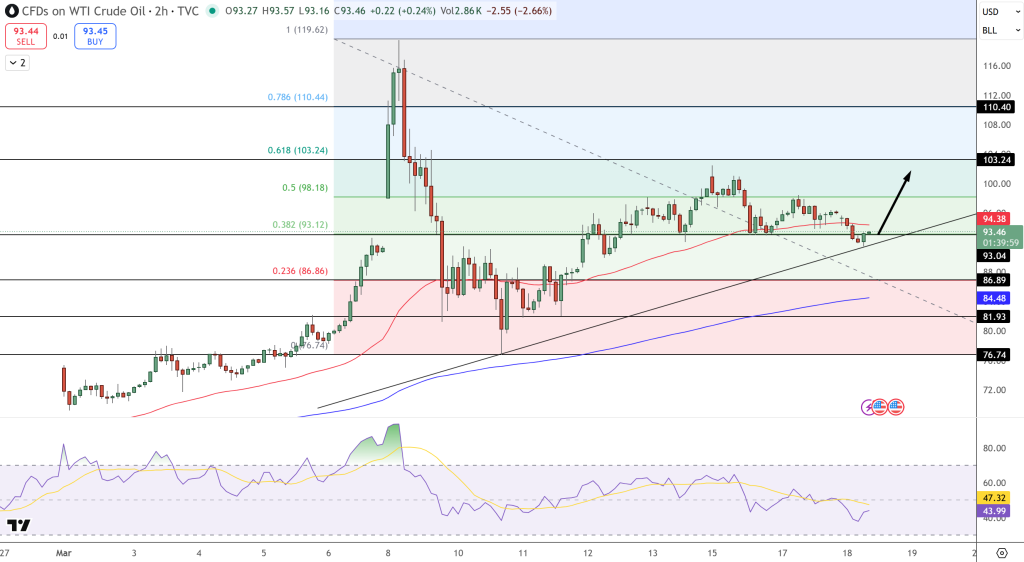
The next challenge for buyers is the 50-period moving average at $94.38. If WTI closes above this level, it could signal a move towards $98.18 (0.5 Fib) and potentially the key target of $103.24 (0.618 Fib).
But if the Fed surprises everyone with a more aggressive stance or if there are signs of tensions easing in the Middle East, a drop below $93.04 could send WTI plummeting down to the mid-$80s where the 200-period moving average is now.
Looking Ahead: The Q3 2026 Price Pivot
Right now, we’re still in “crisis mode” – but the long-term outlook might be more stable. The EIA thinks that if the conflict starts to calm down by mid-year, Brent and WTI might drop to the $70-$80 range by the end of 2026. But for the time being, the market is hanging on every word. Traders are keeping a close eye on the $81.93 level – which is seen as the key support level for the ongoing bull market.
In summary, expect plenty of volatility around the FOMC press conference today. If the Fed goes soft, prices could jump above $100 in a short squeeze. But if they stick to higher rates for longer, WTI might fall back to its recent lows.
- Check out our free forex signals
- Follow the top economic events on FX Leaders economic calendar
- Trade better, discover more Forex Trading Strategies
- Open a FREE Trading Account
- Read our latest reviews on: Avatrade, Exness, HFM and XM

Related Articles


Sidebar rates

Related Posts
 Save
Save