Nasdaq and SEC Shatter Traditional Barriers With Historic Tokenized Trading Approval
The financial world witnessed a tectonic shift this Wednesday as the U.S. Securities and Exchange Commission (SEC) formally approved
Quick overview
- The SEC has approved Nasdaq's pilot program for tokenized stock trading, allowing blockchain-based versions of major companies to be traded alongside traditional shares.
- This program features a dual-track model where tokenized securities are fully fungible with conventional shares, ensuring identical rights for investors.
- Nasdaq's initiative targets the Russell 1000 Index and major ETFs to test blockchain settlement stability before broader market expansion.
- The approval signals a shift in SEC strategy under Chair Paul Atkins, promoting innovation in financial technology and encouraging partnerships across Wall Street.
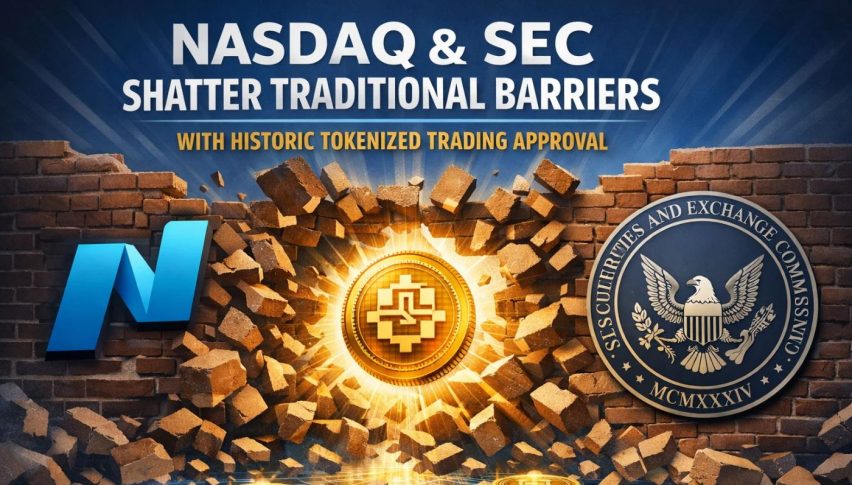
The financial world witnessed a tectonic shift this Wednesday as the U.S. Securities and Exchange Commission (SEC) formally approved Nasdaq’s groundbreaking pilot program for tokenized stock trading. This landmark decision allows the exchange to host blockchain-based versions of the world’s most powerful companies right alongside their traditional counterparts.
For the first time in history, the same order book will handle both digital tokens and conventional shares, effectively merging the speed of the “on-chain era” with the proven security of the U.S. national market system.
One Ticker, Two Worlds: How the Russell 1000 Tokenization Works
The heart of this new program lies in its “dual-track” model, which ensures that tokenized securities are not treated as separate, speculative assets. Instead, they are fully fungible with traditional shares, carrying the exact same CUSIP numbers, ticker symbols, and execution priority.
Whether an investor holds a standard share or a blockchain token, they retain identical rights to dividends, voting power, and liquidation proceeds. This approach is designed to eliminate price discrepancies and ensure that the “National Best Bid and Offer” remains the gold standard for every trade.
https://www.sec.gov/files/rules/sro/nasdaq/2026/34-105047.pdf
The pilot specifically targets the most liquid segments of the market to ensure stability. Initial eligibility is restricted to the Russell 1000 Index, representing the top 1,000 U.S. companies by market cap, along with major ETFs that track the S&P 500 and Nasdaq-100. By focusing on these high-volume assets, Nasdaq and the SEC aim to test the resilience of blockchain settlement under real-world pressure before potentially expanding to the broader market.
The Power of the Flag: Seamless Settlement via the DTC
To make this technology accessible, Nasdaq has introduced a simple “tokenization flag” for eligible market participants. When placing an order, a trader can choose to settle their transaction in token form by providing a registered digital wallet address and selecting a compatible blockchain. This information is then routed through the Depository Trust Company (DTC), which recently received its own “No-Action” clearance from the SEC to handle post-trade tokenization.
- Frictionless Integration: If a participant isn’t qualified or a wallet is incompatible, the system automatically defaults to traditional settlement, preventing operational failures.
- T+1 Continuity: While tokenization happens post-trade, the system maintains the standard T+1 settlement cycle, ensuring that liquidity remains consistent across the exchange.
- Collateral Efficiency: Once a security is in token form, it can be instantly moved for use as margin collateral, a major benefit for institutional high-frequency traders.
- Enhanced Oversight: Market surveillance continues to be handled by Nasdaq and FINRA using existing data tools, satisfying the SEC’s rigorous safety requirements.
A New Era of Innovation Under SEC Chair Paul Atkins
The approval of the Nasdaq pilot is part of a broader regulatory pivot led by SEC Chair Paul Atkins. Moving away from the enforcement-first tactics of the past, the agency is now actively courting “innovation exemptions” to keep the U.S. at the forefront of financial technology.
Atkins recently floated a “safe harbor” proposal that could provide a four-year regulatory runway for crypto startups and allow for expanded fundraising limits, signaling that the SEC is ready to “stop diagnosing the problem and start delivering the solution.”
This regulatory green light has already triggered a wave of strategic moves across Wall Street. Earlier this month, Nasdaq partnered with the crypto exchange Kraken to build a dedicated “equities transformation gateway” slated for a full H1 2027 rollout.
Not to be outdone, Intercontinental Exchange (the owner of the NYSE) has reportedly made a massive $25 billion investment in OKX to develop its own competing tokenized infrastructure. As these giants race to modernize, the dream of 24/7 global trading and instant settlement is rapidly becoming a reality.
- Check out our free forex signals
- Follow the top economic events on FX Leaders economic calendar
- Trade better, discover more Forex Trading Strategies
- Open a FREE Trading Account
- Read our latest reviews on: Avatrade, Exness, HFM and XM

Related Articles
Sidebar rates

Related Posts
 Save
SaveAva

