EUR/USD Price Analysis: Euro Slides to $1.1542 as Middle East War, Energy Shock, and a Stubborn Dollar Change the Game
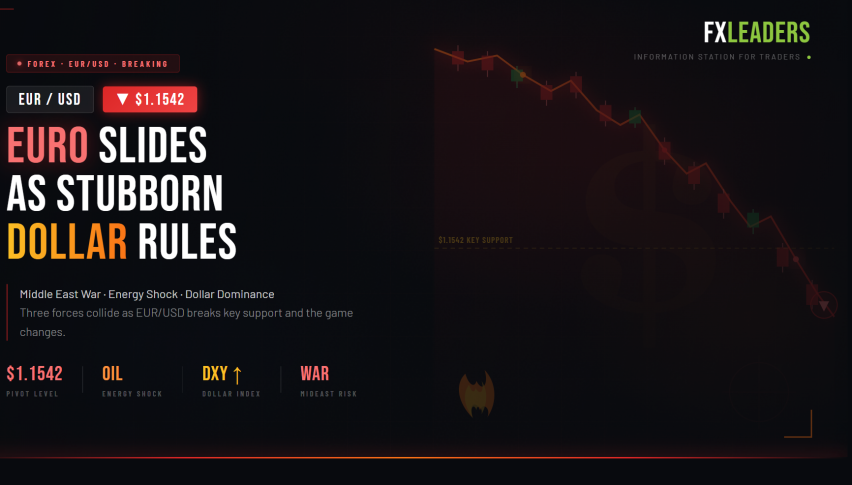
The EUR/USD is trading at $1.1542 on March 26, 2026, trapped in a weak consolidation below $1.1600. A combination of Middle East...
Quick overview
- The EUR/USD is trading at $1.1542, facing pressure from geopolitical risks and rising energy costs in Europe.
- Disruptions in oil and LNG flows due to the Middle East conflict have led to a significant increase in energy prices across the Eurozone.
- Despite the ECB's potential rate hikes, the US dollar remains strong due to a favorable rate differential, causing the euro to weaken.
- Key upcoming data releases, including US Non-Farm Payrolls and Eurozone CPI, could significantly impact the EUR/USD direction.
The EUR/USD is trading at $1.1542 on March 26, 2026, trapped in a weak consolidation below $1.1600. A combination of Middle East geopolitical risk, surging European energy costs, and a Federal Reserve in no hurry to cut rates is keeping the dollar bid and the euro under sustained pressure.
Why Is EUR/USD Falling in March 2026?
The answer comes down to one blunt structural reality: Europe is an energy importer, and the Middle East war is hitting it harder than almost any other major economy.
Disruptions to oil and LNG flows through the Strait of Hormuz have pushed energy costs sharply higher across the Eurozone. Eurozone business activity slumped to a ten-month low in March, while input costs surged at the fastest pace in over three years. German consumer confidence fell to a two-year low heading into April, a signal that the energy shock is already feeding into household behaviour.
ECB President Christine Lagarde responded directly, warning that the bank stands ready to hike rates “at any meeting” if energy inflation spirals. Markets now price in one to two ECB rate hikes by year-end, a dramatic reversal from the steady, patient hold that was consensus just weeks ago.
The ECB vs Fed Rate Gap: Why the Dollar Keeps Winning
Despite the hawkish ECB pivot, EUR/USD has dropped approximately 2.6% in March because the US dollar continues to outperform.
The Federal Reserve is holding rates at 3.50%–3.75% with no urgency to cut. That leaves a rate differential of 150–175 basis points in the dollar’s favour, even with ECB hike expectations rising, and that gap is the primary mechanical force keeping EUR/USD depressed.
The paradox for euro bulls is that ECB rate hikes in this environment are a signal of crisis management, not economic strength. A central bank hiking into an energy-driven slowdown does not attract capital inflows the same way a central bank hiking into growth does.
EUR/USD Technical Analysis: Bearish Structure Building on the 2-Hour Chart
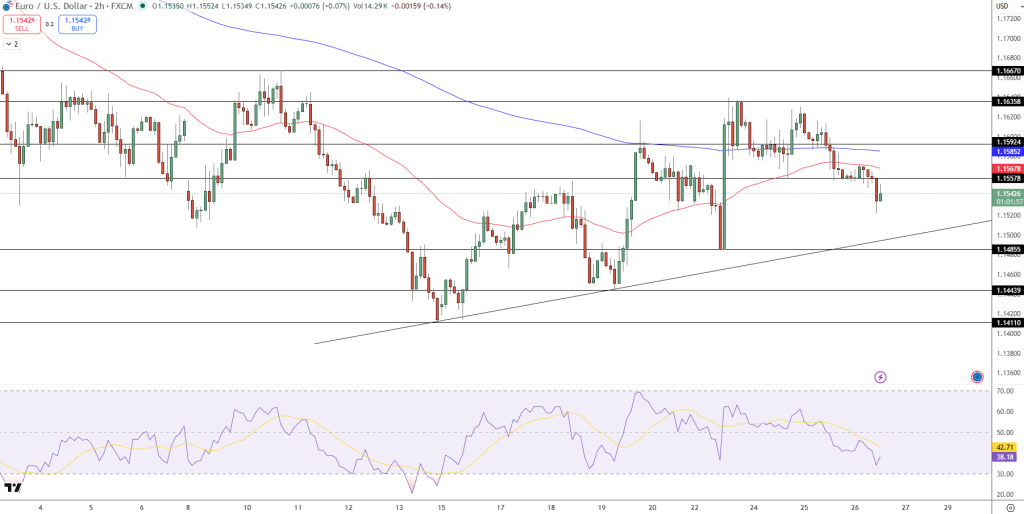
The 2-hour chart is quietly building a convincing bearish case.
Price rejected firmly at $1.1635, printing bearish engulfing candles before rolling back below $1.1592. The short-term EMA has crossed below the longer-term EMA — a bearish crossover confirmation — and the RSI is sitting at 40–43, below the midline, with a mild bearish divergence forming at the $1.1635 swing high. Bears currently hold the momentum edge.
EUR/USD trade setup (short bias):
Sell on bounce into $1.1580–$1.1592 | Stop above $1.1640 | Target $1.1497, then $1.1439 on a confirmed break below $1.1525.
A clean break below $1.1525 is the line in the sand. Bulls need a sustained reclaim above $1.1600 to neutralise this bearish structure.
Three Data Catalysts That Will Move EUR/USD This Week
US JOLTS Job Openings — a labour market health check that directly shapes Fed rate cut expectations and USD direction.
Eurozone CPI — the most important domestic release for EUR this week. A hot reading would reinforce ECB hike expectations and could temporarily support the euro. A soft print alongside rising energy prices would deepen the stagflation narrative — the worst possible backdrop for EUR/USD.
US Non-Farm Payrolls (NFP) — the upcoming week’s highest-impact event. A strong NFP reading combined with weak Eurozone CPI would likely crack $1.1525 and open the path to $1.1439. A soft NFP print could reignite euro bulls and test the $1.1630–$1.1670 resistance zone.
FAQ: EUR/USD – Energy Shock, ECB Policy, and Key Levels Explained
Why is the euro falling against the dollar in 2026? The euro is falling because the Middle East war has disrupted oil and LNG flows through the Strait of Hormuz, hitting energy-importing Europe far harder than the US. At the same time, the Federal Reserve is holding rates at 3.50%–3.75% with no imminent cuts, keeping a 150–175 basis point rate differential in the dollar’s favour.
What is the EUR/USD forecast for this week? The short-term bias is bearish. A break below $1.1525 would open the door to $1.1497 and $1.1439. The key event risk is the combination of Eurozone CPI and US Non-Farm Payrolls. A strong NFP alongside weak Eurozone CPI would be the clearest trigger for a downside break.
How does the energy shock affect the euro? The Eurozone imports a large share of its energy from the Middle East. When oil and gas prices surge due to conflict, European inflation rises, growth slows, and businesses face higher input costs — a stagflationary mix that erodes euro strength even when the ECB is raising rates.
What is the ECB’s current interest rate in 2026? The ECB’s deposit facility rate is currently at 2.00%, with the main refinancing rate at 2.15%. Following Lagarde’s warning about energy-driven inflation, markets are now pricing in one to two additional rate hikes by year-end 2026.
What are the key EUR/USD support and resistance levels right now? Key support sits at $1.1525 (break confirmation level), $1.1497 and $1.1439 below. Resistance is at $1.1580–$1.1592 (EMA zone), $1.1635 (recent swing high), and $1.1670 above.
Can EUR/USD recover to $1.20 in 2026? Yes — the longer-term structural case remains intact. If the Fed resumes cutting in H2 2026 and energy tensions ease, the rate differential narrows and EUR/USD could recover toward $1.20. Most major bank forecasts place EUR/USD in a $1.10–$1.18 range for 2026, with direction hinging on how quickly the Fed moves relative to the ECB.
- Check out our free forex signals
- Follow the top economic events on FX Leaders economic calendar
- Trade better, discover more Forex Trading Strategies
- Open a FREE Trading Account
- Read our latest reviews on: Avatrade, Exness, HFM and XM

Related Articles

Sidebar rates

Related Posts
 Save
Save