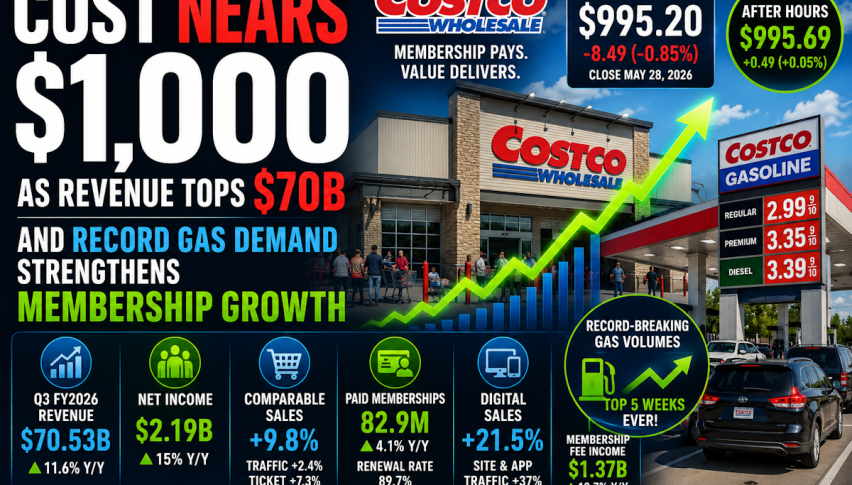
Costco reported fiscal third-quarter revenue of $70.53 billion, marking an 11.6% year-over-year increase and exceeding Wall Street expectations.
The company experienced a 15% rise in net income to $2.19 billion, driven by strong membership growth and digital sales, which surged by 21.5%.
Record fuel sales contributed significantly to Costco's growth, with the company achieving its highest fuel-volume weeks in history as consumers sought cheaper gasoline.
Despite concerns over valuation, Costco's long-term outlook remains strong due to its membership-driven revenue model and ongoing expansion plans.
Costco Wholesale delivered another quarter of double-digit growth, pushing quarterly revenue above $70 billion for the first time as consumers flocked to its warehouses for lower fuel prices, value-focused shopping, and expanding digital services.
While shares slipped modestly after earnings, the results reinforced Costco’s position as one of the strongest operators in global retail. The company continues generating robust sales growth, record membership retention, and accelerating digital engagement even as consumer spending remains pressured by inflation, geopolitical uncertainty, and shifting shopping habits.
The latest quarter also highlighted a key theme emerging across retail in 2026: consumers may be spending more cautiously, but they continue gravitating toward value-oriented businesses with strong pricing power.
Costco Delivers Another Quarter of Double-Digit Growth
Costco reported fiscal third-quarter revenue of $70.53 billion, up 11.6% year over year and above Wall Street expectations.
Adjusted earnings per share came in at $4.93, while net income rose 15% to $2.19 billion.
Key highlights included:
Revenue increased 11.6% to $70.53 billion
Net income rose 15% to $2.19 billion
Comparable sales increased 9.8%
Membership fee income climbed 10.7%
Digital comparable sales surged 21.5%
Paid memberships grew 4.1% to 82.9 million
Executive memberships increased 9.6% to 41.2 million
Traffic growth remained healthy at 2.4%, while average ticket size increased 7.3%, reflecting both higher spending and inflation-related price effects.
The company also maintained exceptional renewal rates:
Worldwide renewal rate: 89.7%
U.S. and Canada renewal rate: 92.2%
Those figures remain among the strongest in global retail and continue reinforcing Costco’s recurring-revenue model.
Record Gas Sales Become an Unexpected Growth Driver
One of the most surprising themes from the quarter was fuel demand.
CEO Ron Vachris said Costco recorded the five highest fuel-volume weeks in company history during the quarter as consumers searched for cheaper gasoline amid rising energy prices linked to geopolitical tensions in the Middle East.
Key fuel-related trends included:
Record-breaking gasoline volumes
Increased first-time gas station users
Higher warehouse traffic linked to fuel purchases
Strong member acquisition from fuel savings
Management noted that members who regularly purchase gas tend to spend more inside Costco warehouses, creating a powerful customer-retention cycle.
The fuel business is increasingly acting as both a profit driver and a customer acquisition tool.
Membership Economics Continue to Strengthen
Membership remains Costco’s most important competitive advantage.
The company generated $1.37 billion in membership fee income during the quarter, up 10.7% year over year.
Executive memberships continue expanding rapidly and now represent:
41.2 million memberships
More than half of total membership fee revenue
Costco’s highest-spending customer segment
This recurring revenue stream helps Costco maintain industry-leading pricing while supporting long-term earnings stability.
The model also provides significant protection during economic slowdowns.
Costco’s Digital Growth Accelerates
Costco’s digital business remains one of the retailer’s fastest-growing segments.
Digital comparable sales jumped 21.5%, while website and app traffic increased 37%.
The digital momentum suggests Costco is successfully modernizing its business without sacrificing its warehouse-centric model.
Costco’s AI Strategy Is Different From Big Tech
While many companies are using AI to justify workforce reductions, Costco is taking a different approach.
CEO Ron Vachris recently said the retailer is using AI to improve employee productivity rather than eliminate jobs. The company has implemented AI tools across pharmacy, gas stations, accounting, and IT operations, but management continues emphasizing human decision-making and customer service.
That philosophy reflects Costco’s broader culture, which has historically emphasized employee retention, operational consistency, and long-term customer relationships.
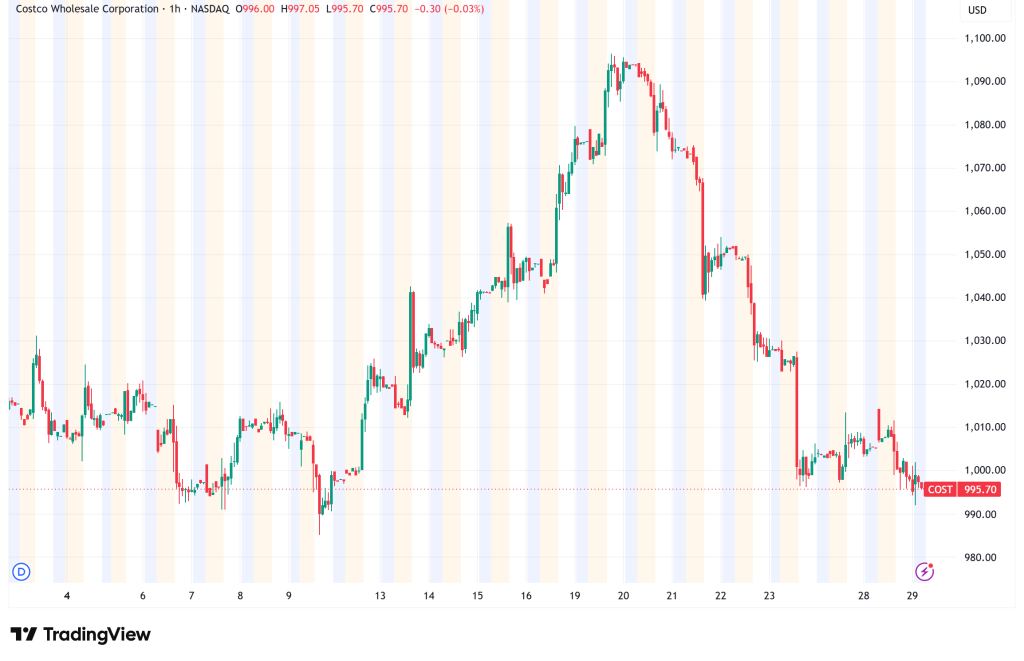
How did Costco stock move after earnings release?
Technical Analysis: Costco Remains in a Powerful Long-Term Uptrend
Technically, Costco remains one of the strongest charts in large-cap retail despite recent post-earnings volatility.
The stock continues trading near record highs after years of sustained institutional accumulation.
The moving-average structure remains one of the strongest among large-cap consumer stocks.
Key Support and Resistance Levels for COST Stock
Level Type
Approximate Area
Immediate Resistance
$1,020–$1,030
Major Resistance
$1,080
Near-Term Support
$950–$970
Secondary Support
$900
Major Trend Support
$850
A sustained move above $1,030 could reinforce Costco’s longer-term bullish trend, while the $950 area remains an important support zone.
COST Stock Valuation Remains the Biggest Debate
The primary concern for investors is no longer growth.
It is valuation.
Costco currently trades at roughly 52 times earnings, significantly above most retail peers.
Bulls argue the premium is justified because of:
Industry-leading membership economics
Exceptional renewal rates
Defensive business model
Consistent earnings growth
Strong balance sheet
Global expansion opportunities
Critics counter that much of this strength is already reflected in the share price.
The stock’s rich multiple leaves little room for operational missteps.
Long-Term Outlook: Costco Remains a Retail Compounder
Costco’s long-term investment case remains remarkably intact.
The company continues benefiting from multiple structural advantages:
Membership-driven recurring revenue
Strong customer loyalty
Global warehouse expansion
Digital growth
Fuel traffic advantages
Scale-based pricing power
Management expects to open 26 warehouses this year and more than 30 annually in future years, creating additional growth opportunities.
While valuation may limit near-term upside, Costco remains one of the highest-quality businesses in retail. The company’s ability to generate double-digit revenue growth, maintain industry-leading renewal rates, and attract customers during periods of economic uncertainty continues making it one of the market’s most durable long-term compounders.
Lead Markets Analyst – Multi-Asset (FX, Commodities, Crypto)
Arslan Ali Butt serves as the Lead Commodities and Indices Analyst, bringing a wealth of expertise to the field. With an MBA in Behavioral Finance and active progress towards a Ph.D., Arslan possesses a deep understanding of market dynamics.
His professional journey includes a significant role as a senior analyst at a leading brokerage firm, complementing his extensive experience as a market analyst and day trader. Adept in educating others, Arslan has a commendable track record as an instructor and public speaker.
His incisive analyses, particularly within the realms of cryptocurrency and forex markets, are showcased across esteemed financial publications such as ForexCrunch, InsideBitcoins, and EconomyWatch, solidifying his reputation in the financial community.





 Save
Save