AVGO Stock Rebounds Toward $391 as $200 Billion Samsung AI Deal Tests Key Resistance
Broadcom (AVGO) rebounds toward $391 as its $200 billion Samsung AI partnership challenges resistance despite valuation and demand risks.
Quick overview
- Broadcom stock rebounded to around $390 after a 2.69% drop, supported by a $200 billion partnership with Samsung aimed at enhancing AI infrastructure.
- The partnership will focus on advanced memory products and semiconductor technologies, reinforcing Broadcom's position in the AI chip market.
- Despite strong AI revenue growth and a solid financial outlook, Broadcom faces technical resistance and risks related to hyperscaler spending.
- The stock's performance is closely tied to upcoming earnings from major cloud providers, which could influence investor sentiment and growth expectations.
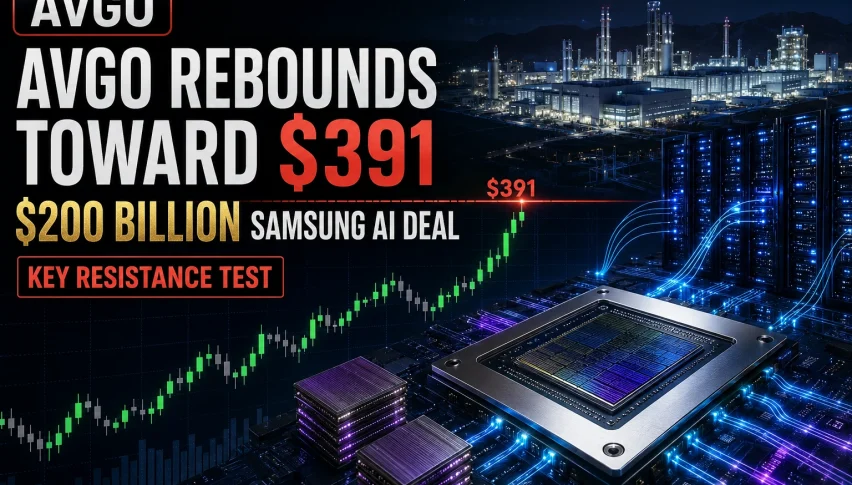
Broadcom stock recovered toward $391 overnight after falling 2.69%, as a planned $200 billion Samsung partnership strengthened its AI growth story while technical resistance and hyperscaler spending risks kept investors cautious.
AVGO Stock Tests $390 as Samsung Partnership Expands Broadcom’s AI Chip Ambitions
Broadcom stock is attempting to regain the important $390 level after a volatile week, supported by an expanded semiconductor partnership with Samsung Electronics and renewed optimism surrounding artificial intelligence infrastructure demand.
AVGO fell $10.55, or 2.69%, to $381.92 on Friday before recovering to approximately $390.65 in overnight trading, a gain of 2.29%.
The rebound follows news that Broadcom and Samsung intend to expand their strategic collaboration across memory, foundry manufacturing and advanced semiconductor packaging. The agreement is expected to cover more than $200 billion of business over the five years through 2030.
The scale of the partnership reinforces Broadcom’s position as one of the most important suppliers of custom AI processors and networking technology. However, the stock remains significantly below its June record high, while the technical picture suggests buyers still need to overcome substantial resistance.
Samsung Partnership Strengthens Broadcom’s AI Supply Chain
Broadcom and Samsung signed a memorandum of understanding designed to support the next generation of artificial intelligence infrastructure.
Under the proposed collaboration, Samsung would provide advanced memory products, including high-bandwidth memory, for Broadcom’s future AI accelerators. HBM has become a critical component in AI systems because it allows processors to move enormous quantities of data more efficiently.
The partnership also includes Samsung’s 2-nanometer and smaller manufacturing technologies for Broadcom-designed products, including wireless broadband communications solutions.
Advanced packaging is another important part of the agreement. Samsung and Broadcom plan to work on 2.3D and 2.5D integration technologies intended to combine memory, logic and other components within increasingly complex AI systems.
This end-to-end relationship could help Broadcom secure access to several of the most constrained parts of the semiconductor supply chain.
Demand for AI processors has placed pressure on advanced memory, leading-edge manufacturing and packaging capacity. A long-term partnership with Samsung could give Broadcom greater supply visibility as its hyperscale customers expand custom-chip deployments.
Broadcom’s Custom AI Strategy Gains Momentum
Broadcom has emerged as one of the strongest alternatives to Nvidia within the AI semiconductor market.
Rather than selling the same general-purpose accelerator to a wide range of customers, Broadcom develops application-specific processors tailored to the infrastructure and software requirements of individual cloud companies.
These custom AI accelerators, often described as XPUs or ASICs, can provide better power efficiency and workload optimization for hyperscalers operating enormous data centers.
Broadcom currently has custom chips in production with several major hyperscale customers and is working with additional companies on next-generation processors. Management has suggested that the opportunity could reach between $60 billion and $90 billion in fiscal 2027.
The Samsung agreement could make that opportunity easier to address by combining Broadcom’s chip-design expertise with advanced memory, foundry capacity and packaging.
However, a memorandum of understanding does not guarantee that all of the estimated $200 billion will become realized revenue. The eventual financial contribution will depend on customer demand, manufacturing execution and the pace at which new AI processors reach mass production.
Strong AI Revenue Supports AVGO’s Long-Term Story
Broadcom’s recent financial results have provided evidence that AI demand is already becoming a major growth engine.
In fiscal Q2 2026, company revenue increased approximately 20% to $16.75 billion, while AI semiconductor revenue rose 46% to about $6.1 billion.
The company also generated roughly $6.8 billion in free cash flow and reported an adjusted EBITDA margin near 69%, highlighting the strength of its fabless operating model.
Unlike major cloud providers, Broadcom does not need to build and operate the data centers using its chips. It designs semiconductors and relies on manufacturing partners, allowing the company to benefit from AI infrastructure spending without matching the capital expenditure of its customers.
Broadcom guided for third-quarter revenue of approximately $17.2 billion, supported by networking demand, custom accelerators and its infrastructure-software business.
Those numbers suggest the stock’s retreat from its June peak has been driven partly by broader valuation compression across AI-related shares rather than a clear deterioration in Broadcom’s operating performance.
Nevertheless, elevated expectations leave little room for disappointing growth.
Hyperscaler Earnings Become the Next Major Catalyst for Broadcom
Microsoft, Meta and Amazon earnings could have a significant effect on Broadcom stock.
All three companies are investing aggressively in AI infrastructure and represent the type of customer demand that supports Broadcom’s networking and custom-silicon businesses.
If major cloud providers raise their capital-expenditure plans, investors may interpret the move as evidence that AI demand will remain strong through the remainder of 2026 and into 2027.
Broadcom supplies switching chips, networking processors and custom accelerators used to connect and operate enormous AI clusters. Continued growth in hyperscaler spending could therefore strengthen several parts of its semiconductor business simultaneously.
However, the relationship creates concentration risk.
Broadcom’s largest AI opportunities depend on a relatively small group of technology companies. Any reduction in data-center spending, delay in custom-chip programs or decision to move more design work internally could produce an outsized effect on future growth expectations.
The stock’s high valuation makes this risk particularly important. Investors are not merely expecting Broadcom to participate in the AI boom; they are pricing in years of rapid and profitable expansion.
VMware Expands Broadcom Beyond Semiconductors
Broadcom’s infrastructure-software business provides another important source of earnings and cash flow.
VMware generated approximately $6.6 billion in recent quarterly revenue, while Broadcom has continued shifting enterprise customers toward VMware Cloud Foundation.
The company’s new partnership with Standard Chartered demonstrates the strategic importance of this platform. The international bank plans to use VMware Cloud Foundation to modernize infrastructure supporting operations across 54 markets.
The project is intended to create a standardized private-cloud environment for core banking, payments and digital services while improving security and resilience.
This relationship strengthens Broadcom’s exposure to enterprise infrastructure and provides diversification beyond the cyclical semiconductor market.
However, VMware’s transition has also created concerns among some customers regarding pricing and product changes. Broadcom must demonstrate that higher revenue and efficiency do not come at the cost of long-term customer retention.
AVGO Technical Outlook: $390–$400 Remains the Key Test
From a technical perspective, Broadcom’s four-hour chart presents a mixed picture.
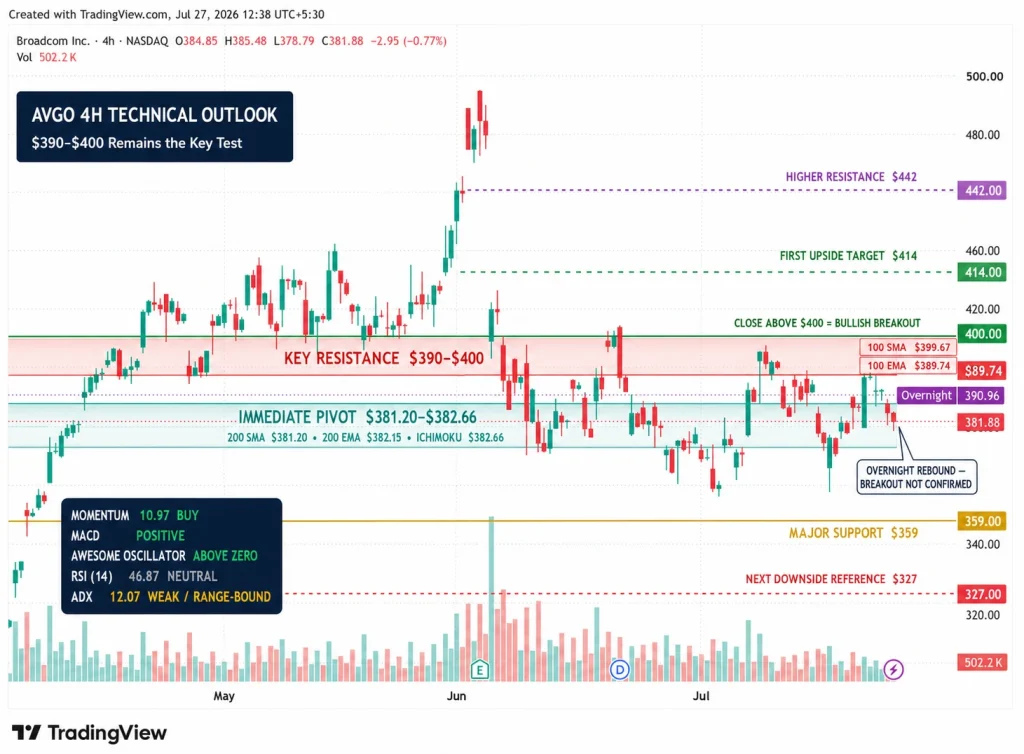
At $381.92, AVGO finished below most major moving averages. The 200-period simple moving average at $381.20 provided immediate support, while the Ichimoku baseline at $382.66 and the 200-period EMA at $382.15 define the first short-term pivot region.
The overnight recovery to approximately $390.65 has lifted the stock above several shorter moving averages clustered between $385 and $388.
However, the 100-period EMA at $389.74 represents immediate resistance, while the 100-period simple moving average near $399.67 reinforces the psychological $400 level.
A sustained four-hour close above $390 could improve the technical structure and allow buyers to challenge $400. A decisive move through that region could open the way toward approximately $414, followed by the higher resistance zone near $442.
Momentum indicators offer some encouragement. The Momentum indicator shows a buy signal at 10.97, while MACD has also turned positive. The Awesome Oscillator remains above zero.
However, the Relative Strength Index stands at 46.87, showing that buyers have not yet established clear control. The Average Directional Index is only 12.07, indicating a weak trend and increasing the possibility of continued range-bound trading.
If AVGO fails near $390–$400, initial support sits around $382 and $381. A decisive break below this area could expose $359, where the broader rising trend faces a more important test. Below $359, the next major downside reference is near $327.
Broadcom Stock Faces a Critical Breakout Test
Broadcom’s expanded Samsung partnership strengthens one of the most compelling AI infrastructure stories in the semiconductor industry.
Access to advanced memory, sub-2-nanometer manufacturing and next-generation packaging could support Broadcom’s custom processors as hyperscalers build increasingly specialized AI systems.
Strong AI revenue growth, high margins, substantial free cash flow and VMware’s expansion provide additional support.
However, the stock’s overnight rebound has returned AVGO directly to an important resistance zone. Buyers must establish a sustained break above $390 and then $400 before the technical outlook becomes decisively bullish.
For now, improving momentum suggests another breakout attempt is possible, but weak trend strength, hyperscaler concentration and demanding valuation expectations remain important risks.
The Samsung partnership gives Broadcom a stronger long-term supply-chain foundation. The next test is whether cloud spending and customer demand can grow quickly enough to justify both the scale of the agreement and the expectations already embedded in AVGO stock.
- Check out our free forex signals
- Follow the top economic events on FX Leaders economic calendar
- Trade better, discover more Forex Trading Strategies
- Open a FREE Trading Account
- Read our latest reviews on: Avatrade, Exness, HFM and XM

Related Articles


Sidebar rates

Related Posts
 Save
SaveAva