IBM Stock Slides 2.2% After Revenue Outlook Cut as AI Spending Shifts Away From Mainframes
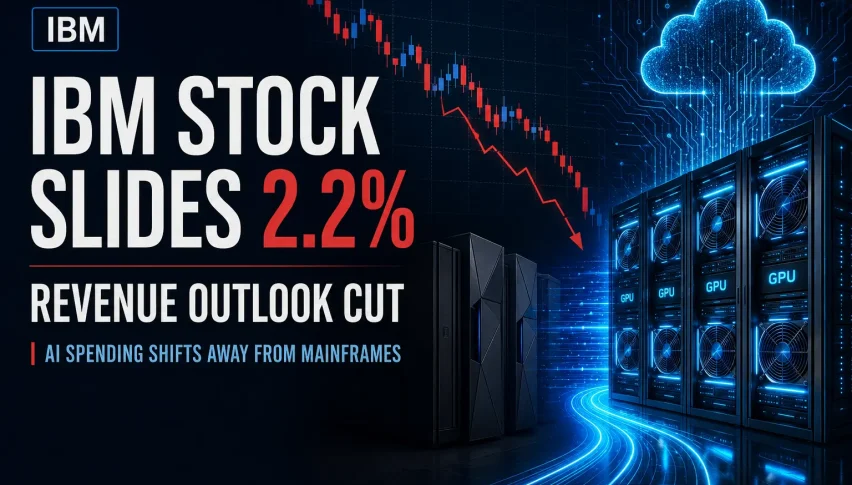
IBM stock slips 2.25% after cutting its 2026 revenue outlook as weak mainframe demand offsets AI software growth and Red Hat momentum.
Quick overview
- IBM's shares are under pressure following a lowered full-year revenue growth forecast due to weak mainframe demand, despite strong performance in software and AI.
- The company's second-quarter revenue of $17.16 billion was below expectations, with a significant 42% decline in mainframe sales impacting overall results.
- Management remains optimistic about enterprise AI spending and productivity initiatives, but investors are cautious due to delayed infrastructure purchases and a reduced revenue outlook.
- IBM's long-term strategy focuses on enterprise control and software orchestration rather than competing with large AI models, while maintaining a commitment to quantum computing investments.
IBM shares remained under pressure after the company lowered its full-year revenue growth forecast, with weaker mainframe demand overshadowing continued strength in software, Red Hat and AI. While management insists enterprise AI spending remains healthy, investors are questioning whether infrastructure budgets are crowding out broader technology purchases.
IBM entered earnings season hoping to reassure investors after issuing a rare preliminary warning earlier this month. Instead, while management delivered a confident long-term message around artificial intelligence, hybrid cloud and quantum computing, the market remained focused on slowing revenue growth and weaker-than-expected enterprise spending.
Although the earnings report contained several encouraging developments—including expanding AI software demand, healthy free cash flow and accelerating productivity initiatives—the sharp decline in IBM’s infrastructure business once again highlighted how uneven the enterprise AI spending cycle has become.
Mainframe Weakness Overshadows IBM’s AI Momentum
IBM reported second-quarter revenue of $17.16 billion, up just 1% from a year earlier but below Wall Street expectations.
Adjusted earnings came in at $2.93 per share, also narrowly missing analyst estimates, while GAAP EPS declined to $2.27.
The biggest disappointment came from IBM’s infrastructure division.
Revenue fell 7% year-over-year as IBM Z mainframe sales collapsed 42%, significantly worse than management had anticipated.
The decline reflects customers delaying or reducing large capital expenditure projects as enterprise technology budgets increasingly prioritize AI servers, GPUs, networking equipment and storage infrastructure.
CEO Arvind Krishna acknowledged that several large client transactions slipped during the quarter but argued the demand had been deferred rather than cancelled.
According to IBM, roughly one-third of those delayed deals have already closed early in the third quarter, supporting management’s view that customer demand remains intact rather than structurally impaired.
Still, investors were unconvinced.
The mainframe slowdown follows several years of strong upgrade cycles and raises questions about how quickly IBM’s newer AI-focused businesses can offset weakness in its legacy infrastructure operations.
IBM Cuts 2026 Revenue Growth Forecast
The earnings report also included a downward revision to IBM’s full-year revenue outlook.
Management now expects constant-currency revenue growth between 4% and 5%, compared with its previous forecast of more than 5%.
While the revision was smaller than some investors feared after last week’s warning, it reinforced concerns that enterprise customers are becoming more selective about where they allocate AI budgets.
Chief Financial Officer James Kavanaugh attributed much of the slowdown to delayed infrastructure purchases rather than weakness across IBM’s broader software portfolio.
The company also maintained its expectation that free cash flow will increase by roughly $1 billion during 2026 despite the slower revenue outlook.
That guidance reflects IBM’s ongoing productivity initiatives, AI-driven internal automation and tighter cost controls across sales, marketing and supply chain operations.
Software Continues to Lead IBM’s Growth Strategy
Despite weaker overall results, IBM’s software business continued delivering solid performance.
Software revenue increased 5% to $7.76 billion, led by continued demand for Red Hat, watsonx, HashiCorp and Confluent.
Red Hat revenue rose 11%, while the company’s Data software segment grew an impressive 19%, highlighting continued enterprise demand for AI-ready infrastructure and data platforms.
Consulting revenue remained broadly stable at $5.3 billion, while Distributed Infrastructure delivered 37% growth, partially offsetting the sharp decline in IBM Z systems.
Management emphasized that roughly 80% of software revenue remains recurring, providing resilience despite fluctuations in hardware demand.
Krishna argued that as AI adoption moves beyond experimentation, enterprises will increasingly require software capable of orchestrating multiple AI models, managing data governance and securing hybrid cloud environments.
IBM believes this positions watsonx, Red Hat and its broader hybrid cloud portfolio at the center of enterprise AI deployments rather than competing directly with large language model providers.
Productivity and Cost Controls Become Increasingly Important
IBM also announced additional productivity initiatives designed to offset slower revenue growth.
Management plans to expand AI-assisted software development, automate more internal operations and improve supply chain efficiency.
The company is also broadening its sales coverage to thousands of additional enterprise customers while hiring more specialized AI engineers and client-facing technical staff.
These initiatives are expected to improve operating margins while preserving IBM’s commitment to dividend growth.
IBM generated $2.5 billion in free cash flow during the quarter and returned $1.6 billion to shareholders through dividends.
The company has now paid uninterrupted quarterly dividends since 1916, one of the longest records among publicly traded U.S. companies.
While acquisitions increased debt during the first half of the year, management continues to prioritize cash generation as it integrates recent purchases including HashiCorp and Confluent.
IBM’s AI Strategy Focuses on Enterprise Control Rather Than Foundation Models
Unlike many technology companies racing to build increasingly larger frontier AI models, IBM continues focusing on enterprise infrastructure.
Krishna described IBM’s competitive advantage as “hybrid sovereignty and trust,” arguing that businesses increasingly need governance, orchestration and operational control rather than another standalone AI model.
The company believes value will gradually migrate away from expensive AI infrastructure toward software layers that coordinate multiple AI systems while keeping enterprise data secure.
That strategy extends beyond software.
IBM continues investing heavily in quantum computing, committing more than $10 billion over the next five years while remaining on track to deliver its first large-scale fault-tolerant quantum computer by 2029.
The company also announced plans to contribute up to $50 million in quantum computing resources to the U.S. Department of Energy’s Genesis Mission, reinforcing IBM’s long-term commitment to quantum-centric computing.
Although these initiatives are unlikely to materially affect near-term earnings, they strengthen IBM’s positioning across several of the most important long-term enterprise computing trends.
Enterprise AI Spending Is Becoming More Selective
IBM’s earnings highlight an increasingly important theme emerging across enterprise technology.
Companies are not reducing AI investment.
Instead, many appear to be reallocating budgets toward GPUs, servers, networking equipment and AI infrastructure while delaying some software and hardware refresh cycles.
IBM believes this transition is temporary.
Management noted that many delayed enterprise transactions are already beginning to close, while customer demand for AI software, Red Hat and hybrid cloud solutions remains healthy.
Investors, however, appear reluctant to fully embrace that explanation until revenue growth begins accelerating again.
With enterprise technology spending becoming more disciplined, software vendors increasingly need to demonstrate measurable returns on AI investments rather than simply adding generative AI features to existing platforms.
IBM Technical Analysis: $205 Becomes the Critical Support Level
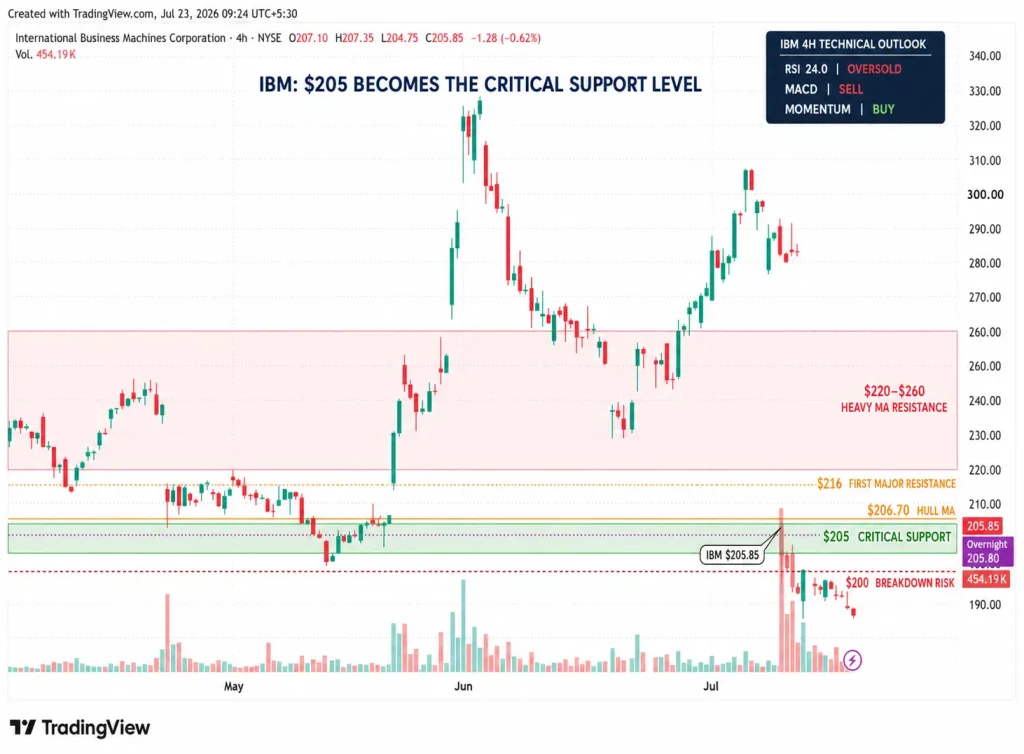
IBM’s four-hour chart remains decisively bearish following the post-earnings decline.
The stock is trading below every major moving average, confirming that sellers remain firmly in control.
Immediate support sits near $205, where overnight trading is testing buyer interest. A sustained break below this level could expose the psychological $200 mark before opening the door to deeper downside.
The first resistance is the Hull Moving Average near $206.70, followed by the 10 EMA around $216. A much heavier resistance zone lies between $220 and $260, where the VWMA, 20, 30, 50, 100 and 200-period moving averages, along with the Ichimoku baseline, remain clustered.
Momentum is deeply oversold but not yet bullish. RSI has fallen to 24, while Williams %R and Momentum suggest selling pressure may be becoming exhausted. However, MACD remains on a sell signal, indicating the broader downtrend is still intact.
For sentiment to improve, IBM first needs to reclaim $216, with a sustained move above $220 providing the first meaningful sign that buyers are regaining control.
IBM’s Long-Term AI Thesis Remains Intact
IBM’s second-quarter results reflected the tension between its long-term AI opportunity and near-term execution challenges.
The company continues building one of the strongest enterprise software portfolios through Red Hat, watsonx, HashiCorp and Confluent while investing aggressively in quantum computing and AI infrastructure.
However, weaker infrastructure sales, slowing revenue growth and a reduced full-year outlook remind investors that enterprise technology spending remains uneven.
Management believes delayed deals will return during the second half of the year, supported by recurring software revenue, productivity improvements and growing enterprise AI adoption.
Whether that optimism proves justified will largely determine whether IBM’s recent correction represents a buying opportunity or the beginning of a more prolonged slowdown.
For now, investors will closely watch software growth, Red Hat performance and the recovery in enterprise infrastructure spending, while the $205 support level remains the key technical battleground.
- Check out our free forex signals
- Follow the top economic events on FX Leaders economic calendar
- Trade better, discover more Forex Trading Strategies
- Open a FREE Trading Account
- Read our latest reviews on: Avatrade, Exness, HFM and XM

Related Articles


Sidebar rates

Related Posts
 Save
Save