META Stock Falls 2.5% Before Earnings as $145 Billion AI Spending Plan Tests Investor Confidence
Meta Platforms stock META slides before Q2 earnings as investors weigh soaring AI spending, a possible cloud business and $615-$623 support.

Quick overview
- Meta Platforms shares have declined ahead of its second-quarter earnings report, with concerns over rising AI infrastructure costs and revenue generation.
- The company is investing heavily in AI, raising questions about whether this will enhance existing products or create new revenue streams.
- Meta's upcoming earnings report is expected to focus on revenue growth, advertising demand, and the impact of AI on user engagement.
- A potential cloud computing business could provide additional revenue, but investors remain cautious due to past spending issues and ongoing legal risks.
Meta Platforms shares extended their decline ahead of next week’s second-quarter earnings report, as investors weighed rising AI infrastructure costs against the possibility that the Facebook parent could turn its enormous computing buildout into a new cloud revenue stream.
Meta Platforms entered the final week before earnings under renewed pressure as investors questioned how quickly its aggressive artificial intelligence investments will translate into additional revenue and profits.
The META stock fell 2.58% to $627.17 during Wednesday’s regular session and declined further toward $620.98 in overnight trading.
The pullback came as momentum weakened across several major technology names, but Meta faces a particularly important earnings test because its AI strategy is entering a more capital-intensive phase.
The company’s advertising business remains highly profitable, while AI-driven recommendation improvements have strengthened engagement across Facebook and Instagram.
However, Meta is now investing at a scale traditionally associated with major cloud providers. That has raised a central question for shareholders: will this infrastructure primarily improve Meta’s existing products, or can it support an entirely new business?
Meta’s July 29 Earnings Could Trigger Another Large Move
Meta confirmed that it will report second-quarter 2026 results after the market closes on Wednesday, July 29, followed by an earnings call at 4:30 p.m. Eastern Time.
Options markets are pricing in a move of approximately 7.9% following the release, reflecting the stock’s history of sharp post-earnings reactions.
Meta’s actual move has exceeded the options-implied range in six of its past eight earnings reports, according to data cited by Investing.com.
That volatility reflects how quickly investor expectations around the company can shift.
Strong advertising revenue and encouraging AI commentary have previously pushed META significantly higher. Conversely, warnings about escalating spending, delayed returns or widening Reality Labs losses have produced steep declines.
The July report is likely to focus heavily on revenue growth, advertising demand, operating margins and Meta’s updated capital expenditure outlook.
Investors will also want evidence that AI is producing measurable improvements in ad targeting, content recommendations, user engagement and business messaging.
AI Spending Is Becoming the Central Debate for META Investors
Meta is expected to spend between $125 billion and $145 billion on capital expenditures during 2026, with much of that investment directed toward AI chips, data centers, networking systems and power infrastructure.
That would place Meta among the world’s largest buyers of advanced computing capacity.
The company needs the infrastructure to train new models, operate Meta AI, improve content recommendations and support AI-powered advertising tools across its Family of Apps.
CEO Mark Zuckerberg has argued that greater computing capacity is necessary to remain competitive as AI becomes embedded across social media, messaging, advertising and consumer hardware.
The investment may also provide a significant competitive moat.
Meta can use its own infrastructure, user data and open-source models to improve applications used by billions of people. Smaller competitors do not have the same ability to fund enormous compute clusters while supporting a global consumer platform.
The risk is that spending could rise faster than revenue.
Investors have not forgotten Meta’s earlier metaverse investment cycle, when heavy spending on Reality Labs damaged margins without creating a large commercial return.
Management will therefore need to explain why the current AI buildout is economically different.
Could Meta Become a Cloud Computing Provider?
One possible answer is cloud computing.
Meta is reportedly laying the groundwork for a cloud infrastructure business that could sell access to unused AI computing capacity and proprietary models.
Zuckerberg said during Meta’s May shareholder meeting that entering cloud computing was “definitely on the table,” noting that companies approach Meta almost every week seeking access to its models or spare computing power.
Unlike Alphabet, Amazon and Microsoft, Meta does not currently operate a major commercial cloud platform.
That means billions of dollars invested in data centers are primarily used internally rather than sold to third-party customers.
A cloud business could change that calculation.
Selling excess capacity would allow Meta to generate revenue from infrastructure during periods when its own demand is below maximum capacity. It could also create a second large business alongside advertising.
Reports that Meta is discussing a potential compute leasing agreement with Anthropic have strengthened that possibility.
The proposed arrangement could be worth as much as $10 billion over two years, although negotiations remain preliminary and no agreement has been confirmed.
Such a contract would represent an important validation of Meta’s infrastructure strategy.
It would show that the company’s spending is not limited to supporting Facebook, Instagram and WhatsApp, but could produce a marketable service for external AI developers.
Anthropic Deal Could Help Monetize Spare AI Compute Capacity
Demand for AI computing remains extremely strong as model developers compete for advanced chips and data-center capacity.
Anthropic, the developer of Claude, has already established major infrastructure relationships and continues expanding its access to computing resources.
A deal with Meta would provide Anthropic with additional capacity while giving Meta a large external customer for infrastructure it is already building.
The arrangement could also serve as a test case for a broader cloud offering.
Meta would not need to immediately recreate the full range of enterprise services available from Amazon Web Services, Microsoft Azure or Google Cloud.
Instead, it could begin by offering specialized AI compute, model hosting and access to its open-source Llama ecosystem.
The opportunity is significant, but so is the competitive challenge.
The established cloud providers have years of experience in enterprise sales, billing, security, compliance and technical support. Meta would need to develop those capabilities or partner with companies that already possess them.
Advertising Remains the Core Earnings Driver
Despite growing excitement around cloud computing, advertising will remain the most important contributor to Meta’s near-term financial performance.
Facebook and Instagram continue benefiting from AI-powered content recommendations that increase user engagement and allow the platforms to compete more effectively with TikTok.
Meta has also used AI to improve ad ranking, creative generation and campaign optimization.
Those improvements help businesses produce more advertisements and target customers more effectively, potentially increasing returns for advertisers and pricing power for Meta.
The company’s scale gives it a powerful feedback loop.
More users create more engagement data, allowing Meta’s models to improve recommendations and advertising performance. Better results then encourage advertisers to spend more across the company’s platforms.
Investors will watch whether this cycle remained strong during the second quarter, particularly as economic uncertainty creates a more selective advertising environment.
Commentary around WhatsApp monetization, business messaging and Threads will also be important because those products could gradually reduce Meta’s dependence on conventional feed advertising.
Legal Victory Removes One Near-Term Risk
Meta received some positive legal news after a Florida teenager withdrew a lawsuit accusing Instagram and other social platforms of contributing to mental health problems.
The trial had been scheduled to begin in Los Angeles on July 27, but the plaintiff dropped the case without receiving payment from Meta, according to the company.
The withdrawal means Meta will avoid a second immediate jury trial over alleged social media addiction.
However, the broader legal risk remains substantial.
More than 3,300 related cases are pending in California state court, with thousands of additional complaints filed in federal court. The lawsuits generally allege that social media companies designed addictive products that harmed younger users. Meta denies the allegations.
The withdrawn case reduces near-term headline risk but does not eliminate the possibility of future judgments, settlements or product restrictions.
Meta Expands AI Beyond Advertising and Social Media
Meta is also broadening its AI research into scientific and industrial applications.
The company joined an initiative led by UK-based CuspAI, which raised $450 million to develop AI systems for materials discovery.
Meta is contributing its Universal Model for Atoms, while Nvidia is providing computing technology to support research across semiconductors, clean energy and advanced manufacturing.
The collaboration places Meta’s AI work closer to industries affected by material and supply-chain constraints.
Although the initiative is unlikely to produce meaningful near-term revenue, it demonstrates that Meta’s models may have applications beyond social media and digital advertising.
META Technical Analysis: $615-$623 Is the Key Support Zone
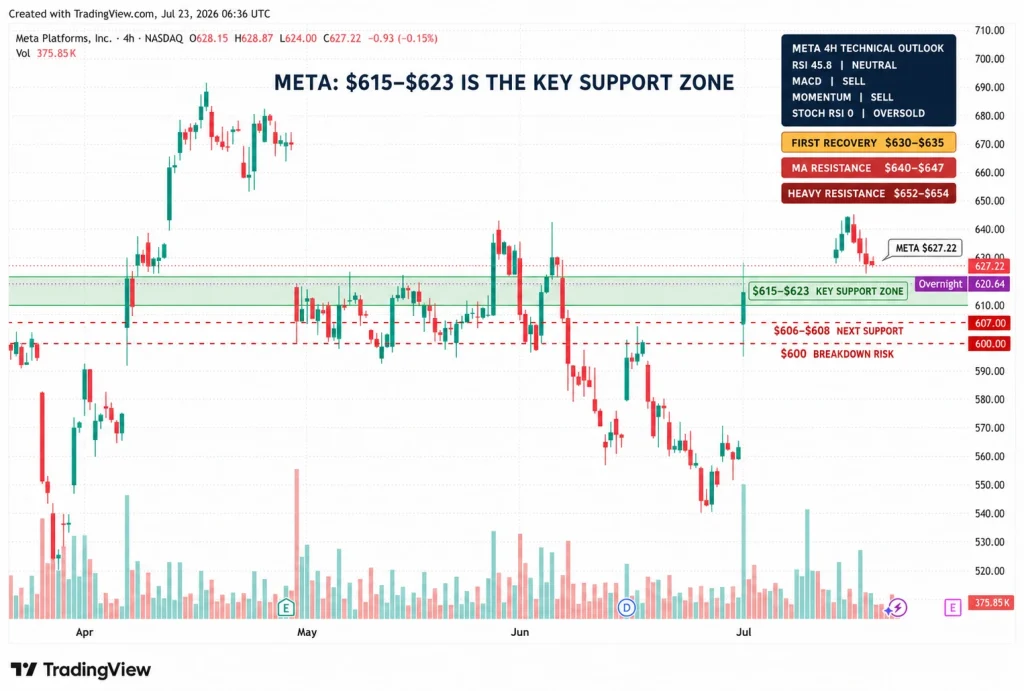
Meta’s four-hour chart has weakened following the latest pullback, but the broader setup has not broken down completely.
META is trading below its short-term moving averages, including the 10 EMA near $642.92, the 20 EMA at $640.63 and the 30 EMA around $633.40. The Hull Moving Average and Ichimoku baseline add immediate resistance near $630-$632.
However, the stock is now testing an important support cluster.
The 50 EMA sits near $622.91, while the 200 EMA is around $622.47. Additional support comes from the 100 EMA near $615.84 and the 200 SMA near $616.33.
This makes $615-$623 the critical zone bulls need to defend.
A sustained break below $615 could expose the 50 and 100-period simple moving averages near $606-$608, followed by the psychological $600 level.
On the upside, META must first reclaim $630-$635. A stronger recovery would require a move above $640-$647, while the VWMA and 20 SMA create heavier resistance near $652-$654.
Momentum is mixed but tilted lower. RSI remains neutral at 45.80, while Momentum and MACD are on sell signals. Stochastic RSI has fallen to zero and Williams %R is flashing a buy signal, suggesting the decline may be becoming stretched.
Earnings Must Justify Meta’s Infrastructure Ambitions
Meta’s pullback reflects uncertainty rather than a collapse in its underlying business.
The company continues operating one of the world’s strongest digital advertising platforms, and AI is already improving recommendations, engagement and advertising performance.
The bigger question concerns how Meta will monetize an unprecedented infrastructure expansion.
A cloud business or major Anthropic contract could strengthen the argument that Meta’s spending will create multiple revenue streams rather than simply increase costs.
Until those plans become clearer, investors may remain sensitive to any rise in capital expenditure or decline in operating margins.
The July 29 earnings report could therefore determine whether META recovers toward the $640-$654 resistance region or breaks below the key $615-$623 support zone.
- Check out our free forex signals
- Follow the top economic events on FX Leaders economic calendar
- Trade better, discover more Forex Trading Strategies
- Open a FREE Trading Account
- Read our latest reviews on: Avatrade, Exness, HFM and XM

Related Articles


Sidebar rates

Related Posts
 Save
SaveAva