PLTR Stock Drops 6% as Valuation Fears, NHS Scrutiny Build Before Palantir Earnings
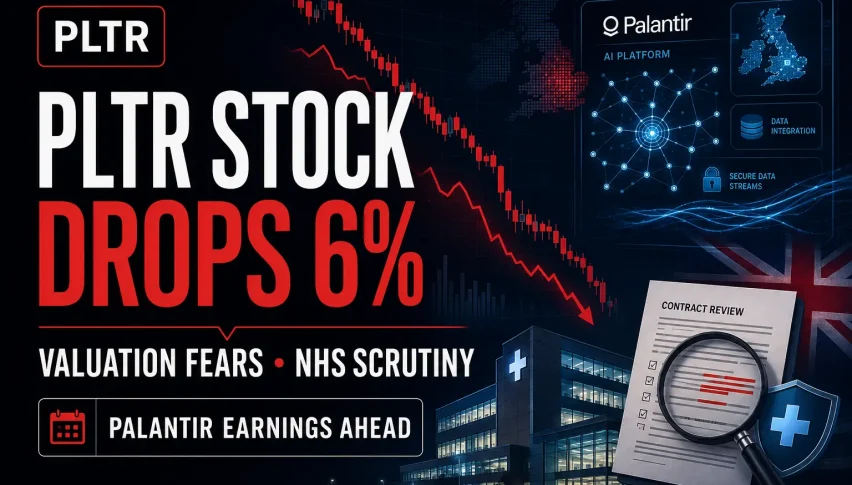
Palantir stock PLTR falls 6% as valuation concerns, insider sales and NHS scrutiny raise risk before its August 3 earnings report.
Quick overview
- Palantir shares dropped 6.1% as investors expressed caution ahead of the company's second-quarter earnings report, influenced by insider sales and scrutiny of its UK healthcare work.
- Despite strong revenue growth in U.S. government contracts, concerns about its high valuation and competition in the AI sector have created significant downside risk for the stock.
- The upcoming earnings report on August 3 is critical, as it will determine whether Palantir can maintain investor confidence and justify its premium valuation.
- Regulatory scrutiny surrounding Palantir's NHS contract adds political and reputational risks, complicating its position in the market.
Palantir shares fell sharply as investors reduced exposure to high-valuation AI software stocks ahead of the company’s second-quarter earnings report. Recent insider sales, scrutiny surrounding its UK healthcare work and persistent concerns about its premium valuation added pressure, despite continued momentum in U.S. government contracts.
Palantir Technologies shares suffered another sharp decline as investors questioned whether the company’s powerful AI growth story can continue supporting one of the richest valuations in the enterprise software sector.
PLTR fell 6.1% to $124.57 during Wednesday’s session before recovering marginally toward $124.96 in overnight trading.
The selloff occurred without a single major financial announcement. Instead, several concerns converged ahead of the company’s second-quarter results on August 3.
Those concerns included recent insider sales, questions surrounding Palantir’s work with the UK National Health Service and broader weakness across expensive AI software companies.
The decline also highlights the difficult setup facing Palantir before earnings. The company continues delivering exceptional revenue growth, especially across U.S. commercial and government markets, but its valuation means merely strong results may not be enough.
Palantir Earnings Preview: Q1 Results Set a High Bar for August
Palantir’s upcoming earnings report follows an exceptionally strong first quarter.
In May, the company raised its full-year 2026 revenue forecast to between $7.65 billion and $7.66 billion, up from an earlier range of $7.18 billion to $7.20 billion.
The increase reflected robust demand from U.S. government customers and continued adoption of Palantir’s Artificial Intelligence Platform.
The company also benefited from the Pentagon’s decision to make its Maven AI command-and-control software an official program of record, strengthening the likelihood of continued long-term military use.
Palantir’s strong government performance has been accompanied by rapid growth in its U.S. commercial business.
Businesses are increasingly using Palantir AIP to connect proprietary data with large language models and deploy AI applications inside production environments.
Unlike standalone chatbots, those deployments are designed to support real operational decisions across areas such as manufacturing, supply chains, insurance, customer operations and cybersecurity.
The August 3 report will need to show that this momentum continued during the second quarter.
Investors will focus on U.S. commercial revenue, government contract growth, adjusted operating margins and any revision to the company’s full-year guidance.
Palantir’s Valuation Leaves Little Margin for Error
Palantir remains one of the market’s most closely watched AI stocks.
Its software is used to integrate large datasets, deploy AI models and support operational decision-making across defense, manufacturing, healthcare, financial services and other complex industries.
That positioning has helped PLTR command a valuation of roughly 90 times forward earnings, according to recent market estimates.
Such a multiple assumes that revenue will continue growing rapidly, margins will expand and Palantir will become a core operating system for enterprise AI.
The problem is that high expectations create unusually high downside risk.
When a stock already reflects several years of potential growth, any sign of slowing contract activity, weaker guidance or narrowing customer demand can trigger a disproportionate correction.
That valuation sensitivity has become more visible in 2026 as investors reassess expensive software companies amid concerns that new AI agents could change how enterprise applications are purchased and used.
Palantir is not a traditional subscription software company, but it is still exposed to shifts in enterprise technology budgets and investor sentiment toward AI.
Insider Sales Add to Pre-Earnings Caution
Recent insider transactions also contributed to the cautious mood.
Palantir’s chief technology officer reportedly sold approximately $24 million of company shares earlier this month, while a director sold more than $2 million on July 15.
Both transactions were conducted under pre-arranged trading plans.
Planned insider sales do not necessarily signal weaker operating performance. Executives frequently use structured programs to diversify their holdings or meet personal financial obligations.
However, the optics can still affect market sentiment, particularly when a company is trading at a premium valuation and approaching a major earnings announcement.
Investors are therefore likely to watch management’s commentary closely on August 3 for evidence that contract momentum and AI Platform demand remain strong enough to justify PLTR’s valuation.
Palantir’s NHS Contract Draws Regulatory Scrutiny
The stock also faced pressure from renewed scrutiny surrounding Palantir’s role in the UK’s NHS Federated Data Platform.
The platform is intended to connect operational data across NHS organizations, helping healthcare providers manage areas such as waiting lists, hospital capacity, supply chains and patient discharge processes.
The UK’s Office for Statistics Regulation has addressed concerns about how performance improvements linked to the platform were communicated.
NHS England updated its methodology to clarify that reported improvements could not necessarily establish direct cause and effect because other variables were not controlled for.
An independent academic evaluation is also expected to examine the platform’s impact more closely.
The issue does not currently indicate that Palantir’s contract will be cancelled. However, it adds political and reputational risk to one of the company’s most visible international government projects.
Healthcare data remains particularly sensitive because of privacy concerns, procurement transparency and public debate about the role of foreign technology companies in national infrastructure.
For Palantir, the challenge is demonstrating measurable benefits while reassuring regulators and the public that data access, analysis and governance remain tightly controlled.
U.S. Government Demand Strengthens Palantir’s Moat
While the NHS controversy creates uncertainty, Palantir continues expanding its role across U.S. government programs.
The U.S. Small Business Administration recently announced a new phase of its pandemic relief fraud initiative using Palantir software.
The system will help investigators identify suspicious activity tied to Paycheck Protection Program and COVID Economic Injury Disaster Loan applications, support enforcement actions and improve efforts to recover misused public funds.
The expansion demonstrates one of Palantir’s most important competitive advantages.
Once its software becomes embedded in mission-critical government workflows, replacing it can be operationally difficult, expensive and risky.
Government agencies often require secure data integration, detailed access controls, auditability and the ability to operate across highly regulated environments.
Palantir has spent years building its reputation around those requirements.
The company’s government relationships therefore provide more than revenue. They create references, technical credibility and long-term contracts that can strengthen its position in defense, intelligence, healthcare and regulated commercial markets.
However, dependence on government business also introduces political and reputational risks.
Contract awards can become controversial, priorities may change after elections and projects involving surveillance, defense or sensitive personal data often attract significant public scrutiny.
Can Palantir Defend Its AI Software Advantage?
The central debate surrounding Palantir is not whether its technology is valuable.
The more difficult question is whether its growth and competitive position can justify its current market valuation.
Supporters argue that Palantir is becoming a foundational enterprise AI platform.
Its software does not simply generate text or automate individual tasks. It connects data, AI models, operational workflows and governance controls across an entire organization.
That makes it particularly attractive to customers operating in complex or highly regulated environments.
Critics argue that competition will intensify as cloud providers, consultancies and open-source developers build similar AI orchestration tools.
An open-source monitoring platform called World Monitor has also attracted attention as investors assess whether lower-cost alternatives could eventually weaken Palantir’s market moat.
Palantir’s long-term performance will therefore depend on whether its proprietary ontology, deployment expertise and customer relationships remain difficult to replicate.
PLTR Technical Analysis: $123-$125 Is the Immediate Support Zone
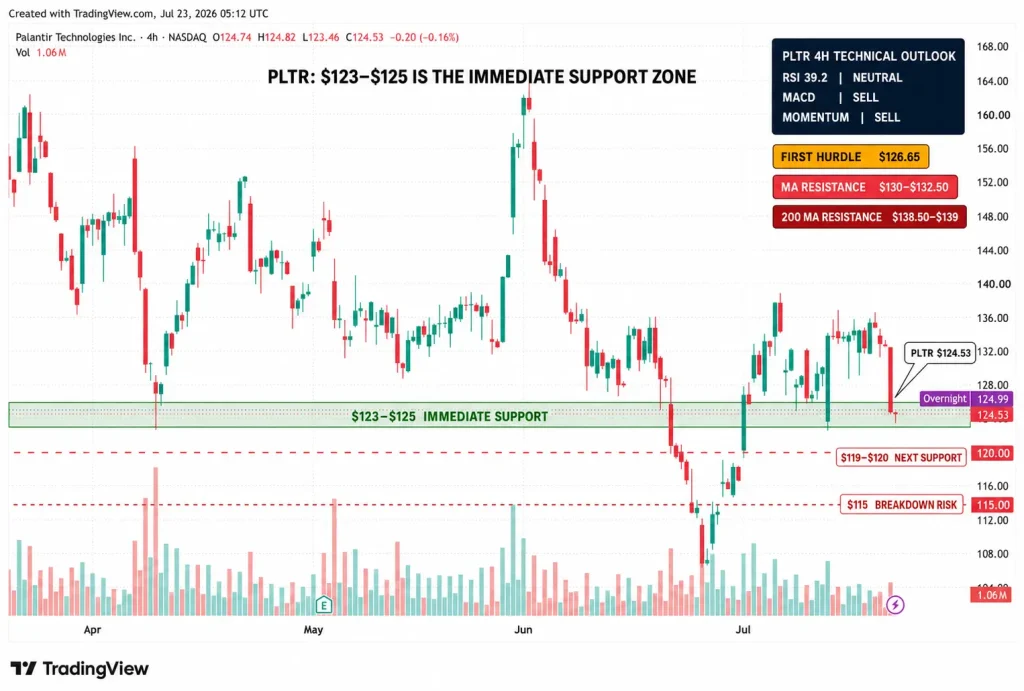
From a technical perspective, Palantir’s four-hour chart has weakened sharply.
PLTR is trading below every major moving average, confirming that sellers control the short-term trend.
Immediate support sits between $123 and $125, close to the current overnight price and recent intraday lows. A sustained break below this area could expose $119-$120, followed by the psychological $115 level.
The first recovery hurdle is the Hull Moving Average near $126.65, which closely aligns with the 50-period simple moving average.
A heavier resistance cluster sits between $130 and $132.50. This zone contains the 10, 20, 30, 50 and 100-period exponential moving averages, several simple moving averages, the VWMA and the Ichimoku baseline.
A decisive move above $132.50 would improve the near-term setup, but stronger resistance remains near $138.50-$139, where the 200-period moving averages are located.
Momentum remains bearish. RSI has fallen to 39.19, while Momentum and MACD remain on sell signals. Stochastic RSI and Williams %R are approaching oversold territory, suggesting the decline may be stretched, but a reversal has not yet been confirmed.
For sentiment to improve, PLTR first needs to recover $130, followed by a sustained breakout above $132-$133.
Earnings Will Decide Palantir’s Next Major Move
Palantir’s latest selloff reflects the tension between exceptional business momentum and an unforgiving valuation.
The company continues winning important government contracts, expanding its commercial AI business and embedding its software into high-value operational workflows.
At the same time, regulatory scrutiny, insider-selling optics and concerns about competition make investors increasingly sensitive to any disappointment.
The August 3 earnings report will therefore be a major test.
Another strong quarter with raised guidance could help restore confidence and push PLTR back toward the $130-$139 resistance region.
A weaker outlook or slowdown in U.S. commercial growth could place the $123-$125 support zone under further pressure.
For now, Palantir’s long-term AI thesis remains intact, but the chart shows investors are demanding fresh evidence before paying a premium for that growth.
- Check out our free forex signals
- Follow the top economic events on FX Leaders economic calendar
- Trade better, discover more Forex Trading Strategies
- Open a FREE Trading Account
- Read our latest reviews on: Avatrade, Exness, HFM and XM

Related Articles

Sidebar rates

Related Posts
 Save
Save