INTC Rebounds Toward $95 After 8% Earnings Selloff as AI Revenue Surges but Capex Risks Grow
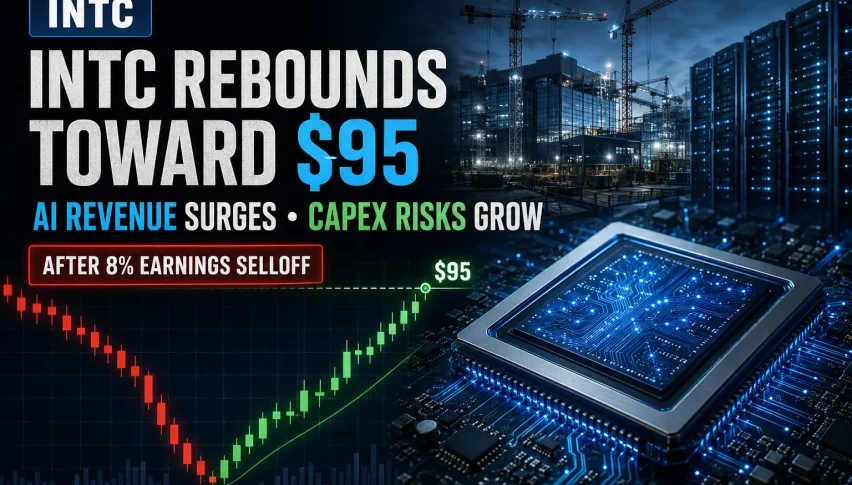
Intel stock INTC rebounds toward $95 after an 8% slide as record growth and AI demand collide with rising capex and foundry losses.
Quick overview
- Intel shares rebounded to around $94.62 after a significant drop, driven by record revenue growth and strong AI-server demand.
- Despite reporting its fastest revenue growth in nearly 15 years, concerns over rising capital spending and foundry losses led to a sharp selloff in Intel's stock.
- Intel's Data Center and AI business saw a 59% revenue increase, but the company faces challenges in proving the sustainability of its AI investments.
- Higher capital expenditure forecasts have raised investor concerns, as Intel must balance aggressive spending with the need for consistent profitability.
Intel shares recovered to around $94.62 overnight after tumbling 7.89%, as record revenue growth and booming AI-server demand struggled to offset higher capital spending, supply constraints and continuing foundry losses.
Intel’s Stock Attempts to Recover as Strong Q2 Results Fail to Calm Spending Concerns
Intel stock is attempting to stabilize after an initially positive earnings reaction turned into a sharp selloff, highlighting the market’s conflicting view of the chipmaker’s accelerating recovery.
INTC fell $7.91, or 7.89%, to $92.32 on Friday after trading between approximately $91.58 and $101.71. Shares later recovered to around $94.62 in overnight trading, gaining 2.49%, but remained well below the important $100 level.
The decline came despite Intel reporting its fastest revenue growth in nearly 15 years, stronger-than-expected adjusted earnings and surprisingly robust demand for data-center processors.
However, investors quickly shifted their attention toward rising capital requirements, persistent foundry losses and questions about whether Intel’s AI momentum reflects durable competitive progress or simply an industry-wide shortage of computing capacity.
Intel Delivers Fastest Revenue Growth in 15 Years
Intel reported second-quarter revenue of approximately $16.1 billion, representing a 25% increase from the previous year and comfortably exceeding Wall Street expectations near $14.4 billion.
Adjusted earnings reached $0.42 per share, almost double the consensus estimate of approximately $0.22. In the corresponding quarter a year earlier, Intel recorded an adjusted loss of $0.10 per share.
Product revenue rose 28% to approximately $15.1 billion, accelerating sharply from the 9% growth recorded during the first quarter.
Gross margin improved by 12.9 percentage points to 40.4%, providing evidence that stronger pricing, greater processor demand and cost controls are beginning to improve Intel’s operating performance.
The figures represent a dramatic improvement for a company that recently faced declining sales, market-share losses and uncertainty surrounding the cost of rebuilding its manufacturing operations.
Nevertheless, the stock’s negative response shows that strong revenue growth alone is no longer enough. After a rally of more than 140% in 2026 and almost 300% over the previous year, investors appear increasingly focused on profitability, cash generation and the sustainability of Intel’s turnaround.
AI and Data Center Revenue Surges 59%
Intel’s Data Center and AI business delivered the strongest growth during the quarter.
Product revenue from the segment jumped 59% to approximately $6.3 billion, exceeding analyst forecasts near $5.6 billion. The increase was driven primarily by powerful demand for server central processing units used alongside graphics processors in artificial intelligence infrastructure.
AI inference and increasingly complex agentic workloads require large amounts of general-purpose computing in addition to specialized accelerators. This has strengthened demand for Intel’s Xeon processors as cloud providers and enterprise customers expand their infrastructure.
Management expects industry server-CPU demand to grow at a double-digit rate during 2026 and 2027, with momentum potentially continuing into 2028.
Supply has struggled to keep pace, allowing chipmakers to benefit from stronger pricing.
The development gives Intel greater exposure to the AI investment boom. However, the company remains in a different position from Nvidia and other suppliers that have led the market for specialized AI accelerators.
For investors, the central question is whether Intel is building a defensible AI business or merely benefiting from customers purchasing every available processor during an exceptional capacity shortage.
Client Computing Benefits From Stronger PC Demand
Intel’s Client Computing product revenue increased 13% to approximately $8.9 billion, supported by improving PC demand and rising processor prices.
The PC market is entering a potentially important replacement cycle as households and businesses upgrade older devices and adopt machines capable of handling AI-enabled applications.
Intel has increasingly positioned its latest processors as AI-ready platforms that can run certain machine-learning workloads locally rather than relying entirely on cloud infrastructure.
A sustained PC refresh cycle could provide Intel with a more reliable source of revenue and cash flow while its foundry strategy remains heavily dependent on investment.
However, competition continues to create risks. AMD has gained ground in several processor categories, while alternative architectures remain increasingly important across laptops, data centers and custom computing systems.
Intel therefore needs more than a temporary market recovery. It must demonstrate that its new processors can protect pricing, regain market share and generate attractive margins.
Intel Foundry Revenue Growth Masks Continuing Losses
Intel Foundry reported revenue of approximately $5.8 billion, a 31% increase from the previous year.
The growth suggests that manufacturing volumes and demand for Intel’s advanced production capabilities are improving. The company is attempting to become a major contract manufacturer while continuing to produce its own processors, making the foundry strategy one of the most ambitious parts of its turnaround.
However, the segment still generated an operating loss of approximately $2.1 billion.
That loss remains a significant financial burden during one of the strongest semiconductor investment cycles in history. Intel must continue spending heavily on advanced process technology, manufacturing equipment and new facilities before the business can potentially achieve sufficient scale.
External foundry demand also remains the critical test. Manufacturing chips primarily for Intel’s own product divisions does not prove that the company can build a profitable third-party platform capable of competing with TSMC.
Until Intel wins more large external customers and demonstrates competitive yields, the foundry business may continue consuming cash despite reporting impressive revenue growth.
Higher Capital Spending Triggers Investor Concern
The biggest reason for the negative earnings reaction appears to be Intel’s capital-spending outlook.
The company increased its expected 2026 capital expenditure from an earlier range near $17 billion to $18 billion to more than $20 billion. Management also indicated that spending in 2027 could be significantly higher than in 2026.
The increase reflects strong demand and the need to expand manufacturing capacity. However, markets have become less willing to reward technology companies for aggressive AI investment without a clear and near-term path to returns.
Intel faces a particularly difficult challenge because it must fund new processors, AI accelerators, advanced packaging and leading-edge manufacturing facilities simultaneously.
Higher spending could eventually strengthen Intel’s competitive position, but it also increases execution risk and places additional pressure on free cash flow.
Investors may therefore remain cautious until rising revenue begins translating into consistent profitability after capital expenditures.
Q3 Guidance Shows Momentum but Supply Remains Tight
Intel expects third-quarter revenue between $15.8 billion and $16.8 billion, above the analyst expectation of roughly $15.1 billion before the report.
Adjusted earnings are forecast at approximately $0.38 per share, compared with the earlier consensus near $0.27, while gross margin is expected to remain around 41%.
The guidance suggests that demand remains strong and Intel’s revenue recovery could continue.
However, management also warned that supply constraints may affect the next quarter, with meaningful improvement expected only toward the end of Q3 and into Q4.
Supply shortages can support prices, but they may also prevent Intel from fully capitalizing on demand. The company must expand output without creating excess capacity if the current AI and server investment boom eventually slows.
INTC Technical Outlook Remains Bearish Below $100
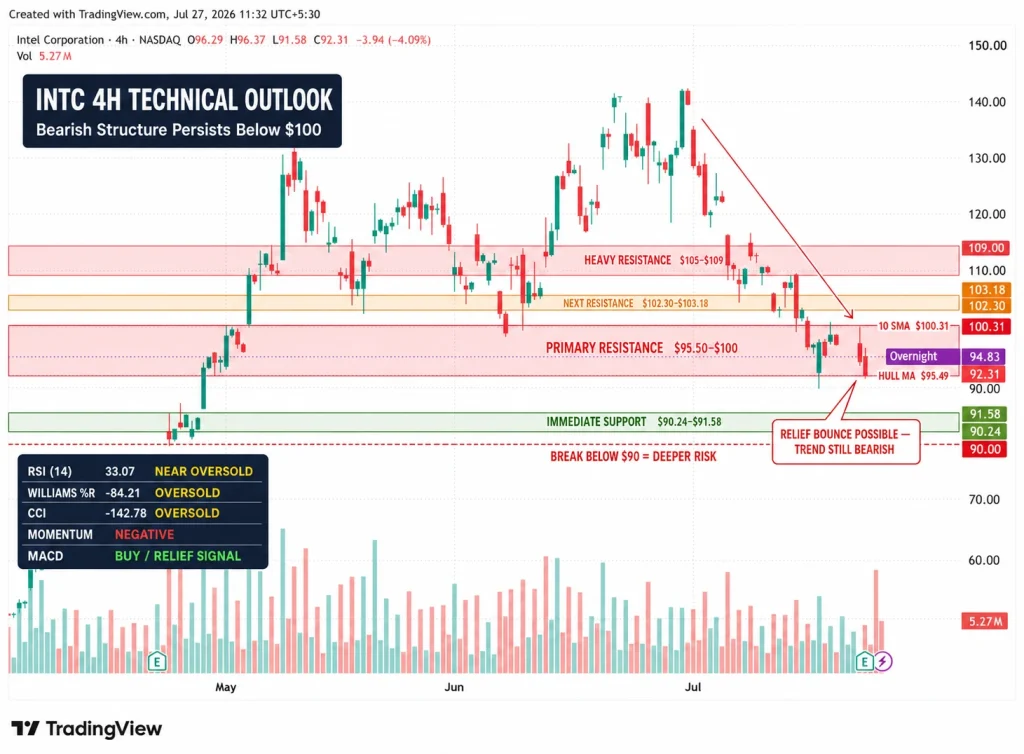
From a technical perspective, Intel’s four-hour chart remains under pressure despite the overnight rebound.
At $92.32, INTC is trading below almost every major short- and medium-term moving average. The Hull moving average stands at $95.49, while the 10-period exponential moving average is near $99.22 and the 10-period simple moving average is around $100.31.
This makes the $95.50–$100 region the first significant resistance zone. A sustained recovery above $100 could open the way toward the 20-period EMA at $102.30 and the Ichimoku baseline near $103.18.
Stronger resistance sits around $105 to $109, where the 30-period averages, 100-period EMA and 50-period EMA are concentrated. Until Intel recovers these levels, rebounds may continue attracting sellers.
On the downside, the 200-period simple moving average at $90.24 represents the most important immediate support. A decisive break below $90 could expose the recent low near $91.58 and increase the risk of a deeper decline.
The Relative Strength Index stands at 33.07, placing INTC close to oversold territory without confirming an extreme reading. Williams %R at -84.21 and the Commodity Channel Index at -142.78 also suggest the selloff has become stretched.
Momentum remains negative, but the MACD currently shows a buy signal. This combination creates the possibility of a relief rebound while leaving the broader four-hour structure bearish.
Intel’s AI Turnaround Faces a Profitability Test
Intel’s second-quarter results show that its revenue engine has recovered much faster than many investors expected.
AI-driven server demand, improving PC sales, higher pricing and stronger gross margin provide meaningful reasons for optimism. Third-quarter guidance also indicates that momentum could continue.
However, the sharp decline in Intel stock demonstrates that the market is looking beyond headline growth.
Foundry losses, capital expenditure above $20 billion, further spending increases in 2027 and uncertainty surrounding external manufacturing demand remain substantial obstacles. Intel must prove that its enormous investments can generate sustainable cash flow rather than simply expand revenue.
For now, the overnight rebound suggests buyers are defending the $90 region. However, INTC must recover $95.50 and then the psychological $100 level before the technical picture begins to improve meaningfully.
Intel has finally joined the AI infrastructure boom, but its next challenge will be showing that stronger demand can produce durable profitability rather than another expensive investment cycle.
- Check out our free forex signals
- Follow the top economic events on FX Leaders economic calendar
- Trade better, discover more Forex Trading Strategies
- Open a FREE Trading Account
- Read our latest reviews on: Avatrade, Exness, HFM and XM

Related Articles


Sidebar rates

Related Posts
 Save
SaveAva