Lockheed Martin Jumps 10% as Missile Demand and Record $230 Billion Backlog Drive Earnings Beat
Lockheed Martin stock LMT jumps 10% after an earnings beat, raised guidance and record $230 billion backlog strengthen its outlook.
Quick overview
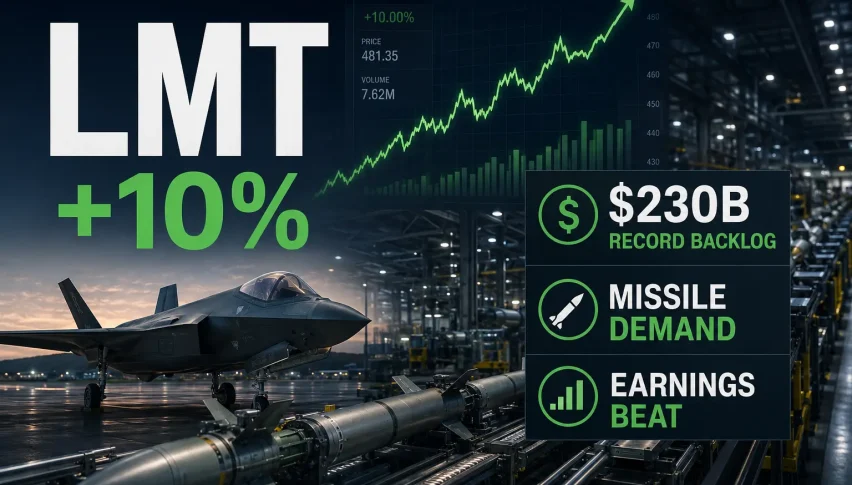
- Lockheed Martin's shares surged 10.54% after reporting stronger-than-expected second-quarter results and raising its full-year forecasts.
- The company achieved quarterly sales of $20.1 billion, an 11% increase from the previous year, and reported a record backlog of $230.4 billion.
- Lockheed's missile division saw nearly 20% revenue growth, driven by increased production of missile-defense systems amid rising global defense spending.
- The company has raised its earnings forecast to between $29.95 and $30.65 per share, reflecting improved cash generation and demand for its defense products.
Lockheed Martin shares surged after the defense contractor delivered stronger-than-expected second-quarter results, raised its full-year forecasts and reported a record backlog as the Pentagon accelerates efforts to rebuild depleted weapons inventories.
Lockheed Martin shares recorded one of their strongest single-day gains in recent years after the defense giant reported accelerating sales, improving cash generation and a sharp increase in contracted orders.
LMT closed around $568.59, up 10.54%, before slipping marginally to $567.50 in overnight trading.
The rally followed second-quarter results that confirmed rising geopolitical tensions are translating into stronger financial growth for major U.S. defense contractors.
Lockheed reported quarterly sales of $20.1 billion, an increase of 11% from the previous year. Net earnings reached $1.8 billion, or $7.94 per share, while cash from operations climbed to $3.2 billion and free cash flow reached approximately $2.9 billion.
The company also raised its full-year sales and earnings forecasts, supported by stronger demand for missile-defense systems, precision weapons and F-35 fighter aircraft.
Lockheed Martin Raises 2026 Guidance
Lockheed now expects full-year revenue between $79.75 billion and $81.75 billion, up from its previous forecast of $77.5 billion to $80 billion.
The revised range also sits above the approximately $79.14 billion analysts had expected before the report.
Management increased its earnings forecast to between $29.95 and $30.65 per share, compared with the earlier range of $29.35 to $30.25.
The midpoint of the new forecast is above Wall Street’s prior consensus estimate of approximately $29.90 per share.
The guidance increase represents an important change from the company’s first-quarter results, when supply-chain constraints, production delays and cost pressure on fixed-price contracts weighed on earnings.
Lockheed reported first-quarter revenue of $18 billion and earnings of $6.44 per share, while maintaining its original full-year outlook.
The stronger second-quarter performance indicates that production improvements and rising demand are beginning to outweigh some of those operational pressures.
Missile Revenue Jumps Nearly 20%
Lockheed’s Missiles and Fire Control division was the primary growth driver.
Segment revenue increased nearly 20% to approximately $4.1 billion, supported by higher production of PAC-3 Missile Segment Enhancement interceptors, Precision Strike Missiles and THAAD missile-defense systems.
The U.S. and allied governments are attempting to rebuild weapons inventories after years of sustained military demand connected to the Russia-Ukraine conflict and escalating hostilities in the Middle East.
According to Pentagon data cited by Reuters, the United States has used more than 50,000 rockets, missiles and rocket-propelled munitions since the start of the Ukraine war in 2022 through the more recent conflict involving Iran.
That level of consumption is forcing defense departments to increase orders and encourage contractors to accelerate manufacturing.
Lockheed is particularly well positioned because it produces several of the most important systems required for air defense and long-range precision attacks.
The PAC-3 interceptor is used with the Patriot air-defense platform, while THAAD is designed to destroy ballistic missiles during the final phase of flight.
The Precision Strike Missile provides the U.S. Army with a longer-range surface-to-surface weapon and is expected to replace older Army Tactical Missile Systems.
$35 Billion THAAD Contract Supports Production Expansion
The missile division also benefited from a recently signed U.S. government contract valued at approximately $35 billion.
The multi-year agreement is intended to quadruple annual THAAD interceptor production, helping the Pentagon restore inventories while improving manufacturing visibility for Lockheed.
Earlier agreements between the company and the U.S. government aimed to increase annual THAAD output from around 96 interceptors to 400. PAC-3 production is also expected to rise from approximately 600 missiles annually to as many as 2,000.
Multi-year contracts are particularly valuable for defense companies because they allow manufacturers to make long-term investments in factories, machinery, suppliers and skilled workers.
Lockheed can expand production more confidently when government demand is contractually visible over several years.
Management has also indicated that the company is discussing additional partnerships to accelerate production, particularly in Europe.
European governments are increasing defense budgets and attempting to expand regional manufacturing capacity after years of relying heavily on U.S. weapons inventories.
Record $230 Billion Backlog Strengthens Revenue Visibility
Lockheed’s total order backlog climbed to a record $230.4 billion, compared with $166.5 billion one year earlier.
That represents growth of more than 38% and provides several years of revenue visibility across missiles, aircraft, space systems and classified programs.
The backlog includes the large THAAD production agreement as well as demand for PAC-3 interceptors, F-35 fighter jets and other defense systems.
A backlog does not guarantee that every dollar will immediately become recognized revenue. Defense programs can be delayed, modified or affected by government budget negotiations.
However, the scale of the order book significantly reduces uncertainty around Lockheed’s long-term demand outlook.
It also strengthens the argument that the current defense-spending cycle may last longer than a typical short-term response to geopolitical instability.
The Pentagon is not simply replacing weapons already used. It is also attempting to increase inventory targets, expand production resilience and prepare for potential future conflicts.
F-35 Production Supports Aeronautics Growth
Lockheed’s Aeronautics division also delivered stronger results, with sales increasing approximately 9%.
Growth was partly driven by higher F-35 production and deliveries.
The F-35 remains the Pentagon’s largest weapons acquisition program and is also used by a growing number of allied countries.
Its lifetime cost, including purchasing, operating and maintaining the aircraft, is estimated at more than $2 trillion.
That scale provides Lockheed with a long-term revenue stream extending beyond new aircraft deliveries.
The company generates continuing income from upgrades, maintenance, spare parts, training and sustainment services across the global F-35 fleet.
However, the program remains exposed to political scrutiny because of its cost, technical complexity and dependence on government funding.
Lockheed must also continue resolving supplier constraints and production delays that previously affected several aircraft programs.
The second-quarter improvement suggests those issues are becoming more manageable, but execution remains important as production volumes rise.
Free Cash Flow Rebounds After Difficult 2025 Comparison
The strong earnings increase was partly supported by an unusually weak comparison period.
During the second quarter of 2025, Lockheed recorded approximately $1.6 billion in program-related losses, mainly associated with challenges in Aeronautics and international helicopter programs within its Sikorsky business.
Those charges reduced earnings to $1.46 per share and resulted in negative free cash flow of approximately $150 million.
By comparison, the latest quarter produced earnings of $7.94 per share and free cash flow of $2.9 billion.
The recovery is therefore not entirely the result of underlying sales growth. Part of the improvement reflects the absence of the large charges recorded a year earlier.
Nevertheless, the 11% revenue increase, stronger bookings and raised guidance show that the earnings beat was supported by more than a favorable comparison.
Improved cash generation gives Lockheed greater flexibility to invest in manufacturing capacity, support suppliers and return capital to shareholders.
UK Hypersonic Contract Expands Missile-Defense Role
Lockheed also secured a £20 million, or approximately $26 million, contract from the UK Ministry of Defence to develop a hypersonic target under Project Bowline.
The system will simulate threats traveling above Mach 5, allowing the UK and its allies to test future missile-defense sensors and interceptor technologies.
Lockheed Martin UK will design, manufacture and test the target, with a live flight demonstration planned at the Hebrides Range in 2027.
The contract is relatively small compared with Lockheed’s major U.S. programs, but it is strategically important.
Hypersonic weapons are difficult to track and intercept because of their speed, maneuverability and unpredictable flight paths.
Project Bowline could strengthen Lockheed’s position in a growing area of allied defense spending while supporting cooperation between the UK, the United States and Australia under the AUKUS security partnership.
LMT Technical Analysis: $560 Becomes the Key Breakout Support
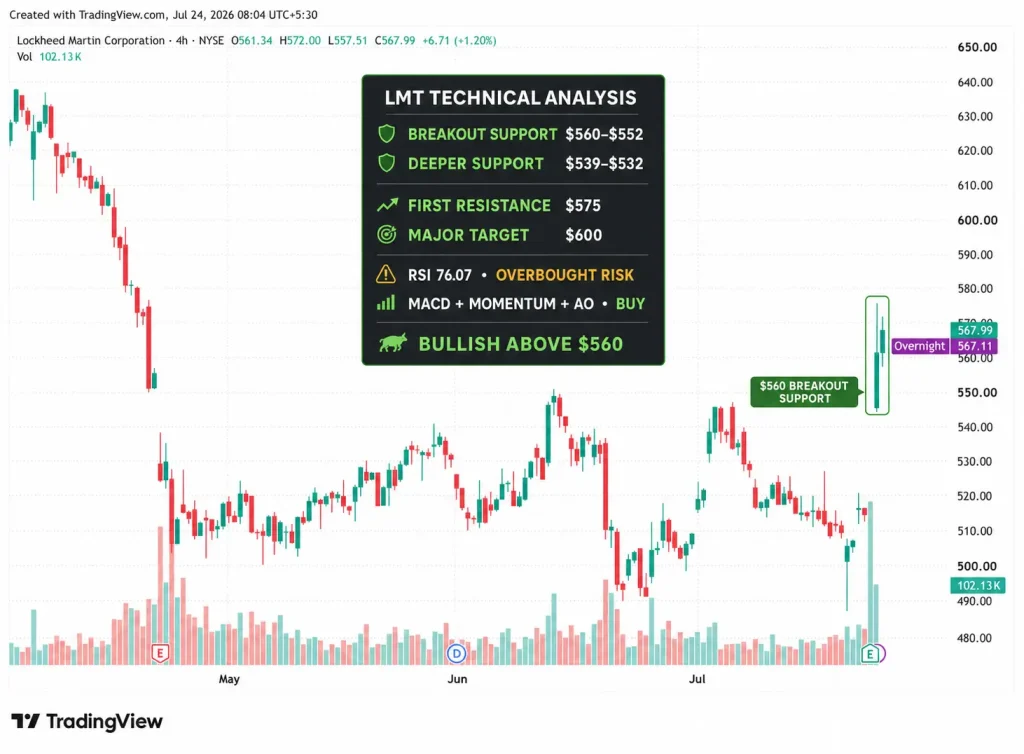
Lockheed Martin’s four-hour chart has turned strongly bullish following the 10% earnings rally.
LMT is trading above every major moving average, including the 200-period SMA near $559.76 and the Hull Moving Average at $551.51. This makes $560-$552 the first major support zone if the stock pulls back.
Below that, stronger support sits around $539-$532, where the 200-period EMA, Ichimoku baseline, VWMA and 10-period EMA are located.
On the upside, the first resistance is near $575, followed by the psychological $600 level. A sustained move above $600 could bring the previous 52-week highs back into focus.
Momentum is firmly positive, with MACD, Momentum and the Awesome Oscillator showing buy signals. However, RSI has climbed to 76.07, while Stochastic RSI and Williams %R are also near overbought territory.
That setup suggests the breakout remains bullish, but the stock may be vulnerable to short-term profit-taking after such a sharp one-day move.
Holding above $560 would keep the breakout intact. A drop below $552 could trigger a deeper retracement toward $540-$530.
Can Lockheed Martin Extend the Earnings Rally?
Lockheed Martin’s results show that rising global defense spending is producing measurable growth in revenue, backlog and cash flow.
Missile production is accelerating, F-35 sales are increasing and the company now has a record $230 billion order book supporting its long-term outlook.
The main risk is that much of the positive earnings news may already be reflected in the stock following its 10% surge.
Supply-chain pressures, fixed-price contract costs and production execution also remain potential challenges.
Even so, Lockheed’s raised guidance and expanding backlog provide a stronger fundamental foundation than the company had earlier in the year.
Technically, $560 is now the critical level to watch.
Holding above that area would support a continued advance toward $575 and $600, while a break below $552 would suggest the earnings rally is entering a deeper consolidation phase.
These remain likely scenarios rather than predictions, particularly after an unusually large single-session move.
- Check out our free forex signals
- Follow the top economic events on FX Leaders economic calendar
- Trade better, discover more Forex Trading Strategies
- Open a FREE Trading Account
- Read our latest reviews on: Avatrade, Exness, HFM and XM

Related Articles

Sidebar rates

Related Posts
 Save
Save