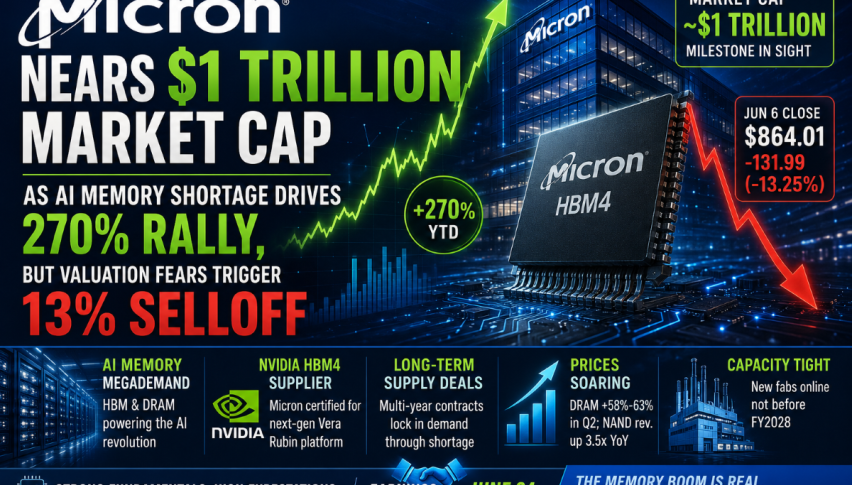
Micron Technology has seen a 270% surge in stock price this year, driven by high demand for AI memory, briefly nearing a $1 trillion market cap.
Despite positive developments like Nvidia's certification and new customer agreements, Micron's shares dropped over 13% due to broader semiconductor market concerns.
Memory pricing is expected to rise significantly, with DRAM prices projected to increase by 58%-63% in Q2 2026 amid ongoing supply constraints.
Investor sentiment remains cautious following CEO Sanjay Mehrotra's stock sale, although analysts view it as routine insider activity rather than a negative signal.
Micron Technology (NASDAQ: MU) has become one of the biggest beneficiaries of the artificial intelligence infrastructure boom.
The memory-chip giant has surged more than 270% this year, briefly approaching a $1 trillion market capitalization as soaring demand for AI memory pushed pricing power across the industry to levels rarely seen in semiconductor markets.
Yet investors were reminded of the risks surrounding high-flying AI stocks this week. Shares plunged more than 13% after a broader semiconductor selloff triggered by concerns about the pace of future AI infrastructure spending.
The decline came despite a series of positive developments, including Nvidia’s certification of Micron as a key HBM4 supplier and new long-term customer agreements designed to lock in demand through the industry’s ongoing memory shortage.
AI Memory Boom Continues to Reshape Micron’s Growth Story
Micron sits at the center of one of the most important supply bottlenecks in artificial intelligence.
AI accelerators require massive amounts of high-bandwidth memory (HBM), and supply remains constrained across the industry.
Recent developments supporting Micron include:
Nvidia certified Micron as an HBM4 supplier for its next-generation Vera Rubin AI platform.
Micron unveiled a full stack of AI-focused memory and storage products at COMPUTEX 2026.
The company signed multi-year Strategic Customer Agreements to secure future demand.
New manufacturing facilities are under construction, but meaningful capacity expansion is not expected until fiscal 2028.
Industry-wide DRAM and NAND shortages continue supporting higher pricing.
The combination has strengthened Micron’s position as one of the most important suppliers in the AI hardware ecosystem.
Memory Prices Are Exploding
The biggest driver behind Micron’s rally remains memory pricing.
Industry forecasts suggest supply constraints could persist for years.
Key industry trends include:
DRAM prices are projected to rise 58%-63% in Q2 2026 after nearly doubling in Q1.
NAND flash revenue surged roughly 3.5x year-over-year during Q1.
Enterprise SSD demand continues accelerating due to AI data center deployments.
HDD lead times reportedly extend into late 2027.
Hyperscaler AI spending is expected to reach approximately $650 billion this year.
Meanwhile, Nvidia has projected global AI data center capital expenditures could eventually reach $3 trillion to $4 trillion annually by 2030.
If those forecasts materialize, memory demand could remain elevated for much longer than previous semiconductor cycles.
Why Investors Suddenly Sold the Micrcon Stock
The recent decline appears driven more by sentiment than fundamentals.
Broadcom’s cautious commentary on AI spending sparked concerns that the AI infrastructure buildout may eventually moderate.
That triggered profit-taking across semiconductor names, particularly among stocks that had generated extraordinary gains in recent months.
Additional concerns include:
Micron’s valuation expanded rapidly during the rally.
Investors are preparing for the June 24 earnings report.
Expectations for AI-related growth have become extremely high.
Some investors worry long-term contracts could cap upside if memory prices continue climbing.
Even after the selloff, Micron remains one of the strongest-performing large-cap semiconductor stocks of 2026.
Micron CEO Stock Sale Draws Attention
Investor concerns also increased after CEO Sanjay Mehrotra sold approximately $38 million worth of Micron shares.
However, the transactions appear less alarming than headlines suggest.
The sales were executed under a pre-arranged SEC Rule 10b5-1 trading plan. Such plans establish selling schedules in advance and are commonly used by executives for diversification and tax planning purposes.
Importantly:
Mehrotra still owns hundreds of thousands of Micron shares.
The sales were scheduled before the recent rally.
No evidence suggests the transactions were linked to upcoming earnings results.
Most analysts view the transactions as routine insider activity rather than a warning sign.
Why is Micron stock down today?
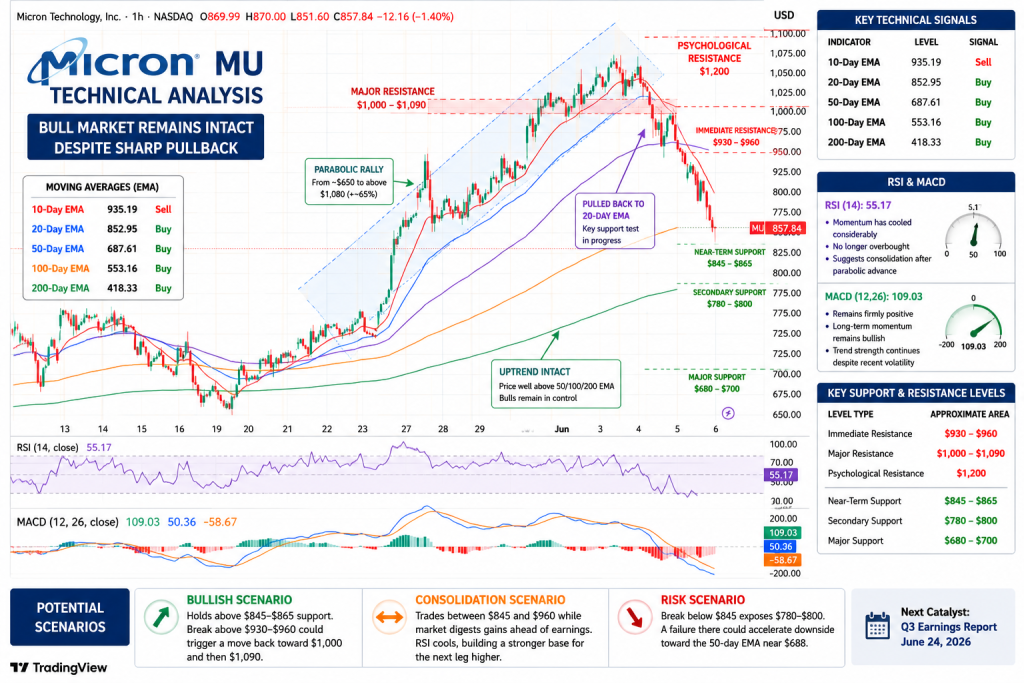
MU Technical Analysis: Bull Market Remains Intact Despite Sharp Pullback
Technically, Micron remains one of the strongest AI infrastructure stocks despite this week’s correction.
The stock has pulled back from recent highs but continues trading well above most major trend indicators.
Key Technical Signals
Indicator
Level
Signal
10-Day EMA
935.19
Sell
20-Day EMA
852.95
Buy
50-Day EMA
687.61
Buy
100-Day EMA
553.16
Buy
200-Day EMA
418.33
Buy
The recent selloff pushed shares below the 10-day moving average, but the stock remains significantly above longer-term support levels.
The broader uptrend remains intact unless deeper technical damage emerges.
RSI and MACD
RSI: 55.17
Momentum has cooled considerably.
No longer overbought.
Suggests the stock is consolidating after a parabolic advance.
The combination suggests Micron may be transitioning from an explosive momentum phase into a consolidation period rather than entering a major trend reversal.
Key Support and Resistance Levels
Level Type
Approximate Area
Immediate Resistance
$930-$960
Major Resistance
$1,000-$1,090
Psychological Resistance
$1,200
Near-Term Support
$845-$865
Secondary Support
$780-$800
Major Support
$680-$700
Holding above the $845-$865 region would suggest buyers remain active after the recent selloff. A recovery above $930 could refocus attention on Micron’s previous highs.
Micron’s Long-Term Outlook: AI Memory the Next Infrastructure Bottleneck?
The long-term investment case remains tied to one question: can AI demand continue growing faster than memory supply?
Current evidence suggests supply constraints remain significant.
Micron benefits from several structural tailwinds:
AI servers require substantially more memory than traditional systems.
HBM remains one of the most supply-constrained semiconductor products.
Data center storage demand continues accelerating.
Memory has historically been one of the most cyclical segments of the semiconductor industry. Today’s shortages could eventually become tomorrow’s oversupply if capacity expansion outpaces demand.
For now, Micron remains one of the clearest pure-play beneficiaries of the AI infrastructure buildout. The recent selloff highlights how quickly sentiment can shift in high-growth technology stocks, but the underlying fundamentals continue pointing toward a memory market that remains exceptionally tight heading into the second half of 2026.
Lead Markets Analyst – Multi-Asset (FX, Commodities, Crypto)
Arslan Ali Butt serves as the Lead Commodities and Indices Analyst, bringing a wealth of expertise to the field. With an MBA in Behavioral Finance and active progress towards a Ph.D., Arslan possesses a deep understanding of market dynamics.
His professional journey includes a significant role as a senior analyst at a leading brokerage firm, complementing his extensive experience as a market analyst and day trader. Adept in educating others, Arslan has a commendable track record as an instructor and public speaker.
His incisive analyses, particularly within the realms of cryptocurrency and forex markets, are showcased across esteemed financial publications such as ForexCrunch, InsideBitcoins, and EconomyWatch, solidifying his reputation in the financial community.



 Save
Save