Gold Price Forecast: Trapped Shorts Covered as $4,025 Floor Absorbs Post-Treaty Markdown
With early July trends crystallising into the July monthly price action, global precious metal markets are seeing pronounced structural...
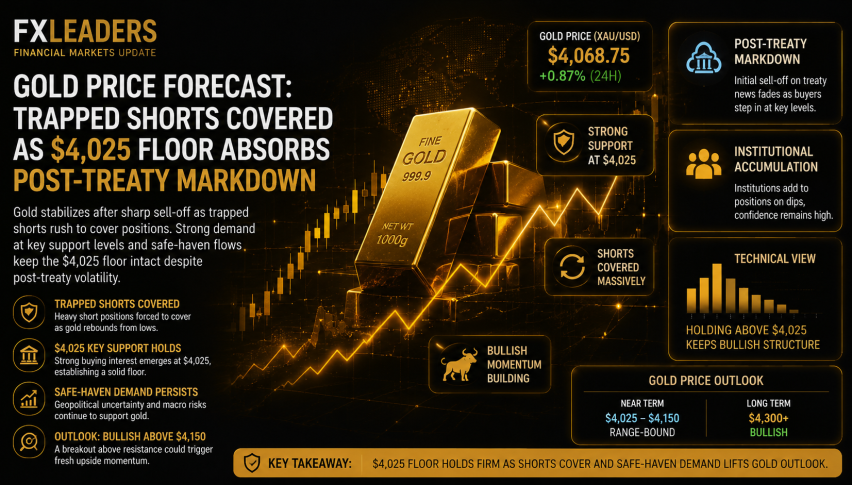
Quick overview
- Global precious metal markets are experiencing significant turbulence, with spot XAU/USD stabilizing at $4,052.94/oz amid reduced geopolitical tensions from the U.S.-Iran Interim Peace Agreement.
- The aggressive monetary policy under Federal Reserve Chair Kevin Warsh has limited rapid price increases, as traders shift expectations towards potential rate hikes instead of easing.
- A 17-month accumulation of gold by central banks, particularly the People's Bank of China, provides a structural support level against selling pressure in the market.
- Technical analysis indicates that gold is nearing a point of selling exhaustion, with key resistance levels identified at $4,091.00 and support at $4,024.00.
With early July trends crystallising into the July monthly price action, global precious metal markets are seeing pronounced structural turbulence. During late Wednesday trade on 8 July 2026, spot XAU/USD found a late afternoon stabilisation at $4,052.94/oz.
Trading houses and algorithmic systems are keeping their books within a tightly bounded range, allowing the paper market to work off its excess short-term leverage and long-dated physical accumulators to provide a robust near-term support level.
Swiss Accords Reduce the Geopolitics Premium
The main reason for the recent multi-week market price action in the precious metals complex has been the on-going expansion of the U.S.-Iran Interim Peace Agreement, the Islamabad MoU, signed on 19 June in Switzerland via Pakistani and Qatari diplomatic mediation, which has brought an end to the Q2 military campaign.
The agreement has removed the U.S. military blockade in the Strait of Hormuz and restored full commercial freedom of navigation there.
In this environment, commercial maritime activity, which is quickly recovering to its near-85% historical rate, has driven the front month of Brent crude below $73/bbl and removed the fear-driven war premium from paper commodity contracts, removing the urgent flight to safety that was shielding the bullion complex while economic indicators have been once again free to influence price action in daily trading.
Warsh’s Sintra Removes Forward Guidance
A major factor limiting a rapid bounce in the spot price is the current aggressive monetary regime, in place since Federal Reserve Chair Kevin Warsh made his strong commitment to political independence and a 2% target at the ECB Forum on Central Banking at Sintra, Portugal.
Given persistent CPI data with a core rate of 4.1% and a headline of 3.8%, Warsh eliminated all forward guidance, stating that policy will be decided on a case by case basis, in private, by the economic data as it comes in.
Warsh said that in recent weeks the upside risk to inflation is much less due to lower fuel prices, and that both U.S. Treasuries and the U.S. dollar are correcting after losing steam a few weeks ago, but the broad macro backdrop continues to be one of tight policy.
Traders are actively backing away from autumn easing expectations, instead shifting bets to price in a potential rate hike as early as October, keeping long-term yields and the opportunity cost of non-yielding assets higher for longer, and capping long-term index exposure in gold.
17-Month Accumulation Creates a Defensible Physical Floor
The divergence between short-term paper selling and long-term physical buying is the fundamental support for the gold market. One key underpinning continues to be the ongoing accumulation from official institutions, the most visible one being the People’s Bank of China (PBOC), now in its 17th month of buying and has been for well over a year.
Given growing geopolitical friction, the potential for de-dollarization in reserve diversification, and fears of a weaponized financial system in a great power competition, emerging market central banks have turned towards a strategy of moving more capital out of G7 government securities and into physical gold, and that continuous, non-retail buying forms a structural bottom that catches selling from other, often paper, desks and that prevents a complete fall in spot prices.
Gold Technical Analysis: 4H Chart Pushes Bears Toward Exhaustion Near Core Support Shelf
In a deviation from central bank interest rate rhetoric, the spot gold price (XAU/USD) has successfully navigated a corrective period on the 4H Chart beneath its leading dynamic trendlines.
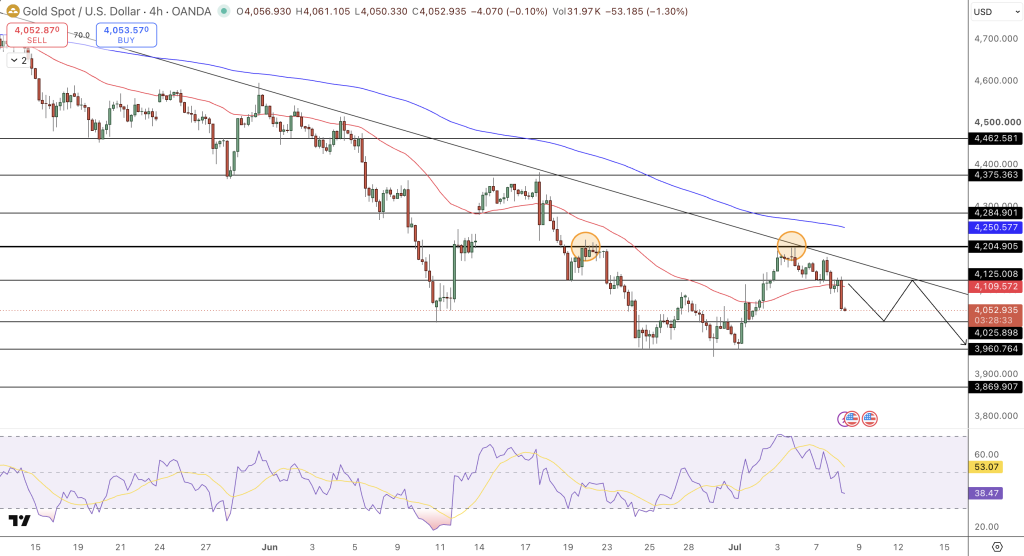
The commodity recently fell through its long-term descending trendline support base to hit $4,052.94, and now sits in a series of lower peaks and troughs on its trailing 4H 200-EMA ($4,257.00). This indicates that the former support shelves have effectively transformed into formidable overhead supply walls.
The 14-Period Relative Strength Index (RSI) has reached a constricted level of 38, meaning the corrective price wash is now complete, with the short-term selling pressure about to reach a mathematical point of saturation against the base of the support.
Additionally, the Moving Average Convergence Divergence (MACD) histogram is starting to print its first positive blocks near the 0.0 line, which shows that the speed at which Gold is now heading lower has now completely dissipated.
Gold Trade Summary
Gold is in a violent post-geopolitical recalibration that will now return short-term power back to the macro bears, as the war risk premium on precious metals will evaporate under the new strong dollar administration headed by Kevin Warsh.
Gold’s 17 months of continued sovereign buying will keep a firm floor underneath the long-term market, however the break down through the downward sloping trendlines show that Gold is about to see selling at former support.
Trade Continuation Strategy
Short on weak, low volume technical retracement toward the broken trendline resistance ceiling at $4,091.00 which will act as dynamic resistance. A tight Stop-Loss above the horizontal resistance area at $4,160.00 to target a trend continuation breakdown through the major horizontal support at $4,024.00 and a final invalidation level at $3,962.00. Extended downside targets will include the major macro support area at $3,903.00.
- Check out our free forex signals
- Follow the top economic events on FX Leaders economic calendar
- Trade better, discover more Forex Trading Strategies
- Open a FREE Trading Account
- Read our latest reviews on: Avatrade, Exness, HFM and XM

Related Articles


Sidebar rates

Related Posts
 Save
Save