Gold Price Forecast: XAU Near $4,030 Has Every Reason to Rally; So Why Isn’t It?
Gold (XAU/USD) trades near $4,030 as softer US inflation clashes with rising oil prices and Fed rate expectations.
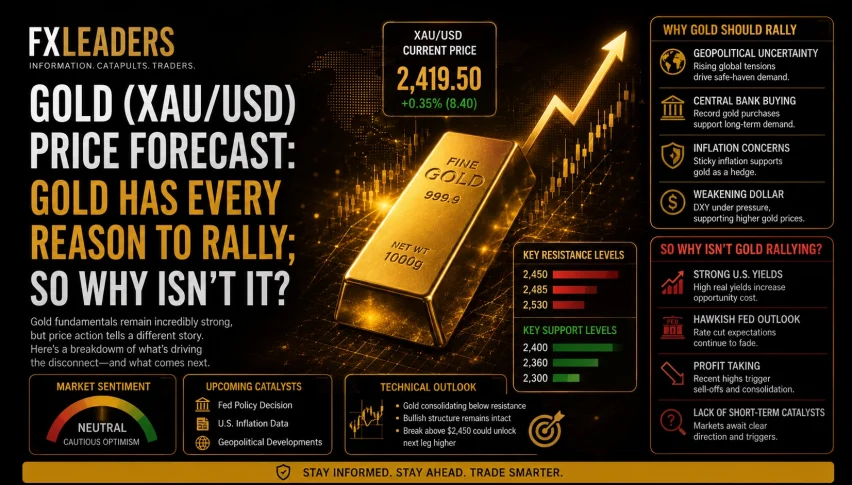
Quick overview
- Gold (XAU/USD) is trading near $4,030, influenced by cooling US inflation and rising oil prices.
- While central bank demand for gold remains strong, concerns over potential Fed rate hikes are impacting market sentiment.
- Higher oil prices are reviving inflation fears, which could lead to prolonged elevated interest rates.
- Gold's price movement is currently constrained, with key support at $4,002 and resistance at $4,071.
Gold (XAU/USD) trades near $4,030 as softer US inflation clashes with rising oil prices and Fed rate expectations. Here’s what’s really driving gold today. On Thursday, the price of gold (XAU/USD) is hovering near $4,030. The market is being pulled in opposing directions by two strong forces. On one hand, US inflation is cooling, official monetary institutions are still buying up some gold, and political and military tensions are escalating in the Middle East, all of which should underpin demand for this time-honored safe-haven asset.
On the other hand, surging crude oil prices are raising concerns about renewed price rises later this year, which would leave the Federal Reserve no choice but to keep interest rates elevated for an extended period.
Such mixed macro conditions are likely the reason why the metal failed to take advantage of the gains made this week, despite what might look like a price rally setup to the outside eye.
Gold’s Biggest Problem Isn’t Demand: It’s the Fed
Gold rose more than 2% earlier this week after June’s inflation print came in softer than expected, causing the dollar to sink while spurring some optimism the Federal Reserve may be pausing further tightening.
That mood soon evaporated. Oil prices have risen since, amid worsening political and military standoffs between the United States and Iran, and that has brought back fears that energy-driven inflation could re-accelerate in the back half of the year. The market now gives 73% odds of another rate hike by December.
For the metal, that is a concern because stronger interest rates raise the attractiveness of yield-earning assets like US Treasury bonds. That can drive a wedge between precious metals and other assets.
Long-Term Buyers Haven’t Gone Anywhere
Gold continues to have one of its most enduring structural underpinnings in the form of central-bank demand. China’s central bank continued buying in June, extending its streak to 20 months. A survey by the World Gold Council released earlier this week indicated 89% of central banks expect the pace of official gold buying will remain strong over the next 12 months.
Unlike speculative investors, central banks buy gold for diversification purposes on a multi-year time horizon. That steady support will continue to exist, even as ETF investors have reduced exposure to the metal during 2026.
At the same time, jewellery demand remains under pressure from elevated prices. But investment demand for physical bullion remains strong as investors seek a place to park money that is less vulnerable to inflation, or economic slowdowns driven by geopolitical tensions.
The Next Move Depends on One Question
It would appear that the next leg in gold’s price trend will depend on how policymakers respond to new economic data rather than current geopolitical headlines. If rising energy prices end up having little impact on the path to inflation, and yields begin to decline, that would clear a path for gold prices to regain the uptick they made this week.
But if higher oil prices end up convincing policymakers that inflation risks are still too high, then expectations of tighter monetary policy are likely to remain.
For now, investors find themselves in a tug-of-war between a supportive macro backdrop that points to prices rising and a Federal Reserve that has yet to declare victory against higher inflation.
Gold (XAU/USD) Price Forecast: Triangle Breakout Approaches
At last check, XAU/USD is trading near $4,027 on the 4-hour chart, maintaining consolidation in a symmetrical triangle pattern as descending price resistance is matched by the ascending price support.
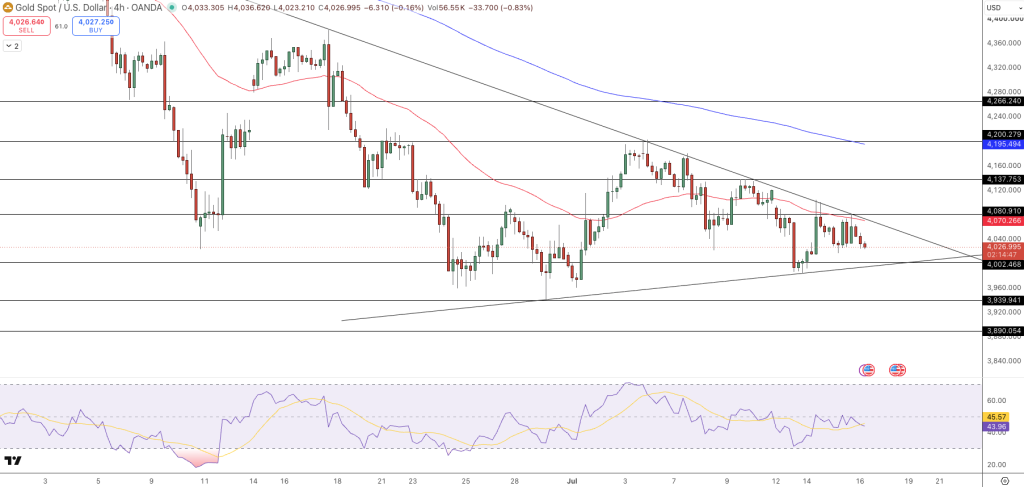
Price continues to trade below the 50-period EMA at around $4,070 and far below the 200-period moving average, around $4,195, suggesting a slightly bearish short-term bias despite the shrinking price range.
The price support level sits at $4,002, where the ascending trendline meets a horizontal demand. A fall below this mark will likely spark selling to $3,940. To see a move higher, price first must break above $4,071. Resistance stands at $4,138, with a follow-through above $4,200.
On the RSI, the indicator remains at 44 as it tries to climb back into neutral territory. Neither bulls or bears has managed a clear edge, so volatility is set to expand.
XAU/USD will remain rangebound between $4,002 and $4,071, but should price break above $4,071, it can target $4,138 to $4,200. On the other hand, a failure below $4,002 could see a re-test of $3,940.
Key Takeaways
-
Gold is caught between cooling inflation and rising expectations of another Fed rate hike.
-
Higher oil prices are negating safe-haven demand by rekindling fears of inflation in the back half of the year.
-
Buying activity from monetary authorities continues to provide solid support despite weaker inflows in ETFs.
-
A re-test of $4,071 could set gold on the recovery path to $4,138 to $4,200, while a drop below $4,002 will likely reinforce the selling bias toward $3,940.
- Check out our free forex signals
- Follow the top economic events on FX Leaders economic calendar
- Trade better, discover more Forex Trading Strategies
- Open a FREE Trading Account
- Read our latest reviews on: Avatrade, Exness, HFM and XM

Related Articles


Sidebar rates

Related Posts
 Save
SaveAva

