XRP Price Prediction: XRP Slips Toward $1.05; Are ETFs and XRPL Growth Enough to Stop the Slide?
XRP is struggling with a painful paradox. The token's fundamental story is far more robust than it was just a year ago. Ripple's...
Quick overview
- XRP's fundamentals have improved significantly, with the resolution of Ripple's SEC case and over $1.4 billion in spot ETF inflows.
- Despite these advancements, XRP's price remains around $1.08, over 50% lower than its January highs due to softer crypto sentiment and competition from stablecoins.
- The XRP Ledger is expanding its utility with new lending protocols and tokenization, but this may not directly increase demand for the XRP token itself.
- Ripple's large escrowed XRP holdings continue to pose a supply risk, impacting market confidence and price stability.
XRP is struggling with a painful paradox. The token’s fundamental story is far more robust than it was just a year ago. Ripple’s protracted legal fight with the U.S. Securities and Exchange Commission is no longer hanging over the asset, spot XRP exchange-traded funds have pulled in over $1.4 billion, and the XRP Ledger is broadening its utility into stablecoins, tokenized assets, and institutional credit.
Still, XRP hovers near $1.08, more than 50% below the highs it saw above $2.30 in January.
The trouble isn’t that the ecosystem isn’t building. It’s that whether this building is creating enough direct demand for XRP to overcome softer crypto sentiment, softer ETF inflows and Ripple’s massive escrowed holdings.
XRP ETFs Are Buying, But Not Fast Enough
Spot XRP ETFs on U.S. exchanges opened a fresh institutional demand stream through the normal channels: traditional brokerage accounts and retirement vehicles. By May, net inflows were running around $1.4 billion, climbing to slightly more than $1.47 billion in late June.
The funds continued to attract money while XRP’s spot price waned, which some saw as a buy the dip opportunity and not a signal to sell. Yet inflows slowed in June to around $59 million, which pales compared to the stronger inflows of May.
That softness is crucial, because ETF buying has to compete with various sellers:
- Existing holders who sell during wider crypto weakness.
- Ripple’s escrow release, each month.
- Traders swapping into Bitcoin or “safer” tokens.
- Redemptions from funds as macro sentiment weakens.
On a fundamental basis, spot ETFs remain bullish because they create new access points for XRP and, at least temporarily, move supply from immediately tradeable hands to ETF custody. But they aren’t a one-way trade. And if their inflows continue to slow, they may not be able to hold XRP without a more general crypto market rebound.
Related Readings: Bitcoin Price Forecast: BTC Falls Below $64K as ETF Demand Struggles to Lift the Market
Ripple’s SEC Case Is Over; So What Is Holding XRP Back?
For much of the past decade, XRP traded as if it might be declared a security by U.S. regulators and have its listings restricted or terminated as a result.
That is much less the case now. The ruling required Ripple to pay a $125.04 million civil penalty mostly linked to institutional sales of the token. Ripple and the SEC would later dismiss appeals in the case, meaning the court’s determination still stands: certain institutional sales to direct buyers constituted offerings of unregistered securities, but sales via exchanges and liquidity providers on a programmatic basis did not.
That made it easier for exchanges, funds, banks and other institutions to list and sell products with XRP without having to worry too much about the legalities. But the regulatory clarity hasn’t brought a surge in demand for the XRP token.
That’s because solving an existential threat doesn’t equate to a sudden need for a token. That explains why XRP hasn’t returned to its all-time highs even with the court case resolved. The market has largely moved past, XRP won’t be a security. It’s now asking, Is Ripple’s use by big institutions growing to the point where they’re likely to accumulate XRP holdings?
XRPL Lending Could Open a New Institutional Market
A crucial development for the XRP Ledger could come from Ripple’s planned institutional lending setup. The XRP Ledger Lending Protocol would make it possible for a fixed-term lending arrangement that lets banks continue to do underwriting, borrower vetting, document preparation and security collateralization off the ledger. The ledger would settle and disburse payments.
This is different from many decentralized lending protocols, which often rely on permissionless participation and overcollateralization. Ripple’s solution is targeted at regulated institutions, which have established legal processes and require permissioned participation.
If implemented, that could bring the XRPL from a token and payment platform to:
- Private credit
- Corporate treasury management
- Working capital financing
- Institutional DeFi
- Tokenized collateral markets
XRP could be a key part, with transaction fees, liquidity provision and a position as the network’s native bridge asset. But banks could lend and settle loans with stablecoins, or through tokenized cash accounts, without holding XRP on the XRP Ledger. That would create utility for the XRPL but not necessarily for the XRP token.
RLUSD Is Growing; But It May Compete With XRP
Ripple USD (RLUSD) has already become one of Ripple’s most important parts of their institutional offering. As of June 2026, this dollar-linked stablecoin was valued at an estimated $1.7 billion. It was also active on multiple chains, including the XRP Ledger (XRPL), the Ethereum chain, and other blockchains that can support stablecoin activity. Ripple has also ramped up adoption through partnerships in regions including Türkiye and Japan.
XRP has a couple of potential use cases. For one, it can benefit from RLUSD, because more stablecoin activity, settlement, and institutional capital could mean more volume and transactions. For the same period, the first month that XRPL ever saw more than $1 billion of stablecoin activity, Ripple also confirmed that interest in tokenized real-world assets was still picking up.
However, for XRP, the upside of RLUSD is not straightforward. Stablecoin activity could increase XRP demand as a bridge, but it’s also possible for users to simply transact in RLUSD without keeping a material amount of XRP.
That means that RLUSD could strengthen Ripple’s overall payments and settlement platform while simultaneously removing the need to use XRP in some cases. This is one of the big questions for valuation. The XRP Ledger can thrive, without XRP being able to capitalize on that success.
Tokenisation Is Expanding Across the XRP Ledger
XRPL’s total value of tokenized assets has surpassed $474 million. Its overall value of represented assets is also at $1.5 billion. This platform already supports tokenized money market funds, government bonds, commodities, and even stablecoins. Meanwhile, partnerships from companies such as Archax, abrdn, Braza Bank, and Meld Gold have helped make the XRP Ledger a platform for regulated digital assets.
On-chain activity has already picked up significantly, too. For instance, on March 15, daily activity hit roughly 3 million transactions, or about three times what the average was in mid-2025. Ripple says this boost came from increased tokenized assets, RLUSD settlement volume, and automated market-maker (AMM) activity.
Ripple also launched a University Digital Asset Xcelerator program in Brazil earlier in the year, which could help developers and researchers build payments, credit, and tokenization solutions in the medium-term.
All of this is a huge boost in XRPL’s profile, and its credibility, among investors. At the end of the day, though, market participants need evidence that more activity and assets will also mean more XRP volume, utility, or demand to hold long-term.
Related Readings: ONDO Price Prediction: Can Tokenised Assets Finally Create Real Value for the Token?
Ripple’s Escrow Keeps Supply Risk in Focus
XRP’s supply is limited to 100 billion. Of that number, there is 62.5 billion XRP now in circulation. As of June 30, Ripple says the company held around 37.66 billion XRP, which includes 32.6 billion XRP now locked up in escrow on the blockchain.
Escrow is a transparent method of controlling supply in that releases are based on a preset schedule and that, at the end of every month, Ripple usually puts the bulk of their monthly XRP release into new escrow contracts.
But, for the XRP community, token supply remains a concern. Any tokens left over following every release might be used for operations, investments, as well as institutional distribution or sales. Consequently, investors are still accounting for the possibility that more XRP will eventually be launched into the market.
While the escrow overhang does not mean heavy selling will occur, it does curb scarcity relative to assets where less supply will be available in the future.
XRP Price Prediction: $1.05 Becomes the Line Bulls Cannot Lose
On the 4-hour chart, XRP was trading around $1.083 after it dropped beneath both the 50-period EMA at $1.099 and the 100-period EMA at $1.101. The price was additionally rejected from the descending trendline that has suppressed rallies since the June peak. Such indicators imply that sellers remain dominant in the near term. The immediate support is established at $1.053. A clear decline below that would indicate another lower low and bring attention to the psychological $1.010 mark.
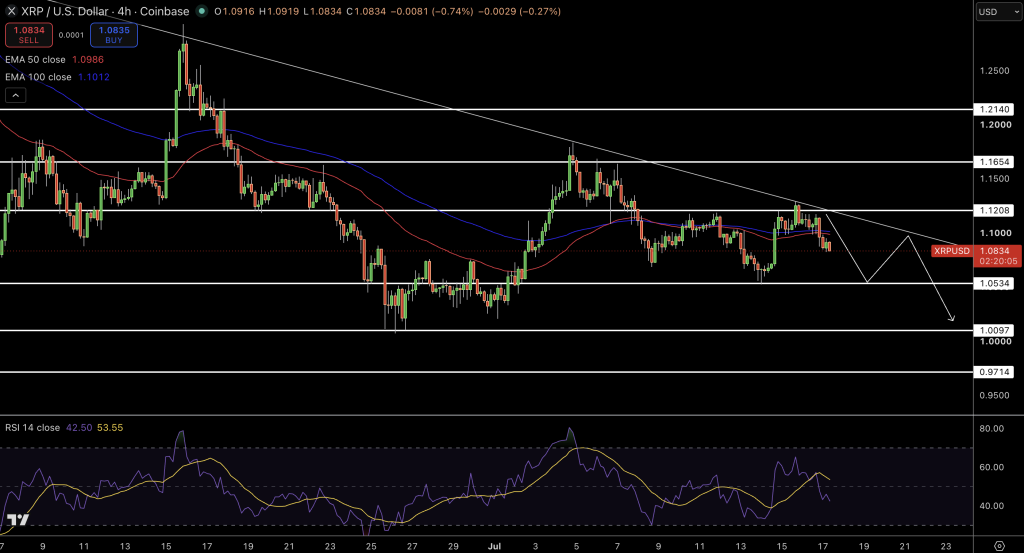
Should selling accelerate, the next significant point would lie near $0.971. In contrast, bulls need to at least buy back the $1.10 to $1.12 resistance zone and rise past the trendline in order to target the next upside point of $1.165, and then $1.214. The RSI has dropped to roughly 42, indicating the loss of buying momentum though still below oversold levels.
That means there still is scope for additional downside before bargain hunters step up. Until XRP regains its moving averages and descending trendline, short-term bounces will likely continue to be met with selling interest.
XRP Outlook: Stronger Network, Uncertain Token Demand
XRP’s long-term fundamentals have substantially improved since the days of the SEC litigation. Spot ETFs have made more institutional participants eligible to invest, there is more certainty surrounding legal risks, the launch of RLUSD is underway and the XRP Ledger is gaining greater prominence for both tokenization and institutional financial activity.
The remaining question is about value capture. A healthier Ripple ecosystem does not automatically imply that institutions will require significant purchases of the token. Stablecoins could pose competition with the native currency, ETF inflows have decelerated and Ripple has a large amount of XRP left over under escrow.
So as long as ETF inflows are sustained, a measurable amount of XRP-based settlement transactions occurs and proof can be shown that institutional XRPL use cases are actually employing XRP as opposed to simply bypassing it, XRP bulls will require a greater set of evidence in order to make their case more persuasive.
The Bottom Line
XRP is still pressured around $1.08 in spite of better regulatory and institutional participation. Spot XRP ETFs have taken in more than $1.47 billion but inflow rates have slowed. Although XRPL lending, RLUSD and tokenized assets are helping make the network more viable, that does not automatically mean they will generate XRP demand on par.
Ripple’s sizeable supply of escrowed XRP remains a constant factor regarding supply. A drop below $1.053 might result in a move toward $1.010 and $0.971, whereas bulls would have to reclaim $1.10-$1.12 before their case is better positioned.
- Check out our free forex signals
- Follow the top economic events on FX Leaders economic calendar
- Trade better, discover more Forex Trading Strategies
- Open a FREE Trading Account
- Read our latest reviews on: Avatrade, Exness, HFM and XM

Related Articles

Sidebar rates

Related Posts
 Save
SaveAva
