Gold Price Forecast: Can XAU/USD Hold Above $4,000 as Fed and Middle East Risks Collide?
On Tuesday, gold (XAU/USD) reclaimed the $4,040 mark by snapping out of a short-term descending trendline and recovering from last week’s...
Quick overview
- Gold (XAU/USD) has reclaimed the $4,040 mark after breaking a short-term descending trendline, recovering from last week's selloff amid geopolitical tensions.
- Rising oil prices are contributing to inflation fears, which may limit gold's upside as they support the dollar and US Treasury yields.
- Central banks continue to be strong long-term buyers of gold, purchasing around 1,000 tonnes annually, while ETF inflows remain mixed as investors await clearer economic signals.
- Upcoming economic data and the Federal Reserve's policy meeting will be crucial in determining gold's near-term direction, with potential for renewed demand if inflation and yields decline.
On Tuesday, gold (XAU/USD) reclaimed the $4,040 mark by snapping out of a short-term descending trendline and recovering from last week’s major selloff as the markets are weighing the heightened Middle East risks against US Treasury yields and bets that Fed could hold higher-for-longer.
Although geopolitical tensions underpin the demand for safe-haven assets, the gold upside is constrained by surging oil prices, which fuel fears of inflation and drive the value of the dollar and yields higher.
Oil Prices Keep Inflation at the Center of the Story
Energy markets continue to be at the center of macro concerns this week, with oil prices continuing to support the price of precious metals. Brent is near $90 per barrel and WTI is still above $84 as military clashes between the US and Iran disrupt the flow through the critical shipping route of Strait of Hormuz where 20% of oil supply moves.
Energy prices tend to increase transportation costs as well as production costs, which adds to worries that the inflation rate may rise again in the near future after falling in June.
For gold, which tends to perform well during high inflation, higher energy prices raise the expectation that the US central bank is unlikely to cut rates or might even hike again.
Treasury Yields Continue Limiting Gold’s Rally
Markets focus on Fed as US treasury yields stay firm and weigh on gold. Following the better than expected retail and labor reports, investors continue to anticipate Fed caution in terms of rate decision. US treasury yields stay near highs; 30Y yield stays above 5%, which increases the opportunity cost of holding assets like gold which doesn’t pay interest.
The dollar also has remained robust, which makes gold and other precious metals more expensive for international buyers. This explains why gold hasn’t performed well recently despite rising geopolitical tensions.
Central Banks Continue Supporting Long-Term Demand
Central banks remain one of gold’s strongest long-term pillars. According to the World Gold Council, central banks have purchased an average of around 1,000 tonnes of gold annually over the past four years, roughly double the pace seen during the previous decade.
China has now increased its gold reserves for 20 consecutive months, while countries including Poland, Kazakhstan and Uzbekistan have also continued adding to their holdings in 2026. Unlike ETF investors, central banks are strategic buyers focused on reserve diversification rather than short-term price movements. Their consistent purchases continue to absorb physical supply and provide a structural floor for gold, even during periods of weaker institutional investment demand.
ETF Investors Await More Policy Clarity
Inflows into physically backed gold ETFs have been somewhat mixed. In June, global ETFs backed by gold registered net outflows of $8.9 billion and a 74-tonne decline in holdings, according to the World Gold Council. That reduced holdings, on net, to around 4,047 tonnes globally in the first half of 2026. Total inflows into ETFs in that six-month span amounted to some $8 billion.
Investors are waiting for more certainty on the inflation path and Fed policy before they build bigger positions. The higher yields being generated from Treasurys has continued to lead some investors to rotate to higher-yielding assets within their portfolio but should those yields fall and should inflation show signs of declining once more, flows into ETFs could start to accelerate and could provide more support to gold.
Markets Turn Attention to Economic Data
This week’s calendar of economic data could play a role in shaping market expectations before the Federal Reserve’s July 28-29 policy meeting. Among key reports to watch: this week’s July initial jobless claims, following last week’s report reading 208,000, which could impact market views on the health of the job market and the economy. The week is also set to feature preliminary July S&P Global Manufacturing and Services PMIs released Friday, and June new-home sales data, which will shed fresh light on business activity and consumer sentiment.
Investors will also get results from a handful of high-flying tech names:
- Alphabet, reported on July 22
- Tesla on July 22
- Intel on July 23
- IBM on July 23
If data comes in strong and corporate earnings surprises are positive, market expectations that interest rates will remain higher for longer and that inflation remains sticky could be reinforced, which should see higher yields and a higher dollar.
Conversely, if the data comes in weaker than expected and earnings are lackluster, market hopes of a more accommodative Fed stance at the Fed’s next meetings later this year may be revived, leading to a positive bias for gold and risk-asset sentiment.
Gold Fundamental Outlook
Gold enters the latter half of the current trading week still looking fundamentally strong in the long term but with a mixed near-term backdrop. Central banks remain a consistent force, having purchased over 1,000 tonnes of gold annually in recent years, and the overall trend of global official reserves remains higher, alongside continuing geopolitical uncertainty in the Middle East and global diversification of international reserves.
But while long-term fundamentals remain supportive of gold, the near-term picture remains challenging. Oil prices in excess of $90 per barrel for Brent crude, yields on the U.S. 30-year Treasury bond in excess of 5%, and the possibility of another hike from the Federal Reserve this year remain supportive of the U.S. dollar and are pushing higher the opportunity cost of holding non-income producing assets, like bullion.
With that said, what remains most crucial in the coming weeks will be the results of US economic data this week and next week’s Fed meeting on July 28-29. Should inflation fall and Treasury yields retreat, gold could find a renewed wave of demand, not just from central bank buyers but from global institutional investors who have not yet bought into the green metal.
Conversely, should oil remain high and the U.S. central bank remain relatively hawkish in its current stance, bullion may be pushed to trade on a more defensive basis in the meantime, while its long-term outlook remains intact.
Gold (XAU/USD) Technical Analysis: Trendline Breakout Opens Door Toward $4,093
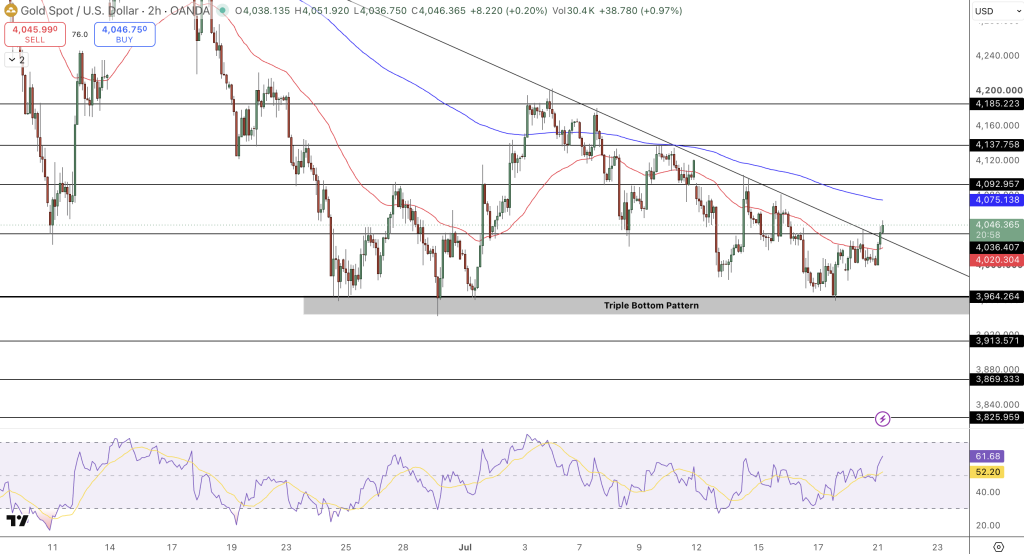
Gold has improved its short-term trend after breaking above a multi-session descending trend on 2-hour time frame, with the price action confirming the bullish control has returned since last week’s decline.
The breakout came as bulls defended the triple-bottom support around 3,964, which helped establish a higher base. The resistance at 4,056 can act as a barrier and break above it could fuel gold prices higher toward 4,093 and 4,138 where the 100-period EMA can bring some resistance.
On the downside, a break below 4,020 level, which acted as a breakout point of trendline, would bring back the focus on the key support zone at 3,964, with 3,914 exposed after that.
The RSI is above 60, suggesting that the bullish trend is improving although it has not yet turned overbought. As long as gold is trading above 4,020, gold will have a near-term positive bias toward 4,093 and 4,138.
- Check out our free forex signals
- Follow the top economic events on FX Leaders economic calendar
- Trade better, discover more Forex Trading Strategies
- Open a FREE Trading Account
- Read our latest reviews on: Avatrade, Exness, HFM and XM

Related Articles



Sidebar rates

Related Posts
 Save
Save