WTI Oil Forecast: Middle East Tensions Keep Crude Above $84 Despite OPEC+ Supply Increase
WTI crude oil held at roughly $84 per barrel to $85 on Tuesday, July 21, close to the highest price it has hit in months because...

Quick overview
- WTI crude oil prices are holding steady between $84 and $85 per barrel due to rising tensions in the Middle East and potential shipping disruptions.
- OPEC+ plans to increase production by 548,000 barrels per day in August, but supply fears and global demand continue to outweigh these increases.
- The US is experiencing lower crude oil inventories and record production levels, which are supporting prices amid peak summer demand.
- Technical indicators suggest a bullish trend for WTI crude, with potential resistance levels at $84.00 and $85.59.
WTI crude oil held at roughly $84 per barrel to $85 on Tuesday, July 21, close to the highest price it has hit in months because of rising Middle East tensions. Brent crude was also hovering close to $90 per barrel as traders kept their focus on the US-Iran fighting and potential shipping disruptions in the Strait of Hormuz as well as another week of possible inventory draws in the US.
Production increases by OPEC+ are being added, but supply fears and global demand still are outweighing them.
Middle East Conflict Drives Price Premium
US-Iran conflict remains the key driver of oil prices. While crude oil exports by Gulf states have not been severely interrupted for long, there is still potential for war to disrupt oil trade through the Strait of Hormuz, the most vital shipping route for oil. According to the US Energy Information Administration (EIA), about 20 million barrels per day of crude oil and petroleum products pass through Hormuz, or about 20% of worldwide petroleum liquids consumption. Insurance costs for tankers and higher freight rates in the area have gone up even with no supply disruptions, thus raising shipping costs and sustaining oil prices.
OPEC+ Continues Boosting Supply
OPEC+ has announced another 548,000 barrels a day production increase for August 2026 as it continues its cautious process of rolling back voluntary cuts made over a few years. According to OPEC secondary sources, Saudi Arabia is making about 9.8 million barrels a day, and Russia is pumping about 9 million barrels a day. Still, several members are producing less than the quota allotted to them due to various operational issues, thus production growth remains below the announced production quota increases.
In its latest Monthly Oil Market Report, OPEC said the world demand for oil will increase by 1.3 million barrels per day in 2026 to surpass 106 million barrels per day. China, India, Southeast Asia and the Middle East are still the main contributors to demand expansion, boosted by transportation fuels, jet fuel and petrochemical demand.
IEA Sees More Balanced Market
The International Energy Agency’s stance is more measured: although demand remains resilient, the IEA anticipates that non-OPEC production growth from the US, Brazil, Canada and Guyana will eventually exceed demand as long as geopolitical risks subside. Global stocks are still quite lean, meaning that even short-term supply interruptions may keep price volatility high even though supplies remain adequate over the medium term.
US Inventories and Production Stay in Focus
The markets are expecting fresh data on the US stockpiles from the American Petroleum Institute on Tuesday and the US Energy Information Administration on Wednesday. The EIA’s figures from last week showed:
- Crude oil inventories were down 3.9 million barrels
- Stocks of gasoline fell by 3.4 million barrels
- Inventories of distillates were up by 4.2 million barrels
Commercial crude stocks in the US are below their five-year seasonal averages, further supporting the price amid this year’s peak summer demand period. Meanwhile, the US output remains on a track to a record 13.5 million barrels per day (bpd).
The latest report from Baker Hughes showed the US rig count standing at 421 active rigs, below the figure from a year ago as shale producers continue to prioritize shareholder returns over aggressive output increases.
Asia Continues Driving Demand
China and India still represent the primary sources of global oil consumption growth. Refinery run rates have risen in China on the back of further government stimulus and a better industrial activity outlook, while India’s petroleum consumption continues to expand in tandem with economic recovery.
At the same time, international air travel activity during the Northern Hemisphere summer is holding up well, supporting jet fuel demand and offsetting weaker industrial consumption in some parts of Europe.
WTI Crude Oil: Technical Outlook Favors Further Upside
From a technical point of view, WTI is firmly bullish. USOIL is trading above its uptrend and the 50-period Exponential Moving Average (EMA) at USD80.79, confirming the ongoing buyer dominance. The overall trend remains an upwards path of higher highs and higher lows.
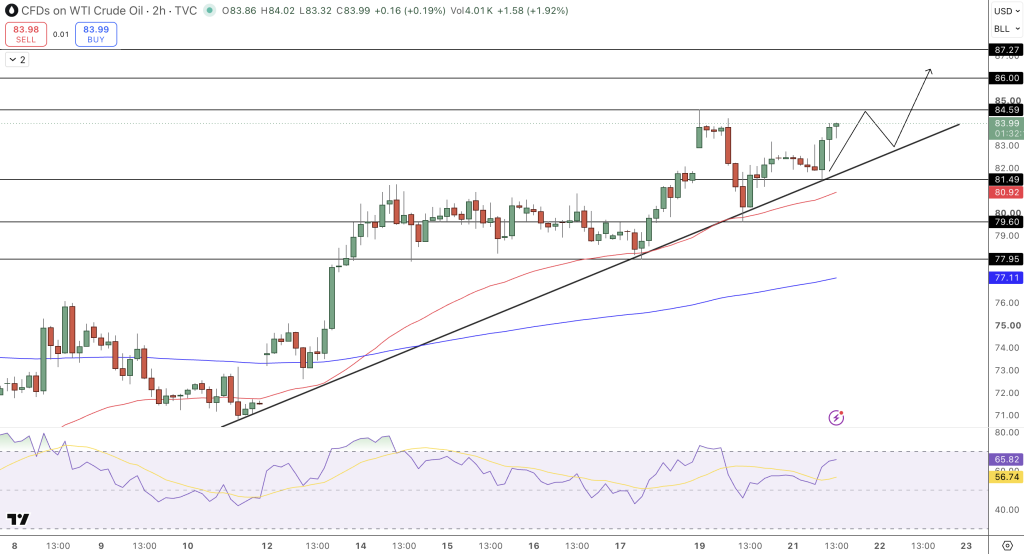
The next level of resistance would be at USD84.00 followed by USD85.59. A sustained move above these levels would pave the way for the psychological level of USD86.00. For the bears, the first level of support sits at USD81.49 with stronger support in the vicinity of the uptrend and the 50-period EMA at USD80.79.
Additionally, market momentum remains in the buyers’ camp, as the Relative Strength Index (RSI) sits at 64.3, meaning there is no sign of the market entering overbought territory just yet.
Bottom Line
Crude futures WTI is entering the second half of July with perhaps one of the best fundamental scenarios in the commodities. A surge in tensions in the Middle East, the key strategic importance of the 20 million barrels a day that is pumped through the Strait of Hormuz, and lower than usual US inventories are all supporting the prices of crude oil above USD84 per barrel.
While OPEC+ members will be boosting the rate of production by 548,000 barrels a day in August, with the US output remaining near the record level of 13.5 million barrels per day, global consumption above 106 million barrels a day and ongoing geopolitical tensions are continuing to limit the downward pressure.
From a technical view, the bullish trend is intact as long as WTI stays above USD81.49. A confirmed move above USD84.00 will allow crude oil to extend its rally towards USD85.59 and USD86.00, but this week’s API and EIA data reports and events in the Middle East will be the main drivers of oil.
- Check out our free forex signals
- Follow the top economic events on FX Leaders economic calendar
- Trade better, discover more Forex Trading Strategies
- Open a FREE Trading Account
- Read our latest reviews on: Avatrade, Exness, HFM and XM

Related Articles



Sidebar rates

Related Posts
 Save
SaveAva

