AMD Stock Tests Key $450 Support on Overspending Concerns after the 2.5-GW CoreWeave Deal
AMD stock is sliding deeper into bearish territory as investors question the sustainability of massive AI infrastructure spending, elevated semiconductor valuations, and growing Chinese competition ahead of the company's earnings report.
AMD stock is sliding deeper into bearish territory as investors question the sustainability of massive AI infrastructure spending, elevated semiconductor valuations, and growing Chinese competition ahead of the company’s earnings report.
AMD Stock Reversal Deepens as $450 Support Comes Into View
AMD shares have suffered another sharp reversal, falling back below the important $500 level as selling pressure spreads across the semiconductor sector.
The stock recently traded near record highs around $574, but sentiment has deteriorated rapidly as investors become increasingly concerned about stretched valuations, rising AI infrastructure costs, Chinese competition, and the sustainability of the massive spending cycle supporting the semiconductor industry.
The latest decline has pushed AMD toward the next major technical support zone around $450, leaving investors increasingly focused on whether buyers can defend that level.
The negative momentum comes at an uncomfortable time for AMD, with the company’s August 4 earnings report approaching. Investors are now demanding stronger evidence that the enormous investments being made in AI infrastructure will translate into sustainable revenue and profits.
2.5-Gigawatt AI Deal Fails to Calm Investors
AMD’s latest decline is particularly notable because it comes alongside a major agreement with Core Scientific, a data-center operator transitioning from cryptocurrency mining toward AI and high-performance computing.
Under the agreement, AMD will gain access to more than 500 megawatts of AI-ready data-center capacity beginning in 2027.
The arrangement could eventually expand to as much as 2.5 gigawatts, highlighting the enormous scale of the infrastructure required to support the next phase of AI computing.
Core Scientific shares rose approximately 6% in premarket trading following the announcement, but AMD investors responded far less enthusiastically.
Core Scientific will work with AMD on physical infrastructure design and the deployment of AMD chips and software. AMD will also receive market-priced warrants to purchase Core Scientific common stock, subject to specified commercial conditions.
The companies did not disclose the remaining financial terms of the agreement.
While the deal potentially strengthens AMD’s position in the expanding AI infrastructure market, it also highlights a growing concern for investors: the enormous cost of building the infrastructure required to support AI demand.
The more capital required to expand AI capacity, the more investors may question whether the eventual returns will justify the spending.
AI Infrastructure Spending Becomes a Growing Risk
The AMD-Core Scientific agreement reinforces the scale of the AI infrastructure boom, but that scale is increasingly becoming a source of concern.
Major technology companies and hyperscalers continue committing enormous amounts of capital to data centers, advanced chips, networking equipment, and energy infrastructure.
However, investors are beginning to question whether spending can continue at its current pace.
Recent earnings from major technology companies have included significant increases in capital expenditure plans, raising concerns about free cash flow and the time required to generate returns from these investments.
For AMD, this creates a complicated situation.
The company stands to benefit from stronger demand for AI accelerators and data-center hardware. At the same time, AMD’s growth expectations are increasingly dependent on customers continuing to spend aggressively.
If hyperscalers eventually slow capital expenditure or demand clearer evidence of returns, AMD could face a sharp reassessment of its growth outlook.
Intel’s Earnings Reaction Sends a Warning
The recent reaction to Intel’s earnings has provided an important warning for the entire semiconductor industry.
Intel reported its fastest revenue growth in approximately 15 years, yet investors still punished the stock as concerns over rising capital expenditure and persistent foundry losses overshadowed the strong top-line performance.
The message from the market was clear: revenue growth alone may no longer be enough.
Investors increasingly want proof that semiconductor companies can convert AI demand into sustainable earnings, cash flow, and attractive returns on investment.
AMD now faces the same scrutiny ahead of its earnings report.
Strong data-center growth and rising demand for its MI-series GPUs could support the stock, but any disappointment on margins, guidance, AI demand, or spending requirements could trigger another aggressive selloff.
Share Price Reverses Swiftly
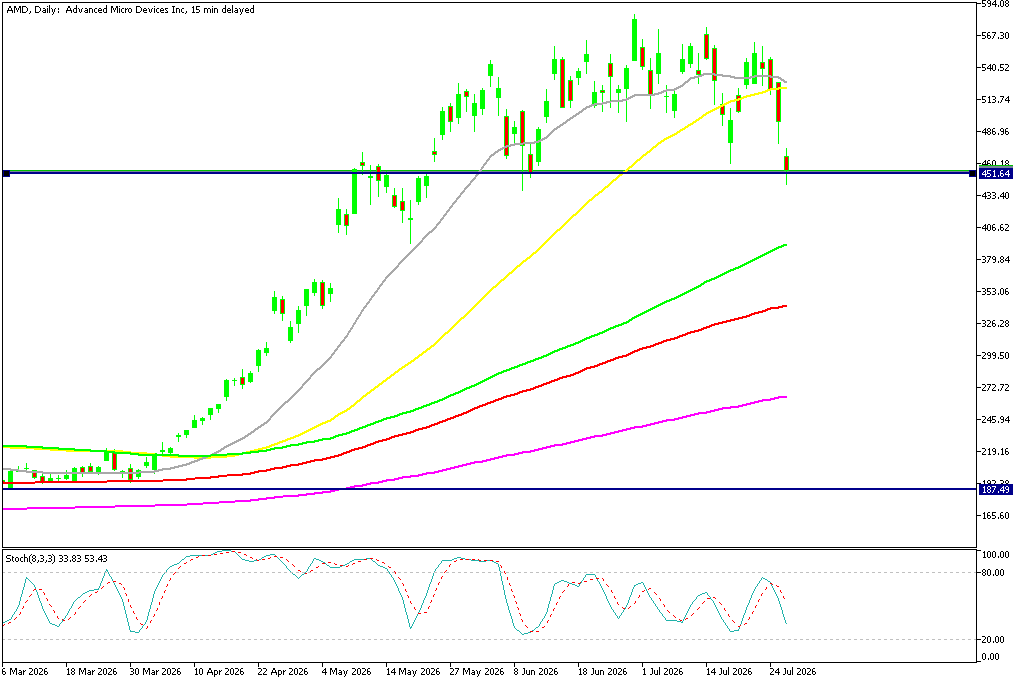
AMD shares fell sharply, sliding roughly 20% in January and pushing the stock below the $200 level. But the 100 SMA (red) acted as support on the daily chart. The price soared higher for three months, with the 20 daily SMA (gray) and reaching a high of $584 in late June before reversing lower and falling below $500 yesterday, breaking the 50 daily SMA as well, which opened the door for further declines toward $450. The stock dipped below that level today but closed just above it, so we will see if sellers will break below tomorrow or if we will see a rebound.
AMD Chart Daily – Testing the 50 SMA
Chinese Competition Adds Another Layer of Pressure
AMD is also operating in an increasingly competitive global semiconductor environment.
China continues to invest heavily in developing domestic semiconductor capabilities, with companies such as ChangXin Memory Technologies expanding production and technological capacity.
Reports that Apple is testing CXMT memory products for devices sold in China have attracted investor attention, while Nio has also reportedly invested in the company.
Although AMD is not primarily a memory manufacturer, the broader expansion of China’s semiconductor industry could eventually increase competitive pressure throughout the supply chain.
Investors are increasingly concerned that Chinese companies may develop cheaper alternatives across various semiconductor categories, potentially creating pricing pressure for established global manufacturers.
That could become a more significant issue if Chinese companies continue improving their technology while receiving strong domestic support.
Global Semiconductor Selloff Adds to AMD’s Problems
AMD’s weakness is also occurring against a deteriorating backdrop for semiconductor stocks globally.
Major Asian chipmakers, including SK Hynix and Samsung Electronics, have experienced significant selling pressure, while U.S. semiconductor stocks have also retreated sharply.
The weakness suggests that investors are not simply reacting to company-specific developments.
Instead, the market appears to be reassessing the entire AI investment cycle.
After an extraordinary rally, investors are becoming less willing to pay extreme valuations based purely on expectations of future AI growth.
The focus is shifting toward profitability, cash flow, capital efficiency, and the sustainability of demand.
Higher Component Costs Create Additional Risks
AMD could also face pressure from rising memory and component costs.
Reports that the company may increase prices for certain Radeon graphics products and graphics memory components highlight the challenges created by tighter supply and higher costs.
Higher prices could potentially protect margins, but they could also weaken consumer demand, particularly in gaming, where buyers are more sensitive to expensive hardware.
That creates another potential problem for AMD as the company attempts to balance rising costs against the need to remain competitive.
AMD Stock Faces a Critical Technical Test
AMD’s move below $500 has significantly weakened its technical setup.
The stock is now approaching the $450 support zone, which could become a crucial battleground for buyers and sellers.
A sustained break below $450 could accelerate the decline and expose the stock to deeper losses as momentum traders reduce positions and investors reassess the company’s valuation.
A strong earnings report and bullish guidance could potentially help AMD recover above $500. However, the risks are mounting.
The 2.5-gigawatt AI infrastructure deal demonstrates the scale of AMD’s opportunity, but it also exposes the enormous capital requirements behind the AI boom.
With semiconductor valuations under pressure, Chinese competition expanding, and investors increasingly questioning the returns from massive AI spending, AMD enters earnings facing a far less forgiving market.
Until the company proves that rising AI demand can translate into durable profitability and strong returns, the stock could remain vulnerable to further downside toward the $450 support zone.
- Check out our free forex signals
- Follow the top economic events on FX Leaders economic calendar
- Trade better, discover more Forex Trading Strategies
- Open a FREE Trading Account
- Read our latest reviews on: Avatrade, Exness, HFM and XM

Related Articles
Sidebar rates

Related Posts
 Save
SaveAva