Micron Stock Surges Toward $927 as AI Memory Shortage Revives the Bull Case
Micron stock MU surges toward $927 as Samsung’s memory warning, AI demand and a Moody’s upgrade revive the bullish outlook.
Micron shares rallied 18% and gained another 5% overnight as Samsung’s shortage warning countered fears of Chinese competition and excess memory supply.
Micron Stock Rebounds Toward $920
Micron Technology (NASDAQ: MU) staged a powerful rebound as investors returned to beaten-down semiconductor stocks following bullish signals from Samsung, Microsoft and Lam Research.
MU gained 18.36% to close at $874.66 before advancing another 5.07% to $919.29 overnight. The combined move lifted the stock approximately 24% from Wednesday’s $739 closing level.
The rally followed a steep correction from Micron’s previous high near $1,255. Concerns about Chinese memory capacity, weaker results from SK Hynix and whether AI infrastructure spending had peaked recently pushed MU as low as approximately $707.
Samsung’s warning that memory supply could remain tight into 2028 challenged that bearish thesis. Moody’s decision to upgrade Micron’s senior unsecured debt also strengthened confidence in the company’s cash generation, customer agreements and balance sheet.
The stock has now reclaimed several important moving averages. However, resistance between $927 and $966 will determine whether this is the beginning of a sustained trend reversal or a sharp relief rally inside a broader correction.
Samsung Strengthens the Memory-Shortage Thesis
Samsung’s latest industry commentary provided the main catalyst for Micron’s rally.
The world’s largest memory manufacturer warned that the imbalance between supply and demand could continue into 2028 as AI data centers consume increasing quantities of advanced DRAM, NAND and high-bandwidth memory.
That outlook directly challenged fears that new Chinese capacity would create a memory glut.
Investors had become concerned that ChangXin Memory Technologies, or CXMT, could pressure conventional DRAM pricing after its Shanghai market debut. Apple’s reported efforts to use Chinese memory suppliers for some non-U.S. products added to those concerns.
CXMT does not currently compete meaningfully in high-bandwidth memory, however. HBM remains the most strategically important part of the market because AI accelerators require increasingly large amounts of fast memory.
Samsung’s warning suggests that growth in AI demand may outpace new supply, even if China expands capacity in older or less advanced memory categories.
Micron and SanDisk were among the largest beneficiaries. The broader semiconductor sector also rallied after Microsoft reported accelerating Azure demand and Lam Research issued strong guidance connected to AI-related chip production.
AI Spending Supports Micron’s HBM Demand
Memory has become a central part of the AI infrastructure buildout.
Training and operating increasingly large models requires not only graphics processors but also substantial quantities of HBM, server DRAM and storage. As AI systems become more complex, memory content per server continues to increase.
Micron has started high-volume shipments of HBM4 to its largest AI customer and has provided qualification samples to another major customer. Development of HBM4E is expected to support the next generation of AI systems in 2027.
The company is also qualifying 256-gigabyte DDR5 memory modules for new AI servers.
Demand from Amazon, Microsoft, Meta, Alphabet, OpenAI and Anthropic provides a strong industry backdrop. These companies are collectively committing hundreds of billions of dollars to data centers, chips and supporting infrastructure.
The key question is whether that spending will continue long enough to support current memory prices. Samsung’s outlook suggests the supply shortage may persist, strengthening Micron’s pricing power.
Moody’s Upgrades Micron to Baa1
Moody’s Ratings upgraded Micron’s senior unsecured notes to Baa1 from Baa2 and maintained a stable outlook.
The agency cited stronger revenue visibility, strategic customer agreements and structural changes in the DRAM and NAND markets.
Micron expects half or more of its future revenue to be covered by take-or-pay commitments. Under those agreements, customers commit to purchasing specified volumes even if market conditions weaken.
The larger contracts include price ceilings near fiscal second-quarter 2026 levels and floors that remain in effect during the agreements. This structure provides customers with supply security while protecting Micron from the full impact of a traditional memory downturn.
That is a significant change for a historically cyclical company.
Memory manufacturers have typically expanded capacity when pricing was strong, eventually creating oversupply and sharp price declines. Long-term commitments may reduce that volatility by giving Micron greater visibility before approving new production.
Micron reportedly has 16 strategic customer agreements, including 14 containing commitments approaching $100 billion through 2030. Customer deposits and other commitments could provide approximately $22 billion of additional support.
Cash Position Strengthens as Debt Falls
Micron’s balance sheet has improved alongside the memory upcycle.
Cash balances reached approximately $30 billion at the end of its fiscal third quarter, while the company reduced debt by around $10 billion over the previous 12 months. Outstanding debt stood at approximately $5.7 billion.
Moody’s expects revenue to rise from approximately $129 billion in fiscal 2026 to $230 billion in fiscal 2027. It also projects free cash flow increasing from $58 billion to $114 billion.
Those are Moody’s expectations—not formal Micron guidance—and depend on memory pricing, customer commitments and AI demand remaining exceptionally strong.
Shareholder returns also face restrictions. Micron’s agreement with the U.S. Department of Commerce limits buybacks through December 2026. Between 2027 and 2029, repurchases generally cannot exceed free cash flow generated during the previous 12 months and remain subject to additional conditions.
As a result, near-term cash generation may be directed toward manufacturing investment and balance-sheet strength rather than aggressive buybacks.
Chinese Competition and Valuation Remain Risks
The rally does not eliminate Micron’s risks.
MU has gained approximately 212% in 2026, creating a much higher valuation base. Even after its correction from $1,255, the stock remains exposed to changes in AI investment expectations and memory pricing.
Chinese manufacturers are also likely to continue expanding. While they remain behind Micron, Samsung and SK Hynix in HBM, progress in conventional DRAM and NAND could pressure pricing outside the premium AI market.
Michael Burry disclosed that he increased a short position in Micron near $880. The position reflects a broader bearish view that enthusiasm surrounding AI and semiconductor demand may have moved beyond sustainable fundamentals.
Insider selling has added another caution. CEO Sanjay Mehrotra sold more than $37 million of stock under a prearranged trading plan. Such scheduled sales do not necessarily indicate a negative outlook, but they may attract attention after a substantial share-price increase.
For the bullish thesis to hold, Micron must demonstrate that HBM demand can offset cyclical weakness elsewhere in memory.
MU Technical Analysis: $927 Becomes the Breakout Test
Micron’s supplied four-hour indicators were calculated before the full overnight advance and therefore understate the latest improvement.
Before the rally extended, RSI stood at 47.58 and the Commodity Channel Index was -24.79, both neutral. MACD remained on a sell signal at -36.23, while the Awesome Oscillator was negative at -95.61.
Those readings reflected the damage caused by the decline from $1,255. The move to $919.29 has now reclaimed several important averages.
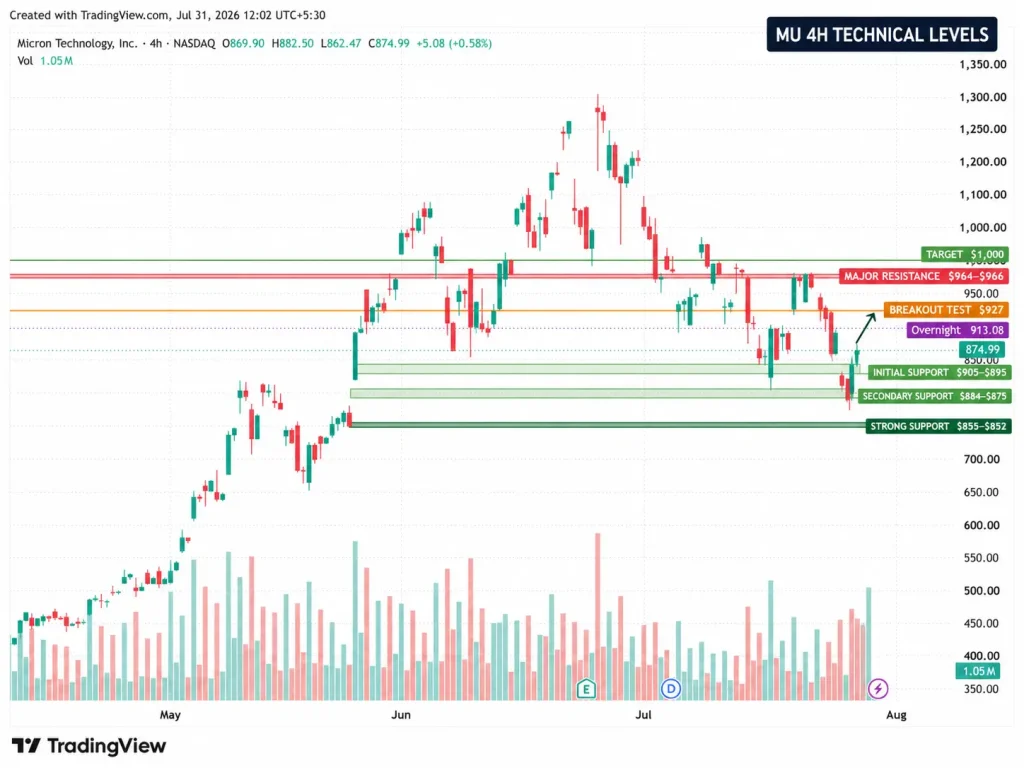
MU is above the 20-period EMA at $883.77, the 20-period SMA at $894.91 and the 30-period averages between $905.29 and $907.42. It has also moved above the 100-period EMA at $897.58.
The next test is the 50-period EMA at $926.88. A four-hour close above $927 would establish a more convincing higher high and open the way toward the 100- and 50-period simple moving averages at $964.10 and $966.48.
Above that zone, $1,000 becomes the next psychological target.
The main technical levels are:
- Immediate resistance: $927
- Major resistance: $964–$966
- Upside targets: $1,000 and $1,028
- Initial support: $905–$895
- Secondary support: $884–$875
- Stronger support: $855–$852
- Bullish trigger: Four-hour close above $927
- Bearish warning: Break back below $875
A rejection near $927 could produce profit-taking toward $905 or $895. Holding that region would preserve the emerging reversal. A return below $875 would weaken the breakout and expose the short-term averages around $852–$855.
How High Can Micron Stock Go in 2026?
Micron’s rally reflects more than a broad semiconductor rebound.
Samsung’s shortage warning supports the argument that AI demand will keep advanced memory supply tight. Moody’s upgrade and Micron’s take-or-pay agreements provide additional confidence that cash flow and pricing may become less cyclical.
The remaining test is technical and fundamental. MU must break $927 and then $964–$966 to confirm a sustained recovery. It must also prove that AI demand can offset Chinese competition and any slowdown in hyperscaler spending.
Above $927, the path toward $1,000 becomes increasingly credible. Failure at that level would leave Micron vulnerable to another consolidation after its unusually sharp two-session recovery.
- Check out our free forex signals
- Follow the top economic events on FX Leaders economic calendar
- Trade better, discover more Forex Trading Strategies
- Open a FREE Trading Account
- Read our latest reviews on: Avatrade, Exness, HFM and XM

Related Articles



Sidebar rates

Related Posts
 Save
Save