AMC Stock Eyes $3 After Credit Upgrade and Record Revenue, but Dilution Risk Remains
AMC stock targets $3 after record revenue and a credit upgrade, but heavy debt, ongoing losses and shareholder dilution remain risks.

AMC Entertainment’s improving box office, record EBITDA and stronger cash position have reduced default risk, although its recovery has come at a considerable cost to shareholders.
AMC Stock Rally Meets the $2.80 Barrier
AMC Entertainment (NYSE: AMC) is approaching a critical technical breakout after record quarterly results and an S&P Global credit-rating upgrade strengthened confidence in the cinema operator’s recovery.
AMC shares gained 0.73% to close at $2.77 before easing 0.54% to $2.74 in overnight trading. The stock remains above every major moving average on its four-hour chart, reflecting strong upward momentum.
However, the rally has also pushed several indicators into overbought territory. The Hull moving average at $2.81 represents immediate resistance, followed by the psychologically important $3 level.
The fundamental picture is equally divided. AMC generated record revenue, adjusted EBITDA and positive quarterly free cash flow. S&P responded by upgrading the company’s credit rating to B- from CCC+.
Yet B- remains a speculative, or junk, rating. AMC still carries approximately $3.8 billion in debt, has substantial rent and interest obligations and continues to report net losses. Its balance-sheet improvement has also depended heavily on issuing new shares and converting debt into equity.
AMC Entertainment Earnings: Quick Overview
- S&P upgraded AMC’s credit rating to B- from CCC+.
- Second-quarter revenue increased 14.2% to a record $1.60 billion.
- Adjusted EBITDA rose 69.6% to $321.4 million.
- Quarterly free cash flow reached $190.1 million.
- Cash and cash equivalents increased to $778.4 million.
- AMC still reported an $11.4 million net loss.
- Estimated debt remains near $3.8 billion.
- Shares outstanding reached 892.6 million after extensive equity issuance.
- The four-hour trend is bullish, but momentum indicators warn that AMC is overbought.
Credit Upgrade Reduces Default Risk
S&P Global Ratings raised AMC Entertainment’s issuer credit rating from CCC+ to B-, assigning the company a stable outlook.
The upgrade reflects improving operating performance, lower debt and a more credible path toward sustainable positive free cash flow. AMC has also extended its nearest significant debt maturities to 2029, reducing immediate refinancing pressure.
This is a meaningful improvement. A CCC+ rating signals substantial vulnerability and dependence on favorable conditions to meet financial commitments. Moving to B- suggests that default risk has declined as AMC’s box-office revenue, liquidity and operating cash generation recover.
The upgrade is not an all-clear.
Any rating below BBB- remains speculative grade. AMC is still highly exposed to disruptions in film releases, weaker consumer spending, higher borrowing costs and changes in audience behavior.
S&P estimates that AMC has approximately $3.8 billion in debt, more than $450 million in annual interest expense and roughly $850 million in yearly rent obligations. Those fixed costs limit how much of an improving box office can flow through to shareholders.
S&P expects AMC to record a modest free-cash-flow deficit for 2026 before generating approximately $75 million of positive free cash flow in 2027. The company must therefore sustain its recovery beyond one record quarter.
Record Revenue Supports the Recovery
AMC reported second-quarter revenue of $1.60 billion, up 14.2% from approximately $1.40 billion a year earlier. It was the strongest quarterly sales result in the company’s 106-year history.
Adjusted EBITDA increased 69.6% to a record $321.4 million, while quarterly free cash flow reached $190.1 million. Cash and cash equivalents rose to $778.4 million.
The improvement shows the operating leverage available in the cinema business. AMC has a high fixed-cost base, so additional ticket and concession revenue can translate into much faster EBITDA growth once attendance passes a certain threshold.
Premium formats are playing a growing role. Strong demand for IMAX and other high-end screens allows AMC to charge more per ticket while increasing concession spending. “The Odyssey,” for example, delivered the strongest two-week IMAX run on record, reinforcing the value of premium theatrical releases.
The broader domestic box office reached approximately $5.63 billion between January 1 and July 29, an increase of 9.4% from the same period in 2025. S&P now expects the 2026 domestic box office to approach $10 billion, up from its earlier $9.3 billion projection.
A stronger release schedule could keep attendance moving higher through the second half of the year. S&P projects AMC revenue growth of approximately 13% in 2026, followed by another 4% to 5% in 2027.
Why AMC Still Reported a Loss
Despite record revenue and EBITDA, AMC posted a net loss of $11.4 million. That was wider than the $4.7 million loss recorded a year earlier.
The continued loss highlights the difference between operating improvement and complete financial recovery.
Rent expense reached $223.8 million during the second quarter. Interest expense totaled $275.9 million for the first six months of 2026. Depreciation and other financing costs also consume a large portion of the cash generated by AMC’s theaters.
Adjusted EBITDA excludes interest, taxes, depreciation and amortization. It is useful for assessing theater-level performance, but it does not represent the profit available to common shareholders.
The credit upgrade could help reduce borrowing costs. Management estimates that improved credit terms may lower interest rates on nearly 75% of AMC’s debt, potentially producing approximately $51 million in annual savings if benchmark rates and leverage remain near current levels.
Those savings would be material. Lower interest payments would leave more cash for debt reduction, theater upgrades and investment in premium screens. But AMC must first refinance or reprice that debt on favorable terms.
Balance-Sheet Repair Has Diluted Shareholders
AMC’s greatest risk has shifted from immediate survival toward long-term dilution.
The company had 892.6 million Class A shares outstanding as of July 22. During the first half of 2026, AMC sold 105.3 million shares through an at-the-market program and another 95.25 million shares directly to institutional investors.
It also issued approximately 142.1 million shares through debt conversions.
These transactions strengthened liquidity, reduced debt and extended maturities. They also spread ownership across a much larger number of shares, reducing each existing shareholder’s claim on future earnings.
That creates an important distinction between AMC’s bonds and its common stock. Lower default risk clearly benefits creditors because it increases the probability that they will be repaid. The effect on shareholders is more complicated if the company achieves that improvement by repeatedly issuing equity.
AMC also raised approximately $200 million through a June equity offering while redeeming its 6.125% senior subordinated notes due in 2027. The transaction reduced near-term financial risk but added further dilution.
The bullish case depends on AMC reaching a point where operating cash flow can finance debt reduction without additional equity issuance. A weak film cycle, by contrast, could force the company back into the stock market.
AMC Technical Analysis: Bullish but Overbought
AMC’s four-hour chart remains firmly bullish.
The stock trades above every major exponential and simple moving average. The 10-period EMA stands at $2.59, followed by the 20-period EMA at $2.44 and the 50-period EMA at $2.23.
Longer-term support is also improving. The 100-period EMA is positioned at $2.05, while the 200-period EMA and SMA stand at $1.90 and $1.69, respectively.
This alignment—short-term averages above longer-term averages—confirms that buyers control the trend.
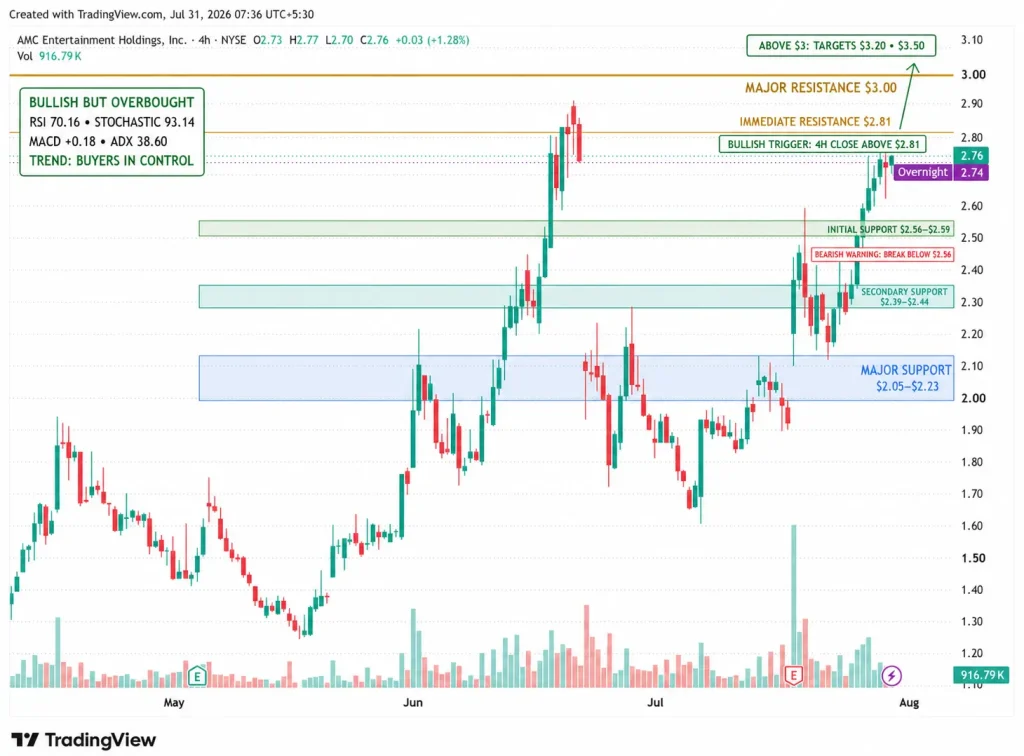
MACD remains on a buy signal at 0.18, the Awesome Oscillator is positive and Bull Bear Power stands at 0.40. The Average Directional Index at 38.60 suggests the current trend has considerable strength.
The problem is that momentum has become stretched.
RSI is at 70.16, marginally above the traditional overbought threshold. Stochastic %K has reached 93.14, Stochastic RSI is at 94.75 with a sell signal and Williams %R stands at -4.41. The Commodity Channel Index and momentum indicator also carry sell signals.
These readings do not automatically mean the rally will reverse. They indicate that chasing the stock near resistance carries increasing risk.
The main technical levels are:
- Immediate resistance: $2.81
- Major resistance: $3.00
- Upside targets above $3: $3.20 and $3.50
- Initial support: $2.59–$2.56
- Secondary support: $2.44–$2.39
- Major support: $2.23–$2.05
- Bullish trigger: Four-hour close above $2.81
- Bearish warning: Break below $2.56
A decisive close above $2.81 would clear the Hull moving average and open the path toward $3. A break through $3 on strong volume could extend the recovery toward $3.20 and $3.50.
Failure at $2.81, combined with overbought oscillators, would increase the probability of a pullback toward the 10-period averages around $2.56–$2.59.
AMC Stock Outlook
AMC’s operating recovery is real. Record revenue, record adjusted EBITDA, positive quarterly free cash flow and a higher credit rating show that the company is in a stronger position than it was a year ago.
The unresolved question is whether the recovery will create value for each common share.
Debt remains high, net losses continue and shareholders have absorbed substantial dilution to stabilize the balance sheet. AMC now needs sustained box-office strength and lower interest costs to reduce debt without issuing more stock.
Technically, the trend remains bullish above $2.56, but the stock is overbought as it approaches $2.81 and $3. A confirmed break above those levels would strengthen the recovery. Until then, the credit upgrade should be viewed as an important milestone—not proof that AMC’s financial risks have disappeared.
- Check out our free forex signals
- Follow the top economic events on FX Leaders economic calendar
- Trade better, discover more Forex Trading Strategies
- Open a FREE Trading Account
- Read our latest reviews on: Avatrade, Exness, HFM and XM

Related Articles



Sidebar rates

Related Posts
 Save
Save