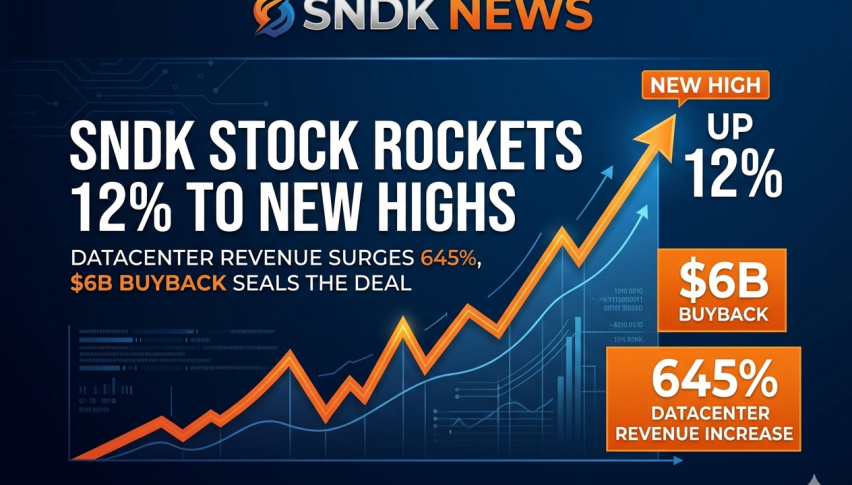
SNDK Stock Rockets 12% to New Highs: Datacenter Revenue Surges 645%, $6B Buyback Seals the Deal
SanDisk's pivot to AI infrastructure is paying off spectacularly, but RSI at 80 warns the SNDK stock 495% YTD rally may be running on fumes.
Quick overview
- SanDisk has undergone a significant business model transformation, resulting in Q3 FY2026 revenue of $5.95 billion, surpassing analyst expectations.
- The company's datacenter revenue surged 645% year-over-year, indicating strong demand for its products in the AI infrastructure market.
- SanDisk's management has initiated a $6 billion stock buyback and secured $42 billion in multi-year supply contracts, reflecting confidence in its new revenue model.
- Despite strong performance, technical indicators suggest potential risks for investors, with the stock trading above its historical norms.
SanDisk (NASDAQ: SNDK) is a different firm than it was 18 months ago. Founded by Western Digital in February 2025, the memory specialist has had one of the most dramatic business model pivots in recent semiconductor history and the Q3 FY2026 results released April 30 confirmed that the transformation is delivering real financial results at a pace that has repeatedly blindsided analysts.
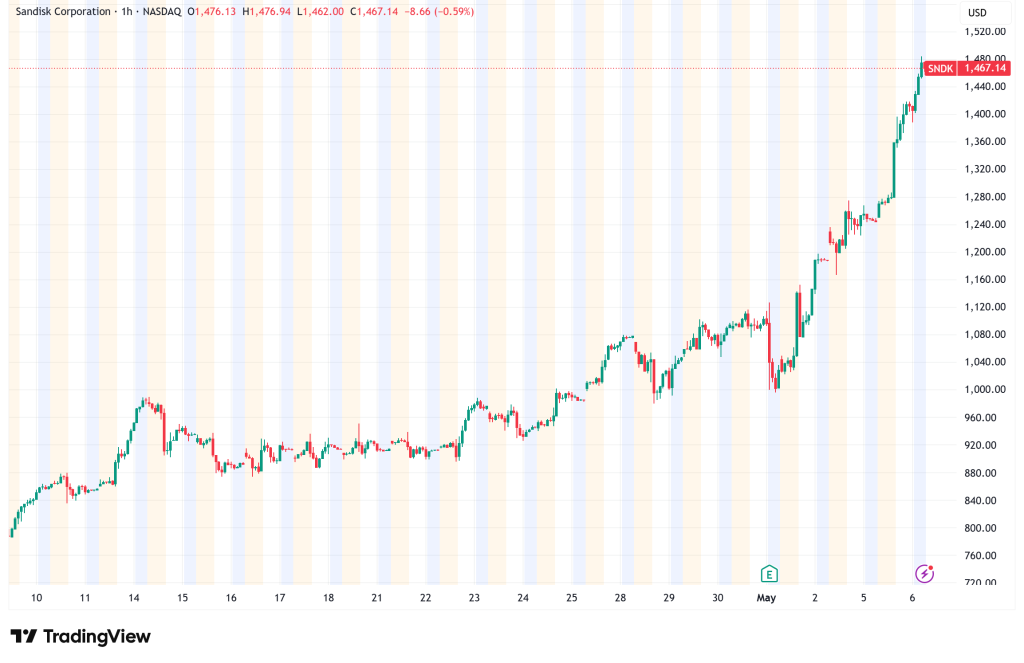
SanDisk’s Transformation Happening Faster Than Expected
The company had revenue of $5.95 billion during the quarter, compared to the average estimate of $4.72 billion. Datacenter revenue, which was barely registering a year ago, jumped 645% year-over-year to $1.47 billion. Non-GAAP EPS of $23.41 compared to a loss of $0.30 per share in the same quarter of last year. Diluted EPS for the nine months ended in FY2026 has ranged from ($14.78) to $29.42. “This quarter was a critical inflection point for us,” said CEO David Goeckeler. “We are moving to a new business model that is founded on multi-year customer engagements with clear cash commitments.
Momentum was added from a wave of analyst upgrades post results. Bernstein boosted its price target to $1,700, Citigroup to $1,300 and Barclays and Wedbush to $1,200. SanDisk’s ability to raise prices faster than the rest of the market points to real supply shortages, not just speculative demand, Wedbush analyst Matt Bryson said.
AI Inference Tailwind Supports SanDisk’s Rally
The narrative behind the numbers in terms of structure is obvious. The AI infrastructure buildout is transitioning from the GPU-heavy training phase toward the inference era, when operating deployed models at scale requires vast amounts of fast, enterprise-grade storage. SanDisk’s specialist TLC devices are quickly becoming the default choice for hyperscalers building out inference capacity for compute-intensive workloads, and next-generation BiCS8 QLC “Stargate” drives for storage-intensive applications.
This week, Samsung admitted a memory chip crunch, something SanDisk’s own figures had indicated: Supply of NAND is inherently constrained until 2026 and likely beyond, offering SanDisk price power that it has rarely experienced in its history. In response, the company has fully abandoned the unpredictable spot market approach and has entered into five multi-year supply deals with hyperscalers valued at more than $42 billion in contracted value. This is a far more sustainable revenue model and you can see that in the margin profile with non-GAAP gross margins of 78.4%.
The company’s first buyback authorization since it was spun out, the $6 billion plan, is a vote of confidence from management. It was “the next logical step,” CFO Luis Visoso said, after the company paid down $3.5 billion in spinoff-related debt in full ahead of schedule in March 2026.
SanDisk’s Q4 Guidance Sets Another Aggressive Bar
Analysts have regularly been taken off-guard by SanDisk’s forward projections. Q4 revenue projection of $7.75-$8.25 billion and non-GAAP EPS of $30-$33 compare to consensus estimates of $8.15 billion in revenue and $33 in earnings — directionally aligned but suggesting sustained outperformance on profitability. The midpoint of the EPS range indicates about 40% sequential growth from an already record quarter.
The aspiration is backed by SanDisk’s product roadmap. Its Stargate PCIe 5 QLC SSD line targets 256TB in 2026 and 512TB in 2027, with a possible one petabyte offering beyond 2028. The corporation has also committed $1 billion to Nanya Technology coupled with a multi-year DRAM supply arrangement, an indication of strategic intent to compete in the wider memory industry and not be solely a NAND player.
Risks for SNDK Investors: Momentum Dangerously Stretched?
The bull case is persuasive, but so is the technical warning. SNDK is above the daily upper Bollinger Band with RSI at 80.14. This combination traditionally leads to significant mean reversion even in structurally favorable movements. $76.70 daily average actual range suggests a single session swing might be devastating.
The memory industry is likewise infamously cyclical. Last year, SanDisk announced a $63 billion expansion of a local fab in Michigan, raising worries about its long-term independence of production capacity. And once NAND supply catches up to demand in 2027, as it traditionally does when elevated margins attract new capacity investment, the margin profile commanding today’s premium might shrink quickly.
Based on Simply Wall St’s DCF analysis, the stock is trading at roughly 60% premium to its intrinsic value of $877 per share based on its current cash flows . The P/E-based paradigm presents a different narrative with a proprietary Fair Ratio of 106x vs. current P/E of 46x, signaling undervaluation relative to SanDisk’s own growth characteristics.
Conclusion: Should You Buy SanDisk Stock?
SanDisk’s Q3 print is one of the biggest earnings beats in recent semiconductor history and the business model change from retail memory vendor to AI infrastructure supplier is definitely working. The $6 billion repurchase, $42 billion in backlog and 645% datacenter revenue growth are not hype – they are operating outcomes.
But with RSI at 80, there is real execution risk for traders chasing strength above $1,400. Key levels to watch on any downturn are the daily pivot at $1,350 and support zone at $1,304. For those who missed the first move, a retracement to that range would make for a better entry. Bernstein’s $1,700 goal gives us with a medium-term directional anchor on the upside — but it’s unlikely to be a straight line from here.
- Check out our free forex signals
- Follow the top economic events on FX Leaders economic calendar
- Trade better, discover more Forex Trading Strategies
- Open a FREE Trading Account
- Read our latest reviews on: Avatrade, Exness, HFM and XM

Related Articles

Sidebar rates

Related Posts
 Save
Save