Coinbase (COIN) Falls Below $185 as AI Restructuring, Stablecoin Push, and Crypto Volatility Divide Investors
Coinbase stock COIN falls below $185 as AI layoffs, stablecoin expansion, and crypto volatility fuel investor uncertainty. What's next?
Written by:
Arslan Butt•Monday, May 25, 2026•3 min read
•Last updated: Monday, May 25, 2026
Quick overview
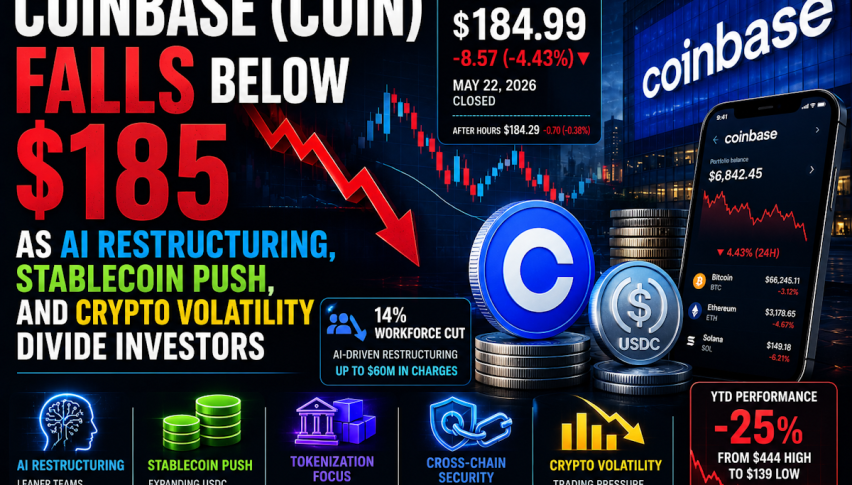
Coinbase shares fell 4.4% to $184.99 amid investor concerns over its AI-driven restructuring and expanding role in crypto infrastructure.
CEO Brian Armstrong is positioning Coinbase as a broader financial infrastructure company, focusing on tokenization and stablecoins.
The company plans to cut 14% of its workforce to adapt to rapid AI disruption and changing market conditions.
Concerns about cybersecurity and regulatory clarity continue to pose risks to Coinbase's long-term growth potential.
Shares of Coinbase fell sharply Friday, closing down 4.4% at $184.99, as investors weighed the company’s aggressive AI-driven restructuring efforts against its expanding role in tokenization, stablecoins, derivatives, and crypto infrastructure.
The decline extends Coinbase’s recent volatility following its inclusion in the S&P 500, a milestone that many expected would cement the company’s transition into mainstream finance.
Instead, the stock has remained highly sensitive to broader crypto sentiment, regulation, cybersecurity concerns, and trading activity.
Coinbase Is Trying to Become More Than a Crypto Exchange
CEO Brian Armstrong is increasingly positioning Coinbase as a broader financial infrastructure company rather than simply a retail crypto trading platform.
On May 24, Armstrong outlined eight areas where he believes the global financial system still requires modernization:
Tokenized real-world assets
24/7 global trading
Stablecoins
AI-powered financial services
Innovation-friendly regulation
Open financial access
Lower-cost capital formation
Sound money
Armstrong argued that tokenization could transform traditional markets through:
Instant settlement
Fractional ownership
Global liquidity
Reduced intermediaries
Stablecoins remain central to that vision.
He specifically highlighted AI agents using stablecoins for autonomous payments, reinforcing Coinbase’s growing focus on blockchain-based financial infrastructure.
Stablecoins and Tokenization Are Becoming Core Growth Themes
Coinbase is increasingly expanding beyond spot crypto trading into infrastructure tied to tokenization and payments.
Coinbase also adopted Chainlink’s CCIP protocol to strengthen cross-chain security following several high-profile bridge exploits.
The company is also working with Flipcash on Solana-based stablecoin infrastructure aimed at expanding USDC usage across partner ecosystems.
Management increasingly sees stablecoins and tokenized assets as long-term recurring revenue drivers that could reduce dependence on volatile spot trading volumes.
Coinbase’s AI Restructuring Signals a Strategic Reset
At the same time, Coinbase announced plans to cut roughly 14% of its workforce.
The restructuring could generate up to $60 million in charges as Coinbase reorganizes into leaner, AI-focused teams.
Management described the layoffs as part of a broader effort to simplify management layers and adapt to:
Rapid AI disruption
Weaker crypto trading activity
Rising compliance costs
Changing fintech economics
The company is increasingly pushing its “Everything Exchange” vision, which includes:
Derivatives
Prediction markets
Tokenized assets
Stablecoin settlement
Cross-chain infrastructure
The goal is to diversify revenue away from pure spot trading.
However, critics argue the strategy still depends heavily on regulatory clarity and broader crypto market strength.
Cybersecurity Risks Remain a Key Concern for COIN Stock
One major overhang remains security.
Coinbase recently disclosed a significant data breach tied to approximately 70,000 customers, while the company also continues increasing spending on cybersecurity, compliance, and infrastructure resilience.
As Coinbase expands deeper into institutional infrastructure, custody, tokenization, and cross-chain settlement, expectations around security standards are rising rapidly.
That could keep operating expenses elevated even after the latest workforce reductions.
Fundamentals: Long-Term Opportunity vs. Near-Term Volatility
The long-term bull case around Coinbase increasingly centers on financial infrastructure rather than retail crypto speculation alone.
Bulls argue Coinbase is becoming:
A stablecoin infrastructure provider
A tokenization platform
A crypto derivatives exchange
A blockchain settlement layer
A regulated gateway into digital finance
Some analysts believe those businesses could eventually support more recurring and diversified revenue streams.
Coinbase’s long-term narrative projects:
$8.5 billion revenue by 2028
$2.1 billion earnings by 2028
Expansion across derivatives and tokenized assets
Some valuation models suggest the stock could eventually justify prices above $380 if infrastructure initiatives scale successfully.
However, bears remain cautious.
Concerns include:
Dependence on crypto market cycles
Regulatory uncertainty
Cybersecurity risks
High earnings volatility
Slowing spot trading activity
Elevated valuation
The company’s P/E ratio near 70 also reflects substantial growth expectations.
Should you buy Coinbase (COIN) stock in 2026?
COIN Technical Analysis: Coinbase’s Momentum Has Weakened Sharply
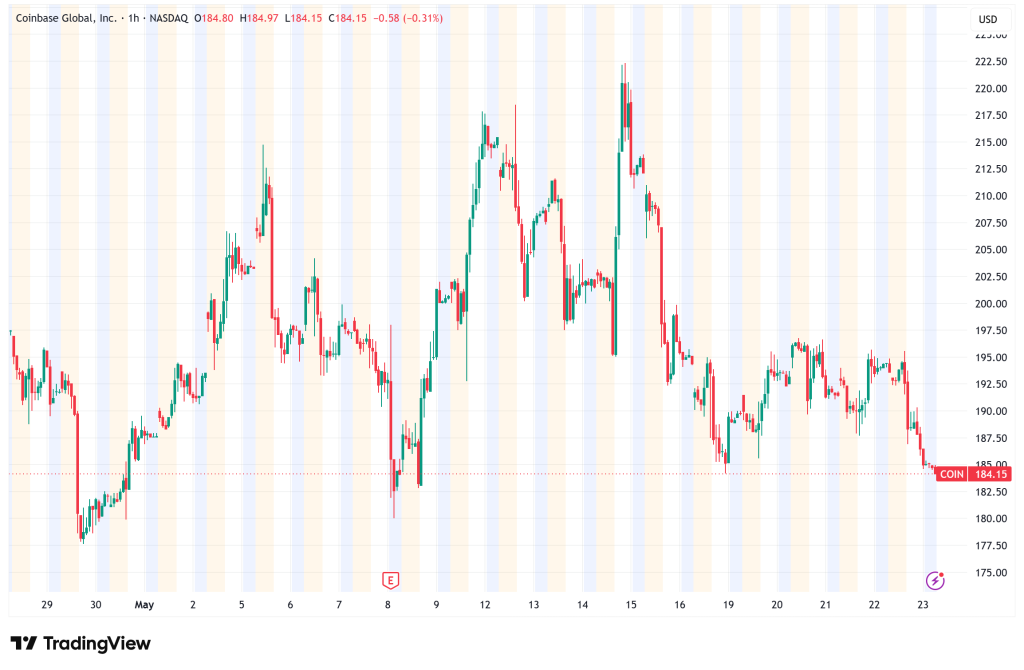
Technically, Coinbase has entered a weaker short-term structure following its sharp decline from recent highs.
Key Technical Signals
Shares fell more than 4% in one session
The stock remains highly correlated to Bitcoin and crypto sentiment
Volume increased during the recent decline
Momentum indicators have weakened
Volatility remains elevated
Coinbase is now trading below several key short-term moving averages, suggesting momentum has cooled.
RSI and MACD
RSI has weakened toward neutral-to-bearish territory
MACD momentum continues softening
Sellers currently control short-term momentum
Crypto market direction remains the key external driver
Key Support and Resistance Levels
Level Type
Approximate Area
Immediate Resistance
$200
Major Resistance
$220–$240
Near-Term Support
$175–$180
Secondary Support
$155–$160
Major Trend Support
$139–$145
A recovery above $200 would improve sentiment significantly. However, a break below $175 could trigger additional downside pressure, especially if crypto markets weaken further.
Long-Term Outlook: Coinbase Is Evolving Into Crypto Infrastructure
The core debate around Coinbase is increasingly about whether it can evolve into the financial infrastructure layer for tokenized markets.
The company already benefits from:
Strong brand recognition
Regulatory positioning in the U.S.
Institutional custody relationships
Stablecoin partnerships
Expanding infrastructure tools
Large retail user base
If tokenization, stablecoins, and blockchain-based settlement continue expanding globally, Coinbase could emerge as one of the largest regulated crypto-financial platforms in the industry.
But the risks remain unusually high.
Coinbase still operates inside one of the world’s most volatile industries, where:
trading activity swings sharply,
regulation remains uncertain,
security expectations are rising,
and earnings can change dramatically within a few quarters.
For now, Wall Street appears divided between viewing Coinbase as either:
a future financial infrastructure giant,
or a highly cyclical crypto trading business trying to reinvent itself fast enough before the next downturn arrives.
Lead Markets Analyst – Multi-Asset (FX, Commodities, Crypto)
Arslan Butt serves as the Lead Commodities and Indices Analyst, bringing a wealth of expertise to the field. With an MBA in Behavioral Finance and active progress towards a Ph.D., Arslan possesses a deep understanding of market dynamics.
His professional journey includes a significant role as a senior analyst at a leading brokerage firm, complementing his extensive experience as a market analyst and day trader. Adept in educating others, Arslan has a commendable track record as an instructor and public speaker.
His incisive analyses, particularly within the realms of cryptocurrency and forex markets, are showcased across esteemed financial publications such as ForexCrunch, InsideBitcoins, and EconomyWatch, solidifying his reputation in the financial community.




 Save
Save