CRM Drops 33% in 2026 Despite Earnings Beat as AI Fears Overshadow $1.2B Agentforce Growth
CRM Stock earnings: Salesforce beats EPS by 24%, but weak guidance and AI disruption fears keep CRM stock down 33% in 2026.
Quick overview
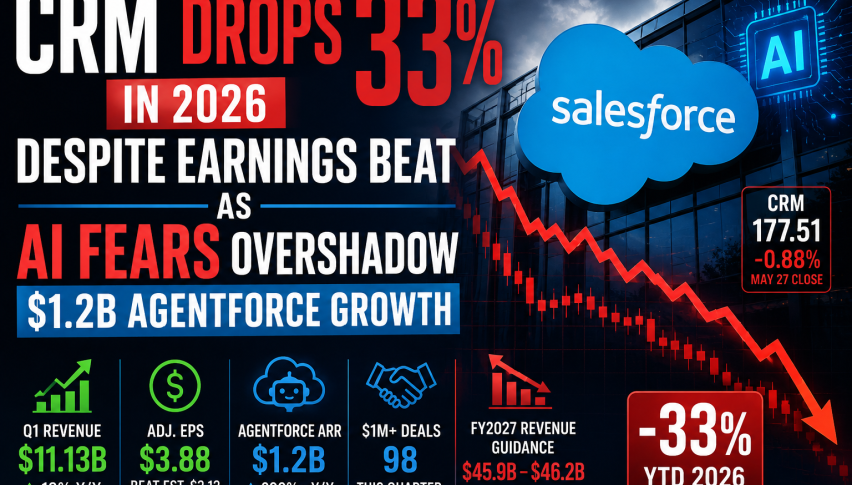
- Salesforce reported strong fiscal Q1 results with $11.13 billion in revenue and $3.88 adjusted EPS, surpassing Wall Street estimates.
- Despite impressive growth metrics, concerns over softer revenue guidance and the impact of AI disruption led to continued selling pressure on Salesforce shares.
- The company's Agentforce platform is emerging as a key growth driver, with over 200% year-over-year growth in annual recurring revenue.
- Salesforce's long-term outlook hinges on its ability to adapt to the AI era and monetize its AI initiatives effectively.
Salesforce beat Wall Street estimates by a wide margin Wednesday, but the results were not enough to stop another wave of selling across the battered SaaS sector as investors questioned whether traditional software companies can survive the AI era without major disruption.
Despite reporting $11.13 billion in revenue, $3.88 adjusted EPS, and more than 200% growth in Agentforce annual recurring revenue, Salesforce shares remained under pressure after management issued softer-than-expected guidance and warned of continued weakness in parts of its core software business.
The reaction underscores a growing reality on Wall Street in 2026: strong earnings alone are no longer enough for software stocks. Investors increasingly want proof that AI products can generate meaningful new revenue fast enough to offset slowing growth, pricing pressure, and the broader “SaaSpocalypse” fears sweeping the enterprise software industry.
Salesforce Beats Earnings Expectations Again
Salesforce reported fiscal Q1 revenue of $11.13 billion, up 13% year over year and ahead of analyst expectations of $11.05 billion.
Adjusted earnings per share came in at $3.88, crushing consensus estimates of $3.12.
Key highlights from the quarter included:
- Revenue grew 13% year over year
- Net income rose to $2.11 billion
- Subscription and support revenue increased 14%
- Salesforce closed 98 new deals worth over $1 million in annual contract value
- Agentforce annualized revenue surpassed $1.2 billion for the first time
- Slack participated in nearly half of all $1 million-plus deals
Management also raised full-year EPS guidance to between $14.06 and $14.12.
However, revenue guidance remained the primary concern.
Salesforce projected Q2 revenue between $11.27 billion and $11.35 billion, slightly below Wall Street expectations of $11.36 billion. Full-year revenue guidance also narrowly missed analyst forecasts.
AI Disruption Fears Continue Pressuring SaaS Stocks
The latest quarter arrives amid growing fears that generative AI platforms could fundamentally disrupt traditional software business models.
Wall Street has increasingly referred to the sector-wide selloff as a “SaaSpocalypse,” driven by concerns that AI agents and advanced coding tools from companies like OpenAI and Anthropic may reduce dependence on legacy SaaS applications.
Salesforce shares have already fallen roughly 33% in 2026 following a more than 20% decline in 2025.
The core concern is straightforward:
- AI agents may automate workflows previously handled through SaaS interfaces
- AI-native software could reduce demand for per-seat software licenses
- Enterprise customers may consolidate software stacks
- AI coding tools threaten traditional enterprise development platforms
That pressure is now forcing major software companies to rapidly reposition themselves as AI infrastructure providers rather than traditional application vendors.
Agentforce Is Becoming Salesforce’s AI Growth Engine
Salesforce is aggressively responding through Agentforce, its autonomous AI agent platform designed to automate sales, service, marketing, and workflow tasks.
The business is still relatively small, but growth metrics were impressive.
Agentforce and AI Metrics
- Agentforce ARR reached $1.2 billion, up more than 200% year over year
- Salesforce delivered 3.8 billion agentic work units during the quarter
- Slack MCP surpassed 1 million active users within six weeks
- Salesforce processed 28.6 trillion AI tokens during the quarter
- Data 360 ingested 52 trillion records
CEO Marc Benioff continues framing Salesforce as a central operating system for enterprise AI workflows.
Benioff said Slack could eventually host more AI agents than human users.
The company also highlighted productivity gains from internal AI deployment:
- Slackbot generated 3.8 million annualized productivity hours
- Engineering headcount remained flat for two years
- AI coding tools helped double feature output year over year
These metrics suggest Salesforce is increasingly embedding AI deeply into both customer-facing products and internal operations.
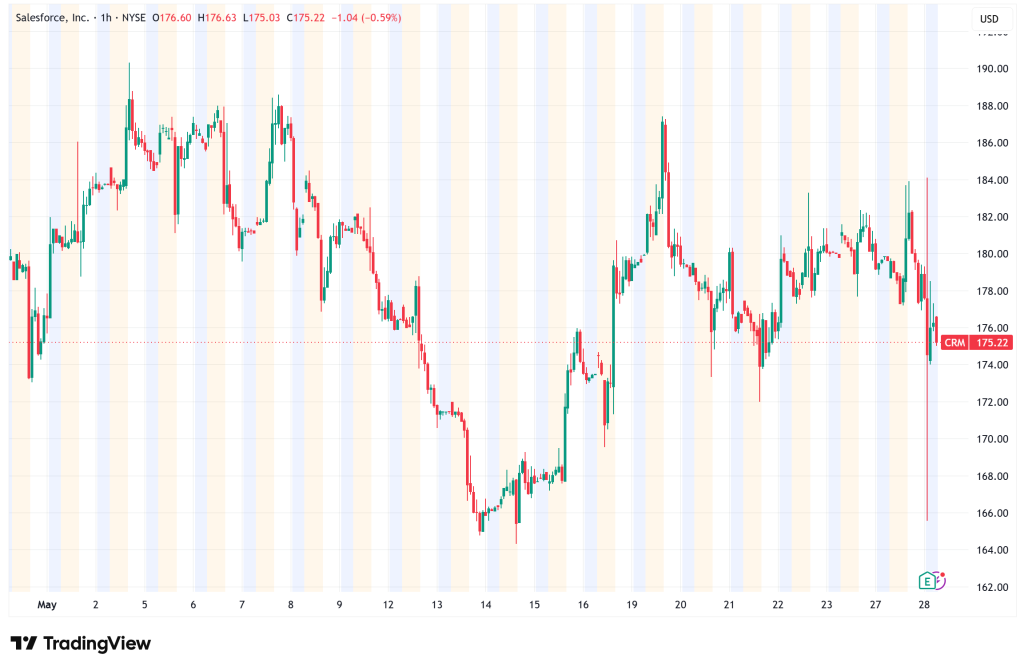
Technical Analysis: CRM Remains in a Long-Term Downtrend
Technically, Salesforce remains under pressure despite stabilizing after months of heavy selling.
The stock has significantly underperformed the broader market in 2026 as investors rotated away from traditional SaaS names toward AI infrastructure leaders.
Key Technical Signals
- CRM remains down roughly 33% year to date
- Shares continue trading below prior major highs
- Momentum remains weak relative to mega-cap tech peers
- Volume spikes suggest elevated institutional repositioning
- AI uncertainty continues weighing on sentiment
The earnings report helped prevent a sharper breakdown, but the chart still lacks a decisive bullish reversal signal.
Moving Averages
- Stock is hovering near short-term moving averages
- 50-day moving average remains under pressure
- 200-day moving average continues trending lower
- Long-term trend structure remains bearish-to-neutral
A sustained recovery would likely require stronger AI monetization evidence and improved top-line acceleration.
Key Support and Resistance Levels for CRM Stock
| Level Type | Approximate Area |
|---|---|
| Immediate Resistance | $190–$195 |
| Major Resistance | $215–$220 |
| Near-Term Support | $170–$175 |
| Secondary Support | $155 |
| Major Long-Term Support | $140 |
If CRM fails to hold the $170 area, sellers could retest deeper support zones. A breakout above $195 would improve the near-term technical picture.
Informatica Acquisition Adds Another Layer to Salesforce’s AI Strategy
Salesforce also continues expanding through acquisitions.
Its recent $9.6 billion acquisition of Informatica contributed roughly $444 million in quarterly revenue and strengthens Salesforce’s enterprise data infrastructure positioning.
Management believes combining Informatica’s data management capabilities with Agentforce and Data 360 creates a more comprehensive enterprise AI ecosystem.
The strategy increasingly mirrors a broader industry trend:
- AI models require governed enterprise data
- Data integration is becoming mission-critical
- Enterprise AI workflows depend on orchestration layers
- SaaS vendors are evolving into AI data platforms
Long-Term Outlook: Salesforce Is Fighting to Redefine Itself for the AI Era
Salesforce now faces one of the most important transitions in its history.
The company still generates enormous cash flow, dominates CRM software globally, and maintains deep enterprise relationships. Slack, Data Cloud, and Agentforce also provide significant long-term optionality.
But investors increasingly view traditional SaaS companies through a new lens.
The central question is no longer whether Salesforce can grow. It is whether Salesforce can evolve fast enough to remain essential in an AI-native enterprise software market.
Several factors will likely determine CRM’s next major move:
- Adoption pace of Agentforce
- Monetization of AI workloads
- Stability of subscription revenue growth
- Integration success with Informatica
- Competitive pressure from AI-native software vendors
For now, Salesforce remains profitable, cash-rich, and strategically important. But Wall Street appears unwilling to fully reward the company until AI-driven growth becomes large enough to offset slowing momentum in its legacy software business.
- Check out our free forex signals
- Follow the top economic events on FX Leaders economic calendar
- Trade better, discover more Forex Trading Strategies
- Open a FREE Trading Account
- Read our latest reviews on: Avatrade, Exness, HFM and XM

Related Articles
Sidebar rates

Related Posts
 Save
SaveAva

