Oracle ORCL Stock Drops to $180 as AI Overspending and Cloud Miss Shake Confidence
Oracle's earnings beat failed to reassure investors as a cloud revenue miss and soaring AI infrastructure spending reignited fears that aggressive investment may be outpacing future returns.

Quick overview
- Oracle's earnings beat expectations, reporting $2.11 per share on $19.18 billion in revenue, but investors were unsettled by a cloud revenue miss and rising AI infrastructure costs.
- The company's capital expenditures surged to approximately $16.5 billion for the quarter, raising concerns about whether future AI demand can justify such high spending.
- Despite a strong backlog of $638 billion in remaining performance obligations, investor sentiment remained cautious due to execution risks and significant capital commitments.
- A new U.S. government contract for a cloud-based HR platform failed to alleviate market concerns, as fears of an AI spending bubble continue to loom.
Oracle’s earnings beat failed to reassure investors as a cloud revenue miss and soaring AI infrastructure spending reignited fears that aggressive investment may be outpacing future returns.
Oracle Selloff Accelerates Despite Strong Headline Results
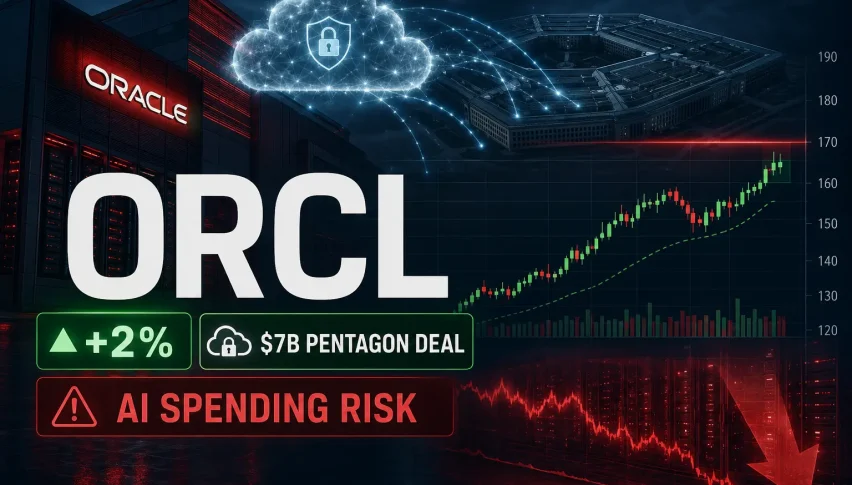
Oracle shares extended their sharp decline following the company’s fiscal fourth-quarter earnings release, with the stock falling below $175 after investors looked beyond better-than-expected earnings and focused on mounting AI infrastructure costs and slowing cloud momentum. Although Oracle delivered solid revenue and profit growth, concerns that capital spending is rising faster than sustainable returns triggered heavy selling and renewed debate over whether the AI investment boom is becoming excessive.
ORCL Chart Weekly – Testing the Support

Earnings Beat Overshadowed by Cloud Disappointment
Oracle reported quarterly earnings of $2.11 per share on $19.18 billion in revenue, comfortably exceeding Wall Street expectations of $1.97 per share and $19.09 billion in revenue. The company also posted strong year-over-year growth compared with earnings of $1.70 per share on $15.9 billion in revenue a year earlier.
However, investors largely ignored the earnings beat after Oracle’s total cloud revenue reached $9.91 billion, narrowly missing analyst expectations of $9.99 billion. While Cloud Infrastructure revenue climbed 93% year over year to $5.8 billion, slightly ahead of forecasts, the modest outperformance failed to offset concerns that growth may be slowing just as spending accelerates dramatically.
Massive AI Spending Raises Overspending Fears
The biggest concern centered on Oracle’s rapidly expanding investment in AI infrastructure.
Capital expenditures reached approximately $16.5 billion during the quarter, pushing annual spending to $55.7 billion, above the company’s earlier guidance of $50 billion. Management expects net capital expenditures to increase to roughly $70 billion during fiscal 2027, while total spending could ultimately reach $90 billion to $95 billion once prepayments for critical components are included.
To finance this expansion, Oracle raised $43 billion through debt financing and $5 billion in equity during the past fiscal year. The company also plans to raise an additional $40 billion through debt and equity in fiscal 2027, including $20 billion via its previously announced at-the-market share sale program.
The sheer scale of these funding requirements has raised fresh questions about whether future AI demand will generate sufficient returns to justify such unprecedented investment.
Strong Backlog Offers Limited Reassurance
Oracle attempted to reassure investors by highlighting strong future demand.
Remaining performance obligations climbed to $638 billion, comfortably above analyst expectations of $589.5 billion, reflecting robust long-term customer commitments tied largely to major AI infrastructure contracts. Many of those agreements include customer prepayments for expensive servers, reducing Oracle’s need to finance future data center construction entirely on its own.
Co-CEO Clay Magouyrk also noted that Oracle has already completed 42% of capacity at its flagship AI data center in Abilene, Texas, with another 35% expected to come online over the next three months.
Despite those positive indicators, investors remained focused on near-term execution risks and the enormous capital commitments still required.
Government Contract Fails to Shift Market Focus
Oracle also secured a significant U.S. government contract to provide a cloud-based human resources platform for federal agencies, replacing multiple legacy HR systems as part of a broader modernization initiative. The agreement represents another important enterprise customer win and further strengthens Oracle’s position within the public sector.
Nevertheless, the announcement had little impact on investor sentiment. Markets remained preoccupied with rising AI infrastructure costs, growing financing needs, and uncertainty over whether cloud providers can generate enough long-term profitability to support today’s aggressive spending. As concerns about an AI spending bubble continue to build across the technology sector, Oracle’s latest results have reinforced investor caution rather than restoring confidence.
- Check out our free forex signals
- Follow the top economic events on FX Leaders economic calendar
- Trade better, discover more Forex Trading Strategies
- Open a FREE Trading Account
- Read our latest reviews on: Avatrade, Exness, HFM and XM

Related Articles
Sidebar rates

Related Posts
 Save
Save