MSFT Stock Breaks Key $380 Support as Investors Question Cost of the AI Race for Microsoft
Microsoft shares remain under heavy pressure as investors grow increasingly concerned that soaring AI infrastructure costs, intensifying competition, and a restrictive interest-rate environment could weigh on future profitability despite strong demand for the company's products and services.
Quick overview
- Microsoft shares are under pressure due to concerns over rising AI infrastructure costs and increased competition, despite strong demand for its products.
- The company's aggressive investment in AI infrastructure has raised alarms about capital intensity and profitability, leading to a shift in investor sentiment.
- Recent changes to Microsoft's AI pricing strategy highlight the challenges of monetizing AI, as costs continue to rise while investors question the speed of returns.
- Legal and regulatory challenges, along with intensified competition, add further uncertainty to Microsoft's future profitability and market position.
Microsoft shares remain under heavy pressure as investors grow increasingly concerned that soaring AI infrastructure costs, intensifying competition, and a restrictive interest-rate environment could weigh on future profitability despite strong demand for the company’s products and services.
Microsoft’s Downtrend Continues to Deepen
Microsoft’s stock has remained trapped in a persistent decline throughout June, with multiple recovery attempts failing to gain momentum. Shares have slipped below the $370 level as investors continue reducing exposure to high-growth technology names amid growing concerns over valuation, rising capital expenditures, and the uncertain economics of artificial intelligence.
The recent weakness marks a notable shift in market sentiment. For much of the past two years, Microsoft’s leadership in cloud computing and artificial intelligence was viewed as one of the strongest investment themes in the technology sector. Today, however, investors are increasingly focused on the enormous costs required to maintain that leadership and whether future returns will justify the escalating spending.
As a result, Microsoft’s impressive operating performance has taken a back seat to concerns surrounding profitability and capital efficiency.
Massive AI Infrastructure Spending Raises Alarm
A major source of investor concern is Microsoft’s aggressive expansion of its AI infrastructure footprint.
The company recently strengthened its long-term capacity plans through a major power agreement tied to a massive data center development in West Texas. The project is expected to provide approximately two gigawatts of additional power capacity and represents one of the largest infrastructure expansions in Microsoft’s history.
Management plans to invest several billion dollars into the campus over the coming years, with development expected to stretch across most of the decade. While the initiative underscores Microsoft’s commitment to maintaining leadership in cloud computing and artificial intelligence, it has also intensified concerns regarding capital intensity.
Investors increasingly view Microsoft as a company transitioning from a software-focused business toward a hybrid infrastructure provider requiring enormous levels of ongoing investment. That shift has prompted growing debate over whether the company can maintain its historically attractive margins while funding such large-scale projects.
AI Pricing Changes Highlight Economic Challenges
Microsoft’s recent adjustments to its AI pricing strategy have further highlighted the challenges associated with monetizing artificial intelligence.
The company announced that its Copilot platform will move toward a usage-based pricing model designed to align customer charges more closely with actual computing consumption. While the change is intended to improve long-term economics, it also serves as a reminder that operating advanced AI systems remains extraordinarily expensive.
The costs associated with training and deploying large language models continue to rise as Microsoft expands investments in specialized processors, data centers, networking infrastructure, and next-generation AI software.
Although management remains confident that demand will continue growing, investors are increasingly questioning how quickly these investments can generate meaningful returns. Concerns are also emerging that monetization may lag behind spending, creating pressure on profitability over the medium term.
Legal and Regulatory Risks Add Further Uncertainty
Microsoft is also facing a range of legal and regulatory challenges that continue to weigh on investor sentiment.
Attention remains focused on an ongoing shareholder lawsuit alleging that the company overstated adoption rates and commercial success for certain Copilot offerings while downplaying capacity limitations within its Azure cloud infrastructure.
While the outcome remains uncertain, the continued legal scrutiny has reinforced concerns about execution risks during one of the most important strategic transitions in Microsoft’s history.
At the same time, regulators continue examining Microsoft’s cloud practices, software bundling strategies, and expanding AI ecosystem. These investigations add another layer of uncertainty as governments around the world increase oversight of major technology companies.
MSFT Stock Weakness – Breaks Key Support
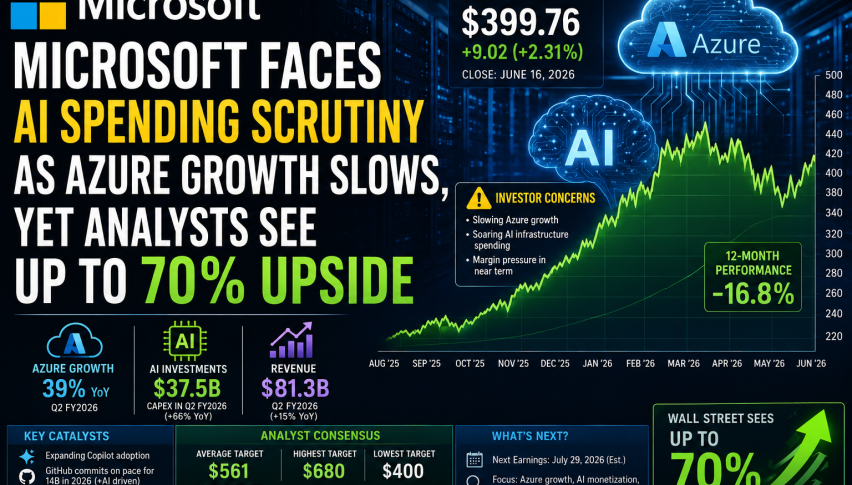
Microsoft shares slipped below the critical $400 level but rebounded strongly last month, climb above $465. This area represents both psychological and technical resistance where a number of moving averages stand, making it an important line in the sand. Buyers failed to break above 50 SMA on the weekly chart and we’ve seen 4 weekly pullbacks, with MSFT down to $367 again and breaking below the 100 weekly SMA.
MSFT Chart Weekly – The 100 SMA Is Giving Up as Support

Microsoft’s stock has undergone a notable repricing in recent months, signaling a broader reset in how investors are assessing mega-cap technology leaders. After peaking above $555 in October, shares retreated sharply, shedding around $200.
However the 50 monthly SMA (yellow) held as support once again and we saw a strong rebound in April and May. But, buyers gave up and sellers returned and MSFT stock has slipped below the 50 SMA which opens the door for further declines.
MSFT Chart Monthly – The Rebounding Off the 50 SMA Ran into the 20 SMA

Strong AI Adoption Fails to Excite Markets
Ironically, Microsoft’s recent share price weakness comes despite significant progress in AI adoption.
One of the company’s largest enterprise AI deployments was recently announced through NHS England, which plans to implement Microsoft 365 Copilot across hundreds of thousands of healthcare workers. The project represents one of the most ambitious workplace AI rollouts globally and highlights growing demand for Microsoft’s productivity-focused AI tools.
However, investors largely overlooked the announcement. Rather than focusing on customer adoption, markets concentrated on whether contracts of this scale can generate sufficient profits to justify the enormous infrastructure investments required to support them.
This reaction underscores the market’s changing priorities. Growth alone is no longer enough; investors increasingly want proof that AI adoption can translate into meaningful earnings expansion.
Competition and OpenAI Concerns Pressure Sentiment
Microsoft’s competitive position is also facing renewed scrutiny.
The company’s partnership with OpenAI has long been viewed as one of its most valuable strategic assets. However, reports suggesting OpenAI may increasingly collaborate with multiple cloud providers have prompted investors to reassess the long-term exclusivity and competitive advantages of the relationship.
Meanwhile, rivals across cloud computing, enterprise software, and artificial intelligence continue accelerating investments, intensifying competition in nearly every major business segment.
With competitors spending aggressively and new AI platforms emerging rapidly, investors are becoming less certain that Microsoft can maintain its current leadership position without continually increasing investment levels.
Investors Demand Profits, Not Just Growth
The biggest challenge facing Microsoft today is not demand but expectations. Investors have already priced in years of AI-driven growth and assume the company will remain at the forefront of the industry’s transformation.
However, as infrastructure spending surges, regulatory scrutiny increases, and competition intensifies, markets are becoming less willing to overlook rising costs. The focus has shifted from technological leadership to profitability discipline.
Until Microsoft can demonstrate that its massive AI investments will generate returns sufficient to offset their growing cost, the stock may continue facing pressure as investors question whether the rewards of the AI boom will ultimately justify the extraordinary capital required to pursue it.
Microsoft Q3 2026 Earnings Highlights
Revenue beats expectations:
- Microsoft Corporation reported $82.9 billion in revenue, up 18% year-over-year, marking a record quarter and surpassing forecasts.
Profitability strengthens:
- Operating income rose 20% to $38.4 billion, while net income increased 23% to $31.8 billion, reflecting strong margin performance.
Earnings growth remains robust:
- Diluted earnings per share came in at $4.27, up 23% on a GAAP basis, signaling consistent bottom-line expansion.
Cloud Segment Drives Growth
Cloud revenue surges:
- Microsoft Cloud generated $54.5 billion, up 29% year-over-year, remaining the key growth engine.
Azure leads momentum:
- Azure and other cloud services grew 40%, highlighting strong enterprise demand for cloud infrastructure and advanced computing services.
- Check out our free forex signals
- Follow the top economic events on FX Leaders economic calendar
- Trade better, discover more Forex Trading Strategies
- Open a FREE Trading Account
- Read our latest reviews on: Avatrade, Exness, HFM and XM

Related Articles

Sidebar rates

Related Posts
 Save
Save