Rising South Africa Taxes and Living Costs Put Pressure on Different-Income Households
While South Africa's highest earners contribute a substantial share of tax revenue, rising indirect taxes and private service costs are increasing concerns about the long-term sustainability of the country's narrow tax base.
Quick overview
- High earners in South Africa contribute over 60% of personal income tax, highlighting the reliance on a small tax base.
- Rising indirect taxes and private service costs are significantly eroding disposable income for households, particularly those earning above R1 million annually.
- The financial burden extends beyond income tax, with additional expenses for private education, healthcare, and security services acting as an extra layer of taxation.
- Concerns are growing about the sustainability of the tax system as high-income earners face increasing pressures from both direct and indirect costs.
While South Africa’s highest earners contribute a substantial share of tax revenue, rising indirect taxes and private service costs are increasing concerns about the long-term sustainability of the country’s narrow tax base.
High Earners Continue to Shoulder Most of the Tax Burden
South Africans earning more than R1 million annually are facing growing financial pressure as taxes, municipal charges, and private service expenses consume an increasingly large portion of their income.
According to Finance Minister Enoch Godongwana, South Africa’s personal income tax system remains highly progressive, with the country’s highest earners contributing a disproportionate share of government revenue. Recent budget data shows that the top 13% of taxpayers account for more than 60% of personal income tax collections, while nearly half of all personal income tax is paid by the top 8% of taxpayers earning above R1 million per year.
These figures underscore the extent to which government finances rely on a relatively small group of taxpayers.
The Real Cost Extends Beyond PAYE
Although many employees focus primarily on Pay-As-You-Earn deductions from their salaries, economists argue that the overall financial burden extends far beyond income tax.
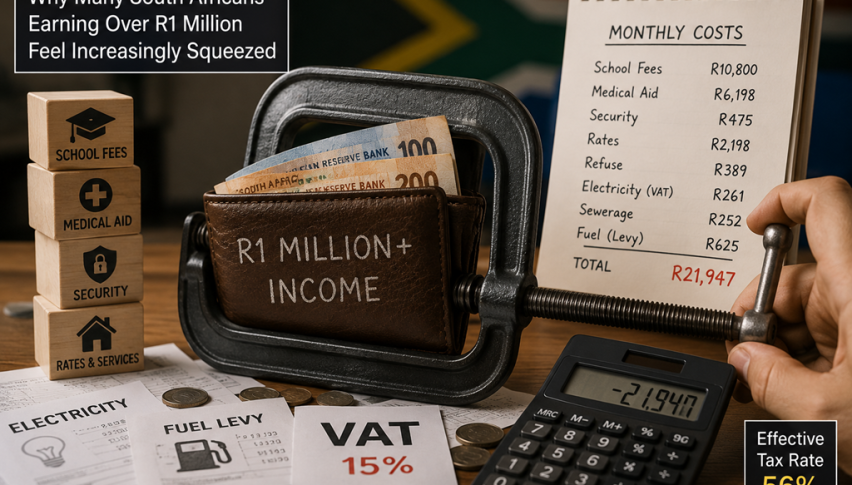
Households routinely face additional expenses through value-added tax, fuel levies, municipal charges, and privately funded services. As a result, many individuals believe their effective financial burden is significantly higher than their official income tax rate suggests.
Economist Dawie Roodt has argued that expenses such as private education, medical aid, and security services effectively function as an additional layer of taxation because citizens often pay for services that would traditionally be expected from the public sector.
This has become particularly relevant for middle- and upper-income households seeking access to reliable healthcare, education, and security.
Private Services Continue to Erode Disposable Income
The cost of privately funding essential services has risen steadily over time.
A reputable private day school can cost approximately R130,000 annually, while comprehensive medical aid coverage may exceed R6,000 per month. Private security services, property rates, refuse collection, electricity-related taxes, and sewerage charges add further pressure to household budgets.
For many families, these expenses have become unavoidable rather than discretionary, making them a permanent feature of monthly financial planning.
Housing costs also remain significant. Municipal rates, utility charges, and service fees continue to increase, reducing the amount of disposable income available after tax obligations have been met.
Indirect Taxes Add Up Quickly
Beyond direct taxation, indirect taxes continue to play a major role in household finances.
Value-added tax applies to a broad range of everyday goods and services, including restaurant meals, clothing, household items, electricity, and various professional services. Fuel levies further increase transportation costs, affecting both consumers and businesses.
While individual payments may appear relatively modest, the cumulative effect over a year can be substantial. For higher-income households with larger spending patterns, indirect taxes often represent a significant additional financial burden.
These costs contribute to a growing perception that disposable income is shrinking despite nominal salary growth.
| Item | Amount (per month) |
|---|---|
| Gross salary | R83,333.00 |
| PAYE | R24,024.42 |
| UIF | R177.12 |
| SDL | R833.33 |
| Total after payroll taxes | R58,298.46 |
| VAT (R5,000 groceries) | R750.00 |
| Fuel taxes (R2,000 petrol) | R625.00 |
| School Fees | R10,800.00 |
| Medical aid | R6,198.00 |
| Medical aid tax credits | -R376.00 |
| Property rates | R2,197.50 |
| Refuse removal | R388.74 |
| Sanitation | R251.66 |
| Electricity tariffs (VAT on R1,000 prepaid) | R260.87 |
| Private security response | R475 |
| Total remaining (effective tax) | R36,727.69 (56%) |
Concerns Grow Over South Africa’s Narrow Tax Base
The concentration of tax revenue among a relatively small number of high-income earners continues to attract attention from economists and policymakers.
Supporters of the current system argue that progressive taxation remains essential for funding public services and social programs. However, critics warn that excessive reliance on a limited group of taxpayers could create risks if skilled professionals and entrepreneurs choose to relocate or reduce investment activity.
Roodt has argued that high-income households play a crucial role in supporting public services through their tax contributions and that maintaining a competitive environment for taxpayers remains important for long-term economic stability.
Balancing Revenue Needs and Economic Growth
South Africa faces the difficult challenge of balancing revenue collection with economic competitiveness.
While the current tax structure generates significant funding for government programs, growing concerns about tax burdens, rising living costs, and the increasing need for privately funded services have sparked debate about sustainability.
As policymakers search for ways to broaden the tax base and stimulate economic growth, the discussion is likely to focus not only on tax rates but also on improving public service delivery and strengthening investor confidence. For many high-income South Africans, the issue is no longer simply how much tax they pay, but how much of their income ultimately remains available after accounting for the full range of mandatory and indirect costs.
- Check out our free forex signals
- Follow the top economic events on FX Leaders economic calendar
- Trade better, discover more Forex Trading Strategies
- Open a FREE Trading Account
- Read our latest reviews on: Avatrade, Exness, HFM and XM

Related Articles

Sidebar rates

Related Posts
 Save
Save