Intel Stock INTC Faces Resistance on Rebound Toward $100 as MSFT Azure Lifts Chips
Intel shares staged a sharp rebound after Microsoft's strong Azure cloud results reignited confidence in semiconductor spending, but the company's costly turnaround strategy, weak foundry demand, and ongoing losses continue to cloud the long-term outlook.
Intel shares staged a sharp rebound after Microsoft’s strong Azure cloud results reignited confidence in semiconductor spending, but the company’s costly turnaround strategy, weak foundry demand, and ongoing losses continue to cloud the long-term outlook.
Intel Stock Rebounds Above $90 After Brief Drop Below $80
Intel stock experienced another volatile trading session as investors continued to assess the company’s latest quarterly results. After falling below $80 for the first time since April, shares have rebounded more than 13%, climbing back above $90 and briefly trading above $94.
The recovery came after Microsoft’s stronger-than-expected quarterly earnings eased concerns that heavy investment in cloud computing infrastructure was failing to deliver meaningful returns. Microsoft’s robust Azure growth restored confidence across the semiconductor industry, lifting chipmakers that had been under pressure in recent weeks.
Despite the rally, Intel continues to face important technical resistance, while investors remain divided over whether the latest bounce represents a lasting recovery or simply relief buying after a sharp selloff.
Microsoft Earnings Revive Semiconductor Sentiment
The broader semiconductor sector rallied strongly following Microsoft’s earnings release.
Azure’s better-than-expected cloud growth reassured investors that enterprise demand for advanced computing infrastructure remains healthy, supporting expectations for continued spending on processors, memory, and data center hardware.
The improved sentiment sparked a broad-based recovery across semiconductor stocks, with the iShares Semiconductor ETF (SOXX) gaining more than 8%.
The rally helped reverse some of the recent weakness that had been driven by concerns over elevated valuations, slowing returns on AI infrastructure investments, and increasing competition within the global chip industry.
While the rebound has improved short-term sentiment, investors continue to differentiate between companies benefiting immediately from higher spending and those still facing lengthy restructuring efforts.
Strong Revenue Growth Still Overshadowed by Heavy Losses
Intel’s second-quarter results highlighted both encouraging progress and significant challenges.
Revenue increased 25% year over year to $16.1 billion, representing the company’s strongest sales growth in approximately 15 years. Management also guided third-quarter revenue between $15.8 billion and $16.8 billion, with reported earnings per share expected at $0.31 and adjusted EPS at $0.38.
However, stronger revenue was not enough to offset investor concerns over profitability.
Intel reported a loss attributable to shareholders of $2.16 per share, although adjusted earnings remained positive at $0.42 per share. Net losses improved to roughly $11 billion, compared with $12.9 billion a year earlier, but the magnitude of those losses continues to weigh on investor confidence.
The latest results reinforce the view that revenue growth alone will not be sufficient. Investors want evidence that Intel can generate sustainable profits, improve free cash flow, and deliver stronger returns on its massive investment program.
Intel Stock Outlook Remains Uncertain
Intel’s latest results show clear operational improvement, particularly in revenue growth and manufacturing progress. However, the company still faces major obstacles, including large financial losses, limited external foundry adoption, heavy investment requirements, and rising global competition.
The return below $80 reflects a market that remains unconvinced that Intel’s recovery has reached a sustainable turning point. Until the company demonstrates stronger profitability and proves its foundry strategy can attract significant outside customers, investor confidence may remain under pressure.
INTC Chart Daily – Buyers Face the $100 Level As Resistance Now?
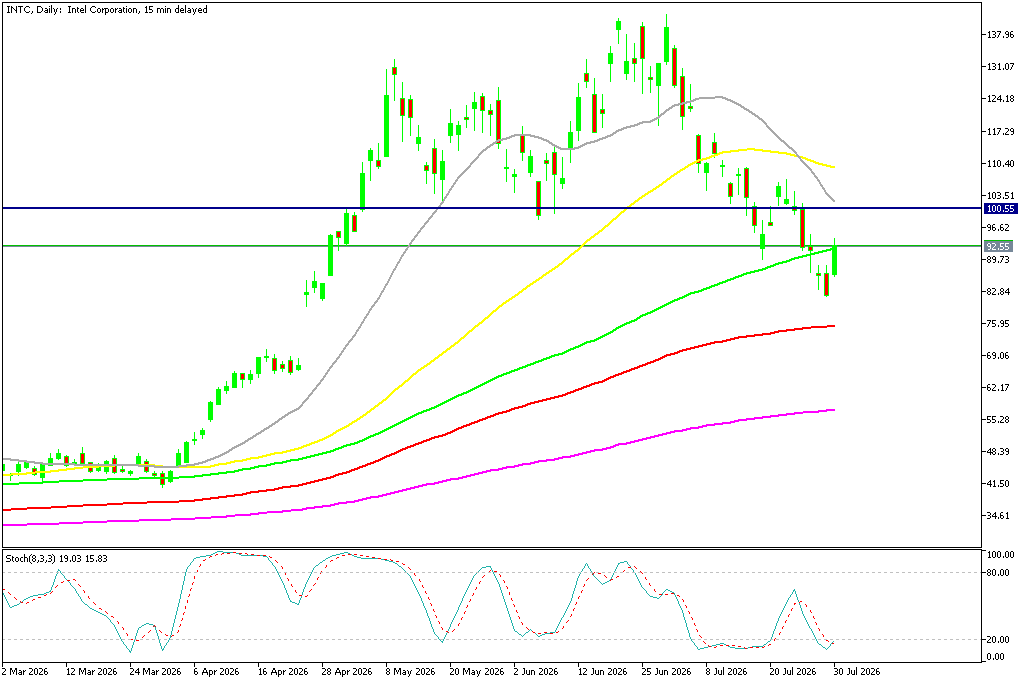
INTC stock has been bearish throughout July, dipping below 80 last night, but the quick reversal higher today indicates that investors are increasingly willing to accumulate shares at perceived value levels. While sustained upside momentum will require further confirmation, the structure has improved meaningfully, despite the recent pullback. The decline broke below the 100 daily SMA in green as well, but is back above it today.
Foundry Business Still Faces Major Questions
Intel Foundry remains the centerpiece of the company’s long-term strategy, but commercial progress continues to lag expectations.
Foundry revenue increased 31% to approximately $5.8 billion, while production of the advanced 18A manufacturing process improved significantly during the quarter. Management also reported continued progress in manufacturing yields.
However, outside customer demand remains limited.
External foundry revenue totaled only about $293 million, representing roughly 5% of total Foundry sales. The division also posted an operating loss of approximately $2.1 billion, highlighting the financial burden of Intel’s manufacturing expansion.
Investors remain cautious because Intel still needs to prove it can attract major third-party customers capable of filling its expanding manufacturing capacity. Until that happens, the foundry business will likely remain a significant source of uncertainty.
Competition and Capital Spending Continue to Pressure Outlook
Intel’s recovery is becoming increasingly complex as global competition intensifies.
China continues investing aggressively in domestic semiconductor manufacturing, reducing dependence on foreign technology while strengthening its own supply chain. Over time, this could increase pricing pressure and make Intel’s competitive recovery more challenging.
At the same time, Intel continues investing heavily in future production capacity. Its recently announced €5 billion expansion of the Leixlip manufacturing campus in Ireland demonstrates management’s commitment to rebuilding manufacturing leadership.
While these investments could strengthen Intel’s long-term position, they also require substantial capital and flawless execution. Investors remain concerned that elevated spending could continue weighing on cash flow until meaningful external demand and stronger profitability emerge.
Q2 2026 Financial Results
|
|
GAAP |
Non-GAAP |
||||||||||
|
|
Q2 2026 |
Q2 2025 |
vs. Q2 2025 |
Q2 2026 |
Q2 2025 |
vs. Q2 2025 |
||||||
|
Revenue ($B) |
$16.1 |
|
$12.9 |
|
up 25% |
|
|
|
|
|
|
|
|
Gross margin |
40.4% |
|
27.5% |
|
up 12.9 ppts |
|
41.8% |
|
29.7% |
|
up 12.1 ppts |
|
|
R&D and MG&A ($B) |
$4.5 |
|
$4.8 |
|
down 6% |
|
$4.0 |
|
$4.3 |
|
down 8% |
|
|
Operating margin (loss) |
11.1% |
|
(24.7)% |
|
up 35.8 ppts |
|
17.2% |
|
(3.9)% |
|
up 21.1 ppts |
|
|
Tax rate |
(0.3)% |
|
(9.2)% |
|
up 8.9 ppts |
|
11.0% |
|
12.0% |
|
down 1 ppt |
|
|
Net income (loss) attributable to Intel ($B) |
$(11.0) |
|
$(2.9) |
|
n/m* |
|
$2.2 |
|
$(0.4) |
|
n/m* |
|
|
Earnings (loss) per share attributable to Intel—diluted |
$(2.16) |
|
$(0.67) |
|
n/m* |
|
$0.42 |
|
$(0.10) |
|
n/m* |
|
Outlook Intel’s sharp rebound shows how quickly market sentiment can improve when broader technology demand strengthens. Microsoft’s Azure results have restored confidence that cloud infrastructure spending remains healthy, providing short-term support for semiconductor shares.
Nevertheless, Intel’s longer-term recovery story remains far from complete. Persistent losses, limited external foundry adoption, rising competition from China, and significant capital requirements continue to present meaningful challenges. Unless the company can convert stronger revenue growth into consistent profitability while expanding its foundry customer base, the recent rally may face increasing resistance despite the improving industry backdrop.
- Check out our free forex signals
- Follow the top economic events on FX Leaders economic calendar
- Trade better, discover more Forex Trading Strategies
- Open a FREE Trading Account
- Read our latest reviews on: Avatrade, Exness, HFM and XM

Related Articles
Sidebar rates

Related Posts
 Save
SaveAva