Nvidia Stock Rebounds Toward $200 as Cathie Wood Buys the Dip, but OpenAI Risk Looms
Nvidia stock NVDA rebounds toward $200 as Cathie Wood buys the dip, but a possible $250 billion OpenAI guarantee raises financing risks.
Nvidia shares recovered as ARK Invest accumulated the stock and strong cloud spending restored AI optimism, although the chart remains bearish below $200–$207.
Nvidia Stock Rebounds After the AI Selloff
Nvidia (NASDAQ: NVDA) is attempting to recover from its latest technology-sector selloff as Cathie Wood’s ARK Invest uses the weakness to increase its exposure to the dominant AI chipmaker.
NVDA gained 2.65% to $195.04 before rising another 1.27% to $197.51 in premarket trading. That puts the stock directly against its first technical resistance near $197.50 and within reach of the psychologically important $200 level.
The rebound followed strong cloud results from Microsoft and Amazon, which reinforced expectations that hyperscalers will continue spending heavily on artificial-intelligence infrastructure.
ARK’s purchases and Morningstar’s new $280 fair-value estimate added support to the bullish case. However, reported discussions that could leave Nvidia guaranteeing as much as $250 billion of financing connected to an OpenAI data-center project have created a new risk.
Investors are questioning whether Nvidia may be moving from selling AI chips to financially supporting the customers buying them.
Cathie Wood Buys Nvidia During the Pullback
ARK Invest purchased approximately 78,965 Nvidia shares across several exchange-traded funds on July 28, according to trade disclosures cited by multiple reports. The position was valued near $15.5 million at the time.
Some reports calculated a slightly smaller purchase based on different trade aggregation and pricing assumptions, but the message was consistent: ARK used Nvidia’s decline to expand its position.
The purchases were spread across funds focused on innovation, autonomous technology, next-generation internet, fintech and disruptive growth.
ARK also reduced some of its AMD exposure, suggesting a tactical rotation toward Nvidia rather than a broad increase in semiconductor holdings.
The move reflects Cathie Wood’s established strategy of buying high-conviction technology stocks during periods of market stress. Nvidia had fallen approximately 17% from its May high as investors questioned the sustainability of AI infrastructure spending and the financing supporting it.
ARK’s purchase formed part of a broader buying program that also included Tesla and SpaceX. Combined purchases across the three companies exceeded $40 million.
Nvidia is not currently among the ten largest positions in ARK’s flagship Innovation ETF, so the trade represents rising conviction rather than an oversized portfolio bet.
Hyperscaler Spending Supports NVDA’s Bull Case
Recent technology earnings helped stabilize sentiment toward Nvidia.
Microsoft reported Azure growth of 43%, while Amazon said AWS revenue increased nearly 37%. Both companies indicated that demand for AI infrastructure remains strong.
Amazon also raised its expected 2026 capital expenditure to approximately $220 billion. Microsoft expects to continue committing substantial resources to cloud capacity, servers and AI accelerators.
Although investors have become increasingly selective about rewarding higher spending, the overall level of hyperscaler investment remains favorable for Nvidia.
The company’s GPUs continue to dominate large-scale AI training and inference. Nvidia’s CUDA software ecosystem, networking products and integrated systems create switching costs that competing chipmakers have struggled to overcome.
Morningstar cited this competitive advantage when assigning Nvidia a $280 fair-value estimate. From a price near $197, that valuation implies potential upside of more than 40%.
Morningstar also expects Nvidia to deliver exceptionally strong revenue growth as cloud providers continue expanding AI capacity. However, it assigns the stock a “very high” uncertainty rating because spending, competition and customer concentration can produce significant volatility.
The $250 Billion OpenAI Question
The largest new concern involves Nvidia’s reported negotiations surrounding OpenAI’s planned data-center campus in Ohio.
Nvidia is reportedly considering guaranteeing up to $250 billion of lease and construction financing connected to the proposed 10-gigawatt facility. Separate discussions could involve additional financing for the chips installed inside the project.
The negotiations have not been finalized, and there is no certainty Nvidia will accept the reported terms.
A guarantee is not the same as an immediate investment or loan. Nvidia would only become responsible for the covered obligations if OpenAI failed to meet its payments.
Nevertheless, the scale is unusual.
OpenAI remains unprofitable and cannot independently access investment-grade financing on comparable terms. Nvidia’s balance sheet could allow lenders to finance the project against Nvidia’s credit quality instead.
That arrangement would accelerate construction and support future chip sales. It would also link Nvidia’s financial exposure more closely to its customer’s ability to generate cash.
This is the circular-financing concern unsettling investors. If Nvidia guarantees the infrastructure financing and helps fund the chips purchased for that infrastructure, a portion of future demand could be supported by Nvidia itself.
Vendor financing is common in capital-intensive industries. The risk comes from size and concentration. If OpenAI’s revenue fails to meet its commitments, Nvidia could lose anticipated sales while assuming liabilities connected to the same project.
Customer Concentration Adds Risk
Nvidia reportedly generated 54% of its revenue from three hyperscale customers in its latest quarter.
This concentration has been highly profitable while Microsoft, Amazon, Meta and other technology companies are expanding AI capacity. It would become more problematic if one or more large customers slowed capital expenditure or shifted more workloads to internally designed chips.
Amazon has Trainium and Graviton, Google uses its tensor processing units, Microsoft has developed custom accelerators and Meta is investing in proprietary silicon.
These products are unlikely to replace Nvidia across every workload in the near term. However, they could limit Nvidia’s pricing power and reduce its share of future inference spending.
Nvidia also reported substantial unrealized investment gains in its latest results. Investors increasingly want to distinguish profit generated by semiconductor operations from gains linked to its expanding portfolio of AI companies.
The company’s next earnings report, scheduled for August 26, will provide an important update on data-center demand, Blackwell shipments, margins and customer concentration.
Nvidia Valuation Looks Cheaper After the Decline
Nvidia’s recent correction has reduced its valuation despite continued AI demand.
One cited estimate places its forward price-to-earnings multiple below 18 times, near its lowest level in years. That creates an unusual setup for a company still expected to produce rapid data-center growth.
The valuation may appear compelling if hyperscaler spending remains strong and Nvidia preserves its market leadership.
But the lower multiple also reflects rising uncertainty. Investors are assigning less value to future earnings because of circular-financing concerns, custom-chip competition and doubts about the returns generated by the broader AI buildout.
The stock’s recovery therefore depends on more than revenue growth. Nvidia must show that customer demand is commercially sustainable without assuming excessive financial exposure to support it.
NVDA Technical Analysis: $200–$203 Blocks the Recovery
Nvidia’s four-hour technical structure remains bearish despite the premarket rebound.
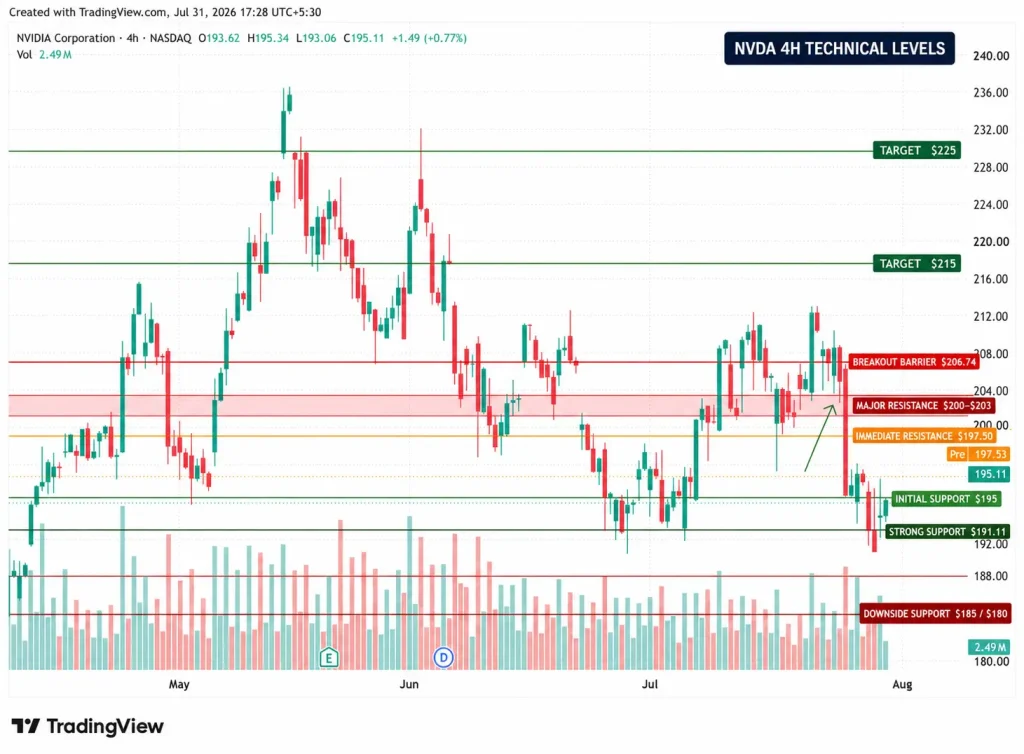
At $197.51, NVDA is testing its 10-period simple moving average at $197.50 and has moved slightly above the 10-period EMA at $197.11. This is the first resistance zone.
Above it, a dense group of moving averages creates stronger resistance between $200 and $203. The 20-period EMA stands at $200.27, the 200-period SMA at $200.29 and the 200-period EMA at $200.82.
The 30- and 50-period averages are positioned between $201.57 and $204.56. The 100-period SMA at $206.74 represents the final major barrier.
Oscillators suggest the stock is trying to rebound from weak momentum. Stochastic %K is at 12.05 with a buy signal, while Stochastic RSI stands at 16.59 and also signals buy. Momentum carries a buy reading despite remaining negative.
However, RSI is only 41.34, MACD remains on sell at -3.17 and the Awesome Oscillator is negative at -9.60. Bull Bear Power at -8.35 confirms that sellers have not fully lost control.
The main technical levels are:
- Immediate resistance: $197.50
- Major resistance: $200–$203
- Breakout barrier: $206.74
- Upside targets: $215 and $225
- Initial support: $195
- Stronger support: $191.11
- Major downside support: $185 and $180
- Bullish trigger: Four-hour close above $203
- Bearish trigger: Break below $191
A move above $203 would clear most of the immediate moving-average resistance and strengthen the case for $206.74, followed by $215.
Failure near $200 could send the stock back toward the Hull moving average at $191.11. A break below $191 would place $185 and $180 back in focus.
What to Expect From Nvidia Stock in the Near Term
Nvidia’s rebound is supported by renewed semiconductor demand, continued hyperscaler spending and institutional dip-buying.
Cathie Wood sees the correction as an opportunity, while Morningstar believes Nvidia’s competitive position supports a $280 valuation.
The unresolved issue is whether the reported OpenAI guarantee would create too much concentrated financial risk. Nvidia’s AI leadership remains clear, but investors may resist any arrangement that makes the company responsible for financing the demand driving its own revenue.
Technically, NVDA remains in recovery mode rather than a confirmed uptrend. A close above $203 would improve the setup, while $206.74 is the level bulls must clear to regain control. Until then, the rebound remains vulnerable to another rejection near $200.
- Check out our free forex signals
- Follow the top economic events on FX Leaders economic calendar
- Trade better, discover more Forex Trading Strategies
- Open a FREE Trading Account
- Read our latest reviews on: Avatrade, Exness, HFM and XM

Related Articles

Sidebar rates

Related Posts
 Save
Save