MU Stock Surges 15% to $746 as AI Memory Supercycle Accelerates and HBM Supply Stays Sold Out
Micron surged 15% to $746 as AI demand drives record memory sales and HBM supply sells out, but valuation at 47% above fair value is a worry

Quick overview
- Micron Technology has experienced a significant re-rating, with a 15% stock jump reflecting the growing importance of memory in AI infrastructure.
- The company reported a record revenue of $23.9 billion for Q2 FY2026, driven by strong demand for DRAM, NAND, and High Bandwidth Memory.
- Supply constraints are creating a structural tailwind for Micron, as long-term contracts with customers provide revenue certainty and mitigate demand volatility.
- Despite its current valuation appearing attractive compared to peers, analysts caution that Micron's stock may be overvalued based on intrinsic cash flow analysis.
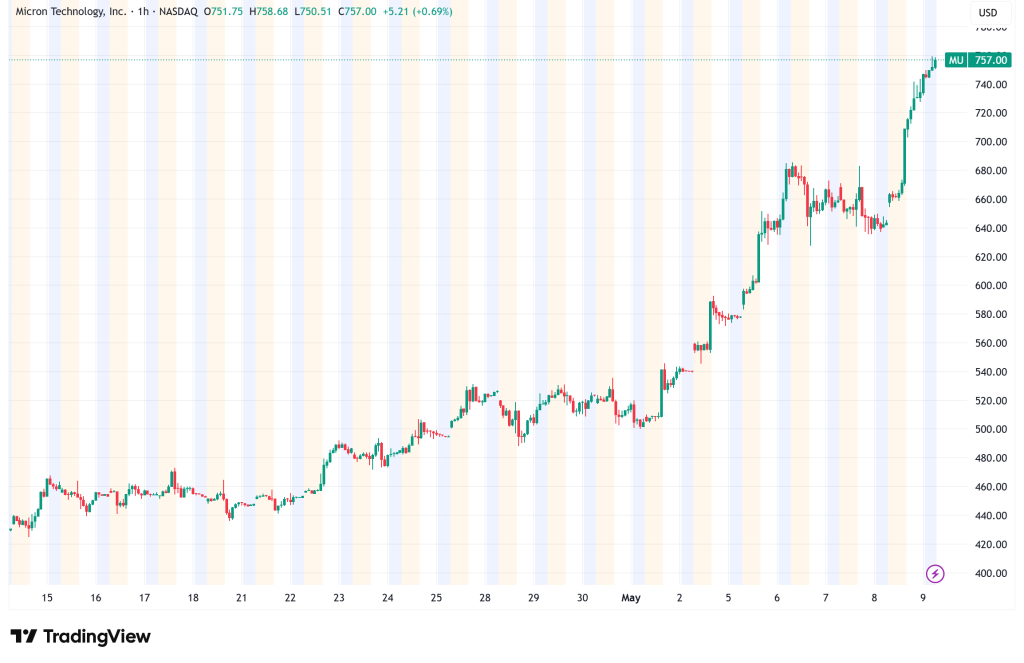
Micron Technology (NASDAQ: MU) has been considered as a cyclical commodities producer for most of its history – inexpensive in good times, painful in downturns. We are watching the frame come apart before our eyes. The 15%-plus jump on May 8, which sent shares to $746.79 and market worth above $850 billion, is a bona fide re-rating of memory’s vital importance to AI infrastructure.
Is Memory the New AI Infrastructure Trade?
The driver is simple: AI inference workloads—the phase where deployed models reply to user queries at scale—need faster access to greater datasets than previous computing paradigms. That’s direct demand for DRAM, NAND and most importantly, High Bandwidth Memory, the specific chip architecture that goes inside Nvidia’s GPUs and AMD’s AI accelerators. “Memory is a strategic asset,” said CEO Sanjay Mehrotra, who has been clear that AI needs “more memory and faster performance memory with each generation.
The evidence backs up the phrase. Micron $MU posted revenue of $23.9 billion for Q2 FY2026, up 196% year-over-year and the company’s fourth straight quarterly revenue record. All three of HBM, DRAM and NAND saw peak sales at the same time, an unusual occurrence that speaks to broad-based demand rather than one product cycle.
Supply Constraints Are the Structural Tailwind
What distinguishes today’s memory environment from past booms is the supply side. Mehrotra has termed supply as “very tight.” Evidence of structural limitation is accumulating. Micron’s entire output of HBM4 for 2026 has already been sold out via binding contracts ahead of the year. Customers, especially hyperscalers wrestling with memory cost pressures, which Meta, Microsoft and Amazon have each publicly highlighted, are increasingly signing three-to-five year supply deals instead of quarterly contracts.
This change in behavior is important. Long-duration contracts moderate demand volatility, give revenue certainty and isolate Micron from spot market pricing swings that have typically hammered memory margins during downturns. This is a structural maturing of the memory business model and if it holds, it significantly transforms the investment thesis.
The other two global HBM suppliers, Samsung and SK Hynix, are both effectively tapped out through their own long-term agreements. It takes 18-24 months to bring new capacity online thus the supply-demand imbalance is unlikely to be corrected fast even if all three players boost investment.
The 245TB SSD Launch Adds a New Growth Vector
On the memory demand side, Micron also recently started shipping its 245TB Micron 6600 ION SSD – a high-capacity enterprise drive for AI and hyperscale data center workloads. At this scale, the drive targets the “warm data” storage layer that AI inference systems rely on for quick access to enormous model weights and datasets. It allows Micron to command top dollar in the enterprise SSD market, and also plays to its HBM and DRAM development trajectory.
What Does the Bear Case for Micron (MU) Stock Look Like?
The stress in the Micron thesis isn’t demand, it’s valuation. The stock trades at $746.79, or around 34.9x forward earnings, which seems cheap versus the peer average of 76.1x, and offers real value on a relative multiple basis. Simply Wall St’s DCF analysis, however, suggests the stock is trading at a 47% premium to its true value, based on its cash flows with the intrinsic value at around $507.88.
Analysts say that with a forward P/E of around 11x based on near-term earnings expectations, Micron remains one of the cheapest ways to play the AI infrastructure theme. The resolution will hinge entirely on whether demand for HBM remains at current levels or whether competitors, especially Chinese NAND suppliers, eventually put enough capacity online to squeeze pricing.
MU Stock Technical Picture: Extended But Momentum-Driven
Technically, the 15% single-session spike and subsequent 5% after-hours extension put MU in obvious overbought short-term territory. Following this rise RSI is probably above 75 and the stock is trading comfortably above its 20, 50 and 200 day moving averages in all timeframes.
Previous resistance zone around $650-$680 has now turned into medium-term support. $700 is the first major technical floor to watch on a decline, $650 is the deeper support level where longer-term buyers would likely step in. On the upside, the $800 psychological level is the immediate goal with analyst price targets suggesting potential toward $850–$900 if the AI memory supercycle sustains.
A stock split is becoming increasingly plausible – Micron has split 3 times in the past and the present $746 price is approaching levels where retail accessibility is a factor. A 10-for-1 split would bring shares to around $75, in line with previous post-split price levels.
Is It a Good Time to Buy Micron Stock?
The 15% jump in Micron is not just speculative momentum, but a real and reasonable re-rating of memory’s importance in AI infrastructure. Sold out HBM supplies, record sales, long-duration customer contracts and a new 245TB enterprise SSD portray a picture of a corporation in a fundamentally favorable situation.
The risk is obvious: memory cycles eventually shift, and a 700% one-year return prices in a lot of confidence. For traders, the $700-$720 zone is the near-term support to target on any retreat entry, with $800 as the immediate upside objective. Longer-term investors should monitor the 11x near-term P/E versus DCF over-valuation signal and size positions accordingly.
- Check out our free forex signals
- Follow the top economic events on FX Leaders economic calendar
- Trade better, discover more Forex Trading Strategies
- Open a FREE Trading Account
- Read our latest reviews on: Avatrade, Exness, HFM and XM

Related Articles



Sidebar rates

Related Posts
 Save
Save