The $99 Billion CRWV Bet: Why CoreWeave Is the Most Contracted Stock in AI Infrastructure
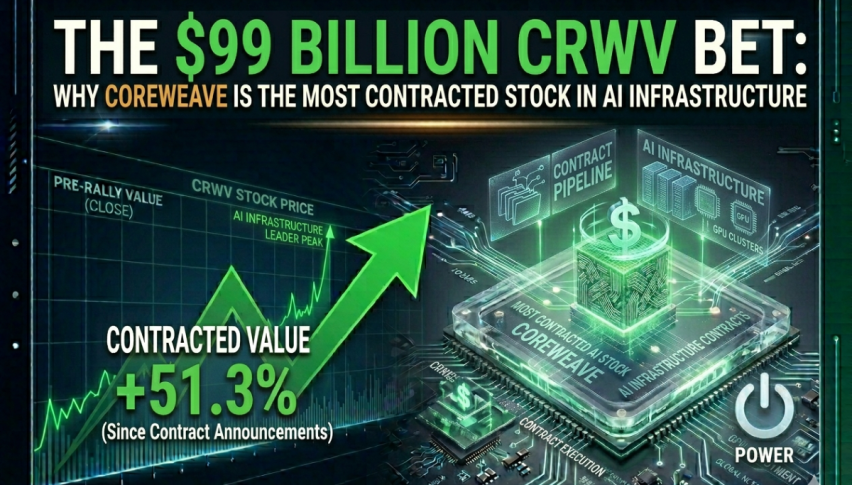
CoreWeave's $99.4B backlog dwarfs its $38B market cap. Is the debt the risk, or the opportunity? A full breakdown on CoreWeave (CRWV) stock
Quick overview
- CoreWeave boasts a $99.4 billion revenue backlog and a $38 billion market cap, making it the largest AI infrastructure company by contracted revenue.
- Despite a significant GAAP net loss of $740 million, the company shows strong fundamentals with a 56% adjusted EBITDA margin and a growing equity base.
- Nvidia's deep involvement with CoreWeave, including a $2 billion equity stake and a $6.3 billion capacity guarantee, solidifies their partnership and revenue stability.
- Analysts maintain bullish positions on CoreWeave despite a Q2 guidance miss, viewing it as a timing issue rather than a demand problem, supported by a robust contractual pipeline.
CoreWeave has the largest contracted revenue pipeline of any AI infrastructure company on the planet — a $99.4 billion backlog at a $38 billion market cap — and a balance sheet that could either be its greatest risk or its greatest validation, depending on how the next 18 months of execution play out.
This is the most leveraged, most contracted, and most structurally important pure-play AI cloud stock in public markets.
CoreWeave’s Fundamentals Reveal Scale Without Profitability (Yet)
Q1 2026 revenue of $2.1 billion, up 112% year-over-year, comfortably beat estimates and continued a pattern of consistent triple-digit growth since the company’s March 2025 IPO at $40. The revenue base is now around $8 billion annualized, and management is guiding toward a $30 billion annualized run rate by end of 2027. Crucially, 75% of that goal is already secured under long-term contracts.
The adjusted EBITDA margin of 56% on $1.2B shows that the core economics of the business are actually strong — the company is spending aggressively not because margins are poor, but because the demand so far exceeds capacity that every dollar of capex is essentially pre-sold.
CEO Michael Intrator’s framing of the situation is direct: the fleet is sold out. You build more because you can sell more.
The concerning number is the GAAP net loss of $740 million, more than double the prior year’s $315 million, driven by $7.7 billion in Q1 capex alone. Total debt stands at $24.9 billion against stockholders’ equity of $4.8 billion, a debt-to-equity ratio of 5.2x that remains deeply strained.
The one genuinely encouraging datapoint buried in the balance sheet: equity grew 43% quarter-over-quarter while debt grew only 16%, meaning the gap is slowly, meaningfully narrowing. The business is becoming more financially sound even as it spends at historic rates.
The overlooked positive is that the $99.4 billion backlog now includes over $40 billion in new commitments added in the quarter alone, and 10 separate customers each committing over $1 billion. This is not concentration risk of the old variety but it is blue-chip diversification at scale, with Meta, Anthropic, OpenAI, and Microsoft as anchor tenants.
The CoreWeave-Nvidia Relationship: Structural, Not Circumstantial
Nvidia’s involvement with CoreWeave runs deeper than most investors appreciate. Nvidia holds a $2 billion equity stake, its largest cloud equity position. Nvidia has a $6.3 billion capacity guarantee deal — it will purchase any unused cloud capacity CoreWeave cannot sell to customers, effectively insuring CoreWeave’s revenue floor.
And now Jensen Huang’s personal foundation has purchased $108.3 million of CoreWeave compute to donate to university and non-profit AI research programs.
This trifecta of financial stake, revenue guarantee, and philanthropy-via-CoreWeave is not coincidental. Nvidia has structurally embedded itself as CoreWeave’s anchor partner because CoreWeave is purpose-built around the Nvidia GPU ecosystem.
As long as Nvidia’s Blackwell and Hopper generations remain the dominant AI compute architecture, CoreWeave’s pricing power and demand pipeline are protected.
CRWV Stock Technical Picture: Off Peak, Building a Base
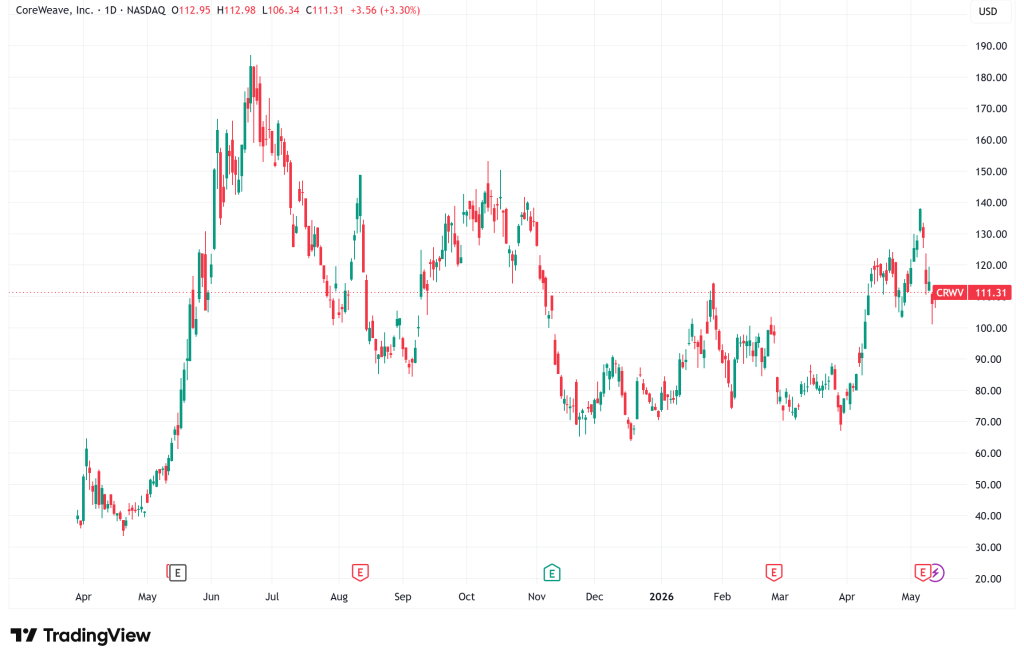
CRWV is in a materially different technical posture than NBIS. After hitting a 52-week high of $187 in early 2025, the stock has pulled back roughly 40% to the $111 range — a significant correction that has reset sentiment and valuation expectations. The RSI has normalized to a neutral 45–50 range, removing the overbought risk that plagued the stock at its highs.
Key support sits at $99–$105, which represents the base of the recent trading range and a level that held during the post-earnings dip. Resistance comes in two layers: $130 (the 50-day moving average vicinity) and $150 (the area where selling accelerated on the post-earnings gap down).
A convincing close above $130 would represent a meaningful technical reset; reclaiming $150 would signal trend recovery.
The relatively low beta of 0.82 — surprising for a high-growth AI stock — suggests the market views CRWV as a more infrastructure-like, less speculative instrument than its peers. Volume running below its 28 million average on the current recovery is a mild caution signal — a durable recovery typically needs institutional conviction behind it.
What Does CoreWeave (CRWV)’s Q2 Guidance Miss Really Mean?
The market’s initial post-earnings reaction was driven entirely by Q2 revenue guidance that came in below expectations. This is worth contextualizing carefully. CoreWeave is in a period of massive capital deployment, data centers take months to come online, and revenue recognition follows capacity activation. The conservative Q2 guide is almost certainly a function of construction and commissioning timelines, not demand softness. The $99.4 billion backlog provides no ambiguity on demand.
Wells Fargo (Overweight, $155 target) and Jefferies (Buy, $160 target) both maintained bullish positions post-guidance miss, emphasizing that the H2 ramp is well-supported by the contractual pipeline. At a 34–40% implied upside from current levels at those targets, the analyst community is effectively calling the Q2 dip a timing issue, not a structural break.
CRWV vs. NBIS: Two Ways to Own the AI Infrastructure Trade
These two stocks represent meaningfully different risk-reward profiles within the same sector. CoreWeave is the larger-scale, more contracted, more leveraged bet, with a lower forward P/S of 9x vs. NBIS’s 16x reflecting the $24.9 billion debt burden. Nebius is the cleaner balance sheet, faster percentage growth, and higher-multiple story.
Owning both captures different parts of the AI infrastructure spectrum: CRWV for scale and backlog certainty; NBIS for balance sheet quality and full-stack platform optionality.
Bottom Line for CoreWeave (CRWV) Investors
CoreWeave’s investment case rests on one central conviction: the $99.4 billion backlog converts. If it does — even partially — the gap between a $38 billion market cap and $99 billion+ in contracted revenue is the opportunity. The risks are real and should not be minimized: $24.9 billion in debt, a H2 execution ramp that the market will scrutinize quarter by quarter, and an Nvidia dependency that some view as circular.
But with 1GW+ of active capacity already sold out, five-year average contract durations, and the deepest institutional partnerships in the sector, CoreWeave is not a speculative bet on AI demand. It is a leveraged bet on AI demand that already exists. For risk-tolerant investors with a 2–3 year horizon, the current setup at $111 — well off the $187 high, with improving balance sheet dynamics and an extraordinary backlog — is worth serious attention.
- Check out our free forex signals
- Follow the top economic events on FX Leaders economic calendar
- Trade better, discover more Forex Trading Strategies
- Open a FREE Trading Account
- Read our latest reviews on: Avatrade, Exness, HFM and XM

Related Articles

Sidebar rates

Related Posts
 Save
Save