NVDA Stock Slips Toward $200 Pre-Q1 As Delayed China Shipments Raise Profit Concerns
NVIDIA shares fell sharply after delays tied to Chinese regulatory approval renewed concerns about export restrictions, future demand demand visibility, and growing geopolitical risks.
Quick overview
- NVIDIA shares fell approximately 4% due to delays in shipments of its H200 AI chips to China, raising concerns about export restrictions and future AI demand.
- The company faces significant geopolitical risks, with a recent multibillion-dollar charge related to U.S. export restrictions impacting its China operations.
- Despite strong technical momentum and earnings performance, caution is growing among investors as operational challenges and competition in the semiconductor industry intensify.
- NVIDIA's long-term growth narrative in AI remains strong, but geopolitical uncertainties and supply constraints may lead to increased market volatility.
NVIDIA shares fell sharply after delays tied to Chinese regulatory approval renewed concerns about export restrictions, future demand visibility, and growing geopolitical risks.
Nvidia Slides as China Shipments Face Delays
NVIDIA shares declined roughly 4% after reports indicated that shipments of its H200 AI chips to China remain delayed pending final regulatory approval from Chinese authorities.
The U.S. government reportedly approved sales of Nvidia’s H200 processors to several major Chinese technology companies, including Alibaba, Tencent, ByteDance, and JD.com.
However, the lack of final shipment clearance has created uncertainty around when related revenue may actually materialize.
The pullback comes after an extended rally in semiconductor stocks and reflects growing investor caution toward companies heavily exposed to geopolitical risks and export controls.
China Restrictions Continue Pressuring Outlook
Geopolitical tensions remain one of Nvidia’s largest strategic risks.
The company recently disclosed a multibillion-dollar charge tied to U.S. export restrictions affecting its China operations, highlighting the growing financial impact of regulatory barriers between Washington and Beijing.
China had previously represented a major growth opportunity for Nvidia’s data center business. However, with portions of future Chinese revenue now excluded from guidance, investors are increasingly focused on whether Nvidia can offset that lost demand elsewhere.
Meanwhile, CEO Jensen Huang participated in a business delegation visit to Beijing aimed at helping revive semiconductor trade discussions and stabilize relationships with Chinese customers.
Additional market attention emerged after disclosures showed Donald Trump acquired a sizable Nvidia share position valued between $1 million and $5 million. Despite the headline, the stock remained under broader selling pressure.
Technical Momentum Remains Strong but Warning Signs Appear
Despite the recent decline, Nvidia continues trading well above major technical support levels, including its 20-day, 50-day, and 200-day moving averages.
Momentum indicators such as MACD still reflect a broadly bullish trend tied to ongoing AI infrastructure expansion.
However, several technical indicators are beginning to signal increasing caution:
- RSI points to overbought conditions
- CCI suggests stretched momentum
- Stochastic RSI indicates possible short-term weakness
- Price action has started consolidating near recent lows
Together, these signals suggest some investors may be becoming more cautious ahead of future earnings and guidance updates.
Technical Picture Reflects Waning Momentum
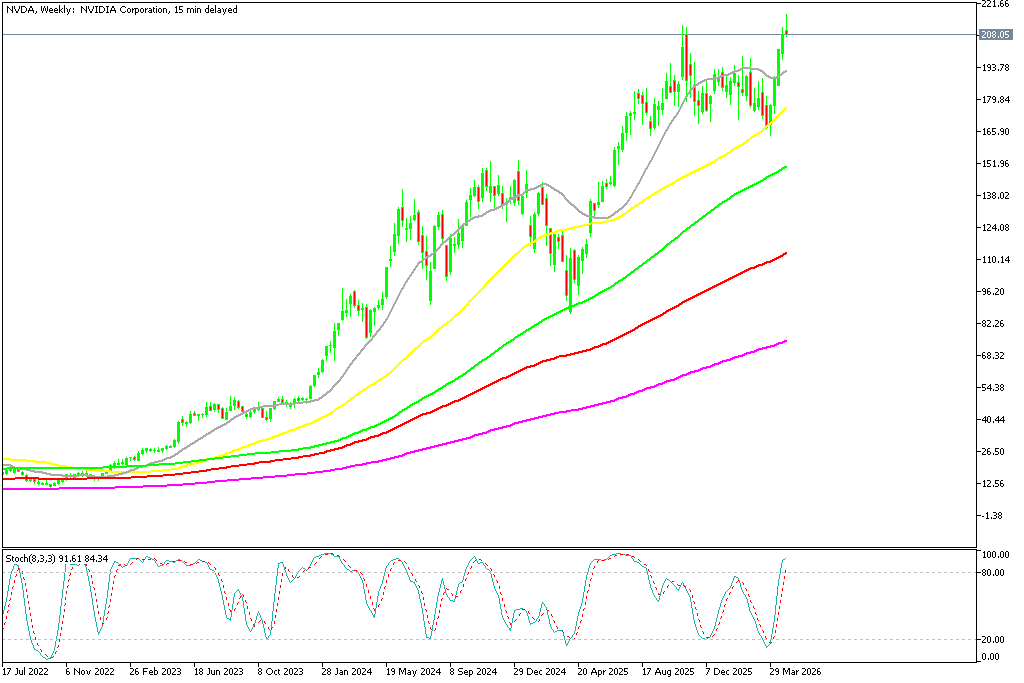
Nvidia’s technical setup mirrors the shifting sentiment. The stock slipped below its 20-week simple moving average (gray), a level that previously provided reliable support and into a deeper pullback to the 50-week moving average (yellow). That moving average turned into support and we saw a strong rebound to a new record high $216.82 by Monday. However the price reversed lower this week and is now heading toward $200 and probably below.
NVDA Chart Weekly – Returning Below October’s High
Supply Constraints and Competition Add Pressure
Operational challenges are also becoming more visible.
Jensen Huang recently acknowledged that manufacturing bottlenecks could continue for several years, potentially limiting Nvidia’s ability to fully meet surging AI-related demand.
At the same time, competition across the semiconductor industry is intensifying. Companies including Advanced Micro Devices and Broadcom continue expanding their presence in AI accelerators, networking, and enterprise computing markets.
Evolving dynamics with partners such as OpenAI have also introduced additional uncertainty around future demand concentration and long-term collaboration structures.
📊 NVIDIA Q4 & Fiscal 2026 Financial Highlights
🔹 Gross Margins
- Fourth Quarter:
- GAAP gross margin: 75.0%
- Non-GAAP gross margin: 75.2%
Full Fiscal 2026:
- GAAP gross margin: 71.1%
- Non-GAAP gross margin: 71.3%
➡️ Q4 margins expanded versus the full-year average, reflecting strong product mix and AI-driven demand.
🔹 Earnings Per Share (Diluted)
Fourth Quarter:
- GAAP EPS: $1.76
- Non-GAAP EPS: $1.62
Full Fiscal 2026:
- GAAP EPS: $4.90
- Non-GAAP EPS: $4.77
➡️ Quarterly earnings outpaced the fiscal-year average, underscoring continued strength in data center and AI segments.
🔹 Capital Return to Shareholders
- Total capital returned in Fiscal 2026: $41.1 billion
- Via share repurchases and cash dividends
- Remaining share repurchase authorization: $58.5 billion (as of Q4 end)
➡️ Strong free cash flow continues to support aggressive buybacks and shareholder returns.
🔹 Dividend Announcement
- Next quarterly dividend: $0.01 per share
- Payment date: April 1, 2026
- Record date: March 11, 2026
Conclusion
Nvidia remains one of the dominant companies in the global AI infrastructure boom, supported by exceptionally strong demand for advanced computing hardware. However, delayed China approvals, tightening export restrictions, supply constraints, and rising competition are beginning to introduce greater volatility into the outlook. While the long-term AI growth narrative remains powerful, elevated expectations and geopolitical uncertainty may continue driving sharper market reactions in the months ahead.
- Check out our free forex signals
- Follow the top economic events on FX Leaders economic calendar
- Trade better, discover more Forex Trading Strategies
- Open a FREE Trading Account
- Read our latest reviews on: Avatrade, Exness, HFM and XM

Related Articles
Sidebar rates

Related Posts
 Save
Save