NVDA Stock Holds Under $200 as China Lockout and Trade Risks Cloud AI Giant’s Outlook
Nvidia trades near $198 as export restrictions eliminate its China AI market while structural demand for its chips remains as strong as ever
Quick overview
- Nvidia's stock is currently at $198.48, showing little change after a strong April where it rose about 20%.
- The company faces significant challenges due to the loss of its AI chip business in China, which has been exacerbated by US export restrictions.
- Despite these headwinds, Nvidia's long-term outlook remains positive, with projected growth in AI infrastructure spending and accelerating sales growth.
- Traders are advised to monitor the $190 support level closely, as maintaining it could lead to further gains towards $202.
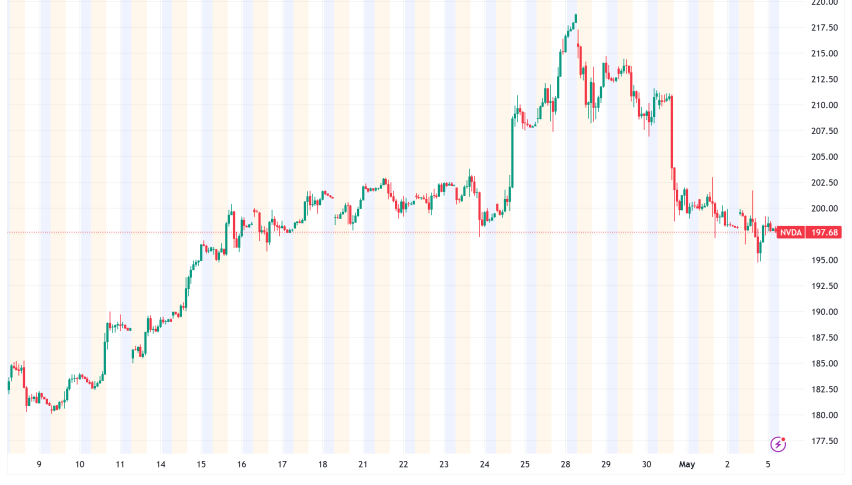
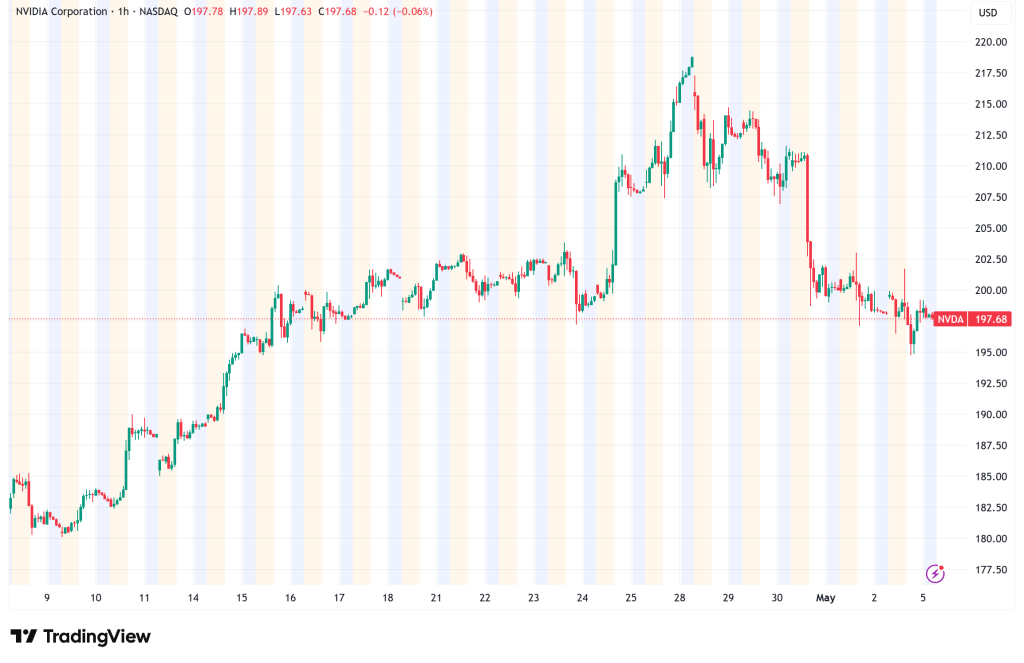
Shares of Nvidia (NASDAQ: NVDA) are at $198.48, basically unchanged on the day, as the stock consolidates after a good April when the shares jumped about 20%. NVDA is up about 6% year-to-date, low by Nvidia’s historical standards but remarkable given the larger software group’s issues with AI value resets.
NVDA Stock Consolidates After a Volatile Run
The near term view is technically one of tentative balance. The stock is trading above its 20-day SMA of $197.20 with the $190 level – confirmed by the Ichimoku Kijun line at $190.55 – providing immediate support. Below that, the 50-day SMA and 200-day SMA around $187 and $184 respectively provide more medium-term support. On the upside, $202 is the critical barrier level to cross before momentum may expand meaningfully.
In the short term, the best bet is more consolidation in the $188-$202 range, with the direction dictated by macro trends and any new cues from Nvidia’s impending earnings.
NVIDIA’s China Lockout: A Structural Revenue Hit
The biggest fundamental headwind for NVDA is the verified loss of its AI chip business in China. “There’s no market share left for Nvidia in the region for AI chips,” said chief executive Jensen Huang bluntly. Not lowered, but erased. Because of US export restrictions. That’s a big, long-term hit to a corporation that had viewed China as one of its biggest growth markets.
Nvidia is being replaced by domestic Chinese competitors who now have both regulatory protection and a captive market to boost development. This compounds the damage: Nvidia loses not only present revenue, but the foothold that would have allowed it to recoup share if policy had altered ultimately.
The China lockout also points to a second risk: Nvidia’s reliance on Asian suppliers, which now account for almost 90% of its production expenses. Partner stockpiling, such as that being undertaken by SK Hynix, suggests that supply chain players are already hedging against additional disruption. If the US-China trade war flares up, both the cost structure and manufacturing line of Nvidia are vulnerable.
NVIDIA Stock Outlook: Bull Case Remains Structurally Intact
Despite the regulatory obstacles, the long-term outlook for Nvidia is hard to argue with. Spending on AI data center infrastructure is forecast to surpass $7 trillion over the next few years, with Nvidia’s chips continuing to be the backbone of that buildout by default. Hyperscalers like Microsoft, Google, Amazon, and Meta are continuing to increase capital spending on AI infrastructure, and so far, those investments are paying off enough to justify more spending.
Now Nvidia’s sales growth is accelerating again. Management predicted for 77% year-on-year growth in Q1 after 73% in Q4. That kind of momentum at the scale that Nvidia is operating at, at a market cap around $5 trillion, is unprecedented historically in the semiconductor business.
Interestingly valuation appears less stretched than headlines suggest. The stock is trading at around 25x forecast earnings, below the 29-37x range it traded for during previous growth cycles when sales growth was slower. With AI euphoria building heading into earnings season, if the forward multiple moves back towards 32x, that suggests about 30% upside from now. Historically, as the end of the year approaches, Nvidia has often gotten near 40x ahead profits, but that would require ongoing trust in 2027 growth estimates.
Can NVIDIA Investors Enjoy More Gains?
One pattern to note for traders: Nvidia has surged substantially in May in each of the past two years, gaining 20% in May 2024 and 32% in May 2025. The setup is similar in that the stock seems mildly discounted versus historical norms heading into Q1 earnings season and AI capex data continues to surprise to the upside but past performance is never a guarantee.
As far as the stock split question goes, we don’t see another split at current pricing. Nvidia’s last split was a 10-for-1 in 2024 at around $1,200 a share. Analysts say it could take several years for a comparable occurrence to occur, however historically, Nvidia has compressed that timescale, meaning the stock would need to gain another 100-200% to hit $198.
Next Steps for NVDA Traders
Nvidia finds itself at a genuine strategic crossroads. The China AI market is closed, supply chain exposure is elevated, and the stock is consolidating after a strong run. These are real risks that traders should price in carefully.
Meanwhile, the fundamental AI demand thesis has never been more attractive, valuations are below historical norms and earnings season is historically a trigger. The $190 support level is the line in the sand for near term bulls – hold that and the way to $202 and beyond remains open. If you lose it, it’ll cost you $188.
A patient approach around present levels with a defined stop below $188 gives a respectable risk/reward setup for traders heading into what has historically been the greatest month of the year for Nvidia.
- Check out our free forex signals
- Follow the top economic events on FX Leaders economic calendar
- Trade better, discover more Forex Trading Strategies
- Open a FREE Trading Account
- Read our latest reviews on: Avatrade, Exness, HFM and XM

Related Articles
Sidebar rates

Related Posts
 Save
Save