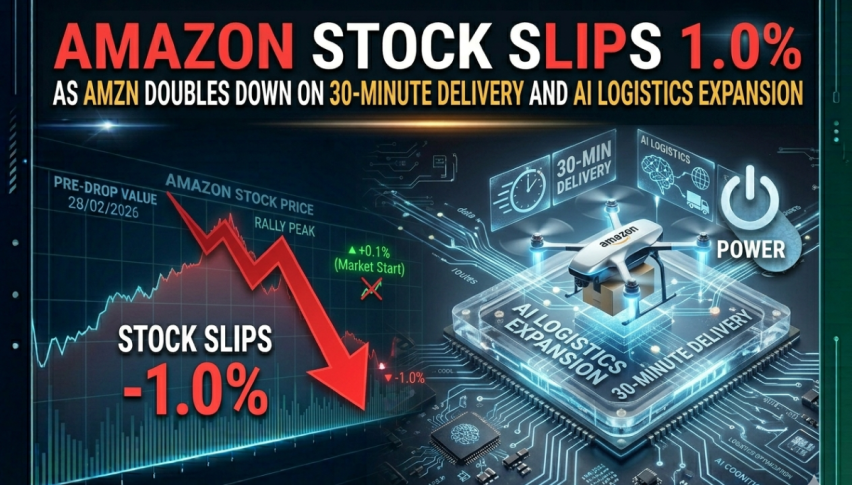
Amazon Stock Slips 1% as AMZN Doubles Down on 30-Minute Delivery and AI Logistics Expansion
Amazon stock analysis: 30-min delivery launch, Supply Chain Solutions, technical signals, and price targets for AMZN in 2026.
Quick overview
- Amazon has launched two major initiatives: Amazon Now for 30-minute grocery delivery and Amazon Supply Chain Solutions for business logistics.
- The stock experienced a slight pullback, attributed more to market conditions than Amazon's fundamentals.
- Amazon Now aims to enhance delivery speed and compete with services like Uber Eats and DoorDash, while ASCS targets the $750 billion logistics market.
- Analysts suggest Amazon's long-term potential remains strong despite short-term valuation concerns, with significant gains in share price over the past year.
Amazon is on the move, literally. In the span of a week, the company has launched two major strategic offensives: Amazon Now, 30-minute delivery of groceries and essentials, and Amazon Supply Chain Solutions (ASCS), a full-suite logistics offering for businesses outside its marketplace. Together, these moves signal Amazon’s intent to replicate the AWS playbook — build massive internal capability, then monetize it externally at scale.
The stock pulled back ~1.2% on Tuesday, closing around $265.82, though after-hours activity showed modest recovery to $267.33. The dip appears less about Amazon’s fundamentals and more about a broader market rotation, compounded by a 3%+ surge in crude oil prices weighing on macro sentiment.
What Amazon Now Actually Means
Amazon’s latest push puts ultra-fast delivery at the center of its strategy, rolling out Amazon Now’s 30-minute delivery across dozens of U.S. cities while extending same-day groceries and supply chain services to consumers and businesses. The service is currently live in Atlanta, Dallas–Fort Worth, Philadelphia, and Seattle at $3.99 per Prime order.
The expansion leverages smaller fulfillment locations positioned closer to customers to achieve rapid delivery times, underscoring Amazon’s strategic push to enhance delivery speed and capture a larger share of online spending.
This is not just a customer convenience play. It’s a competitive moat-building exercise. Amazon already delivers more packages than the U.S. Postal Service, UPS, or FedEx. It took the crown from USPS in 2025 and has been larger than FedEx and UPS since 2023, as those carriers de-emphasized business-to-consumer volumes in favor of higher-margin business-to-business shipments.
Is ASCS an AWS Déjà Vu?
The more significant long-term catalyst may be ASCS. Amazon introduced “Amazon Supply Chain Solutions,” which aims to provide distribution, warehousing, and last-mile delivery to any business. That announcement sent FedEx and UPS shares down roughly 10% initially. TD Cowen analyst Jason Seidl sees ASCS becoming a customer of traditional brokers when it needs additional capacity — suggesting Amazon won’t necessarily cannibalize the entire ecosystem, but will set the rules of engagement.
ASCS competes in a $750 billion market, and Wall Street’s initial view is that there should be enough room for other companies to carve out and maintain profitable niches.
FedEx CEO Raj Subramaniam took a measured stance. He characterized Amazon’s announcement as more of a third-party logistics offering — a business FedEx already participates in, but one that represents only a small piece of the company. FedEx’s third-party logistics segment is “about a $2 billion business,” compared to FedEx’s projected revenue of over $93 billion. Barclays analysts echoed this sentiment, describing Amazon’s move as “more noise than risk,” arguing the announcement was largely a rebranding of logistics capabilities Amazon has offered for years rather than a fundamentally new competitive threat.
Who’s Really Threatened By Amazon’s New Services?
The 30-minute grocery play targets a different set of competitors than ASCS. The rapid grocery delivery business primarily targets services from Uber Technologies, DoorDash, Walmart, and Target. Uber Eats and DoorDash have expanded beyond restaurant deliveries, and retailers have expanded their delivery options to compete with Amazon.
Walmart has been testing new store-based fulfillment systems in Dallas to reduce delivery times, while Target is expanding its same-day fulfillment through its Shipt platform — reflecting a broader industry shift toward “instant commerce,” where speed is crucial for capturing online consumers.
Amazon’s Fundamental Valuation
At a last close of $268.99 versus a narrative fair value of $450, the current price sits well below what some analysts view as Amazon’s long-term potential. The thesis: Amazon is sacrificing short-term margins to secure long-duration dominance in AI infrastructure, advertising, and automated commerce — and those investments are already working, with margins positioned to inflect upward by end of 2026.
The 30-day share price return stands at 12.84%, the 90-day gain at 29.97%, and the 1-year total shareholder return at 28.93%, with a 3-year total shareholder return of approximately 14x — indicating momentum has been strong over both shorter and longer periods. TD Cowen’s John Blackledge reiterated a Buy with a $350 price target following the Amazon Now announcement.
AMZN Technical Analysis: What’s Next After the 37% Gain in 1 Year?
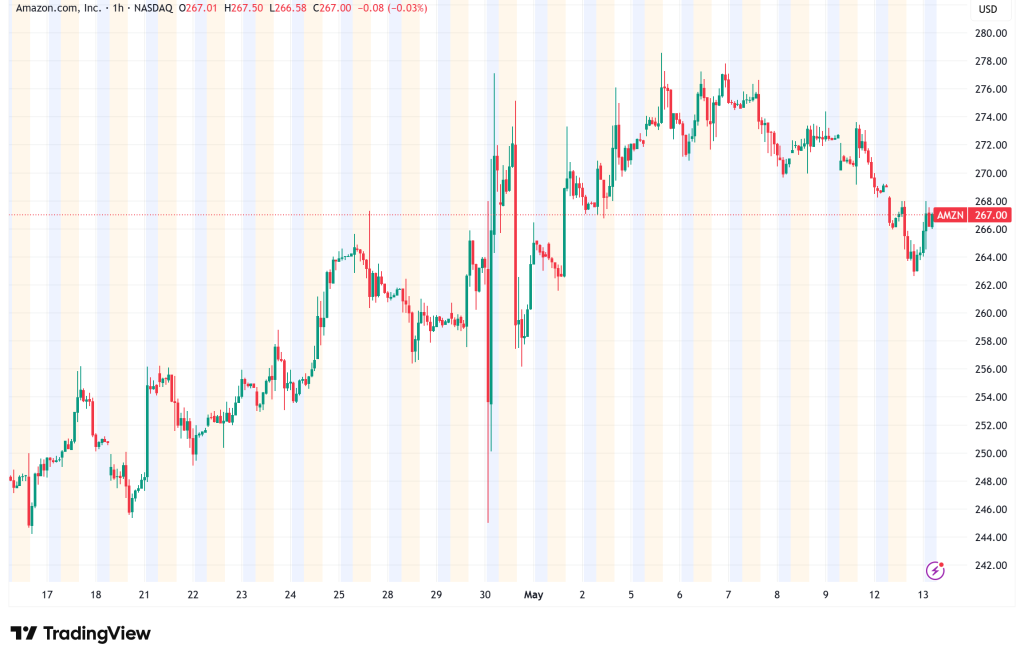
The technical picture tells a nuanced story. On the longer-term frame, Amazon’s chart is unambiguously constructive — a golden cross confirmed in May (where the 50-day SMA crossed above the 200-day SMA), all three major moving averages aligned in bullish order, and 37% gains over the past year. That’s the kind of structural setup institutional trend-followers use as a green light.
The short-term caution comes from the MACD sitting below its signal line, suggesting that momentum is losing steam in the near term. At an RSI of 59.38 — well clear of overbought territory above 70 — there’s room for further upside without an immediate overheating concern, but it also isn’t the kind of deeply oversold reading that screams “buy aggressively right now.”
The most likely base case: a period of consolidation between current levels and the $278.50 resistance ceiling as the market digests two major strategic announcements in a single week. A clean break above $278.50 on meaningful volume would signal continuation; a slide toward $226.50 support (roughly 15% below current price) would be worth watching but, given the macro backdrop, may represent a buying opportunity rather than a structural break.
Should You Buy Amazon (AMZN) in 2026?
Amazon is executing on multiple fronts simultaneously — ultra-fast consumer delivery, third-party logistics disruption, AI-driven commerce, and cloud infrastructure. The bear case is largely about valuation patience; the bull case is about a company that keeps expanding its total addressable market and has the balance sheet and logistics density to back it up.
With over 13 billion same-day or next-day deliveries globally in 2025 and more than 8 billion items delivered in the U.S. (up over 30% year-over-year), the operational engine is running. Whether the stock reflects that at $265 or needs to grind to $350 depends largely on how quickly the margin inflection arrives — and whether “instant commerce” becomes the default consumer expectation or remains a niche premium service.
- Check out our free forex signals
- Follow the top economic events on FX Leaders economic calendar
- Trade better, discover more Forex Trading Strategies
- Open a FREE Trading Account
- Read our latest reviews on: Avatrade, Exness, HFM and XM

Related Articles
Sidebar rates

Related Posts
 Save
SaveAva

