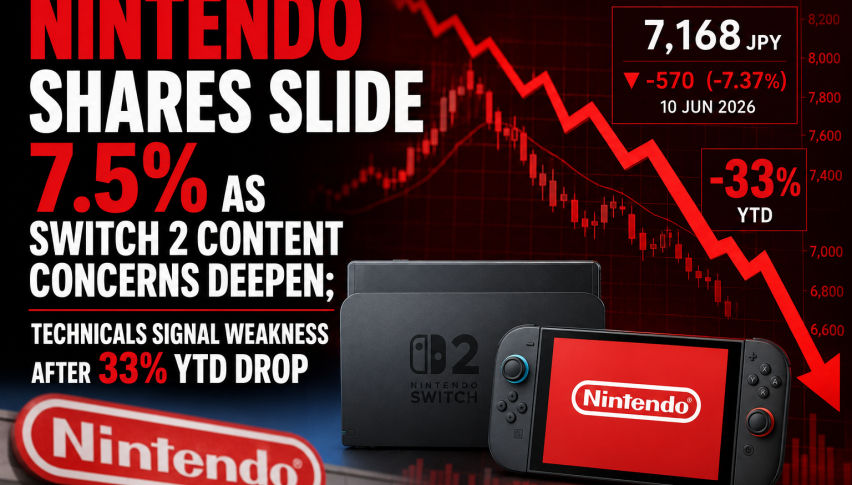
Nintendo Shares Slide 7.5% as Switch 2 Content Concerns Deepen; Technicals Signal Weakness After 33% YTD Drop
Nintendo stock falls 7.5% after a disappointing Direct event as Switch 2 software concerns pressure shares.
Written by:
Arslan Ali Butt•Wednesday, June 10, 2026•3 min read
•Last updated: Wednesday, June 10, 2026
Quick overview
Nintendo shares fell over 7% following a disappointing Nintendo Direct presentation that lacked major game announcements for the Switch 2.
Investors are increasingly concerned about the company's ability to maintain momentum with a steady pipeline of first-party releases.
Despite strong financial performance, analysts worry that Nintendo may not have a major blockbuster title in time for the critical holiday season.
The company's long-term content roadmap remains robust, but investor confidence hinges on the timing of future software releases.
Nintendo shares tumbled more than 7% on June 10 after the company’s latest Nintendo Direct presentation failed to deliver the blockbuster game announcements investors were expecting for the Switch 2 platform.
The sell-off underscores a growing concern surrounding Nintendo’s investment thesis: while hardware demand remains strong, investors increasingly want evidence that the company can sustain the next phase of the Switch 2 cycle with a steady pipeline of major first-party releases.
The stock closed around ¥7,168, down approximately 7.4% on the day, extending its decline to roughly 33% year-to-date.
Nintendo Investors Wanted a System Seller. They Didn’t Get One.
Nintendo’s latest Direct presentation generated significant consumer attention, attracting nearly 4 million views online. However, investors focused on what was missing rather than what was announced.
The biggest disappointment was the absence of a new flagship Super Mario title, traditionally one of Nintendo’s most powerful hardware-selling franchises.
Instead, Nintendo revealed:
A remake of The Legend of Zelda: Ocarina of Time
A new Star Fox title
Additional third-party support announcements
Updates on existing Switch 2 software plans
While Zelda remains one of gaming’s strongest franchises, Nintendo offered little gameplay footage or release detail, limiting its immediate impact on investor confidence.
Several analysts highlighted concerns that Nintendo may enter the critical holiday season without a major first-party blockbuster capable of accelerating Switch 2 adoption.
The Market Is Questioning the Software Roadmap
Nintendo’s challenge is not hardware demand.
The company recently delivered one of the strongest financial performances in its history, supported by the Switch 2 launch cycle.
For the fiscal year ended March 2026:
Revenue surged 98.6% year-over-year to ¥2.31 trillion
Those results demonstrate that the Switch ecosystem remains one of the most profitable businesses in gaming.
However, gaming hardware historically depends on software-driven demand. Investors appear concerned that Nintendo’s near-term release calendar lacks enough major exclusive titles to maintain momentum.
Additional pressure comes from rising Switch 2 pricing, driven partly by higher semiconductor and manufacturing costs.
Several major releases are expected over the coming years:
The Legend of Zelda: Ocarina of Time Remake
Call of Duty expansion onto Switch 2
007 First Light
Resident Evil: Veronica Remake (2027)
Additional unannounced first-party Nintendo projects
The company also continues expanding its digital ecosystem, subscription services, and third-party partnerships.
The key question for investors is timing rather than capability.
Nintendo has repeatedly demonstrated its ability to monetize intellectual property across gaming, movies, merchandise, and digital platforms. The concern is whether the release schedule can maintain investor enthusiasm throughout the early years of the Switch 2 lifecycle.
How to trade Nintendo stock today
Nintendo Technical Analysis: Bearish Trend Despite Oversold Conditions
From a technical perspective, Nintendo’s chart has deteriorated significantly in recent months.
The stock remains below every major moving average, highlighting the severity of the current correction.
The mixed oscillator readings suggest downside momentum is slowing, but a confirmed reversal has not yet emerged.
Moving Average Structure
Moving Average
Level
Signal
10-Day EMA
7,390
Sell
20-Day EMA
7,410
Sell
30-Day EMA
7,530
Sell
50-Day EMA
7,849
Sell
100-Day EMA
8,685
Sell
200-Day EMA
9,688
Sell
Nintendo currently trades below all major short-, medium-, and long-term moving averages.
This configuration reflects a firmly established downtrend.
RSI and MACD
RSI (14): 43
Neutral momentum
Not oversold
Suggests selling pressure has moderated
Leaves room for movement in either direction
MACD: -94
Still below zero
Buy signal developing
Indicates bearish momentum may be weakening
Early signs of stabilization rather than a confirmed recovery
Key Support and Resistance Levels
Level Type
Approximate Area
Immediate Resistance
¥7,350-¥7,500
Major Resistance
¥7,850-¥8,000
Psychological Resistance
¥9,000
Near-Term Support
¥7,000
Secondary Support
¥6,500-¥6,700
Major Support
¥6,000
A sustained move above the ¥7,500 area would indicate improving momentum and potentially signal that the recent sell-off is losing strength.
Conversely, a break below ¥7,000 would suggest investors remain concerned about the software pipeline and could expose the stock to deeper downside toward the ¥6,500 region.
Nintendo’s Investment Story Remains Tied to Execution
Nintendo’s long-term fundamentals remain among the strongest in the gaming industry.
The company benefits from:
One of the world’s most valuable gaming IP portfolios
Significant net cash reserves
High-margin software and digital revenue
Growing entertainment diversification
Strong global brand recognition
The market’s reaction to the latest Direct presentation highlights how dependent Nintendo remains on major software releases to justify premium valuations.
While the Switch 2 launch cycle appears healthy, investors are demanding greater visibility into the next generation of blockbuster titles.
For now, Nintendo remains a fundamentally strong company facing a confidence issue rather than a business model problem. The next major catalyst will likely come from future software announcements and evidence that Switch 2 adoption can remain strong beyond the initial launch phase.
Lead Markets Analyst – Multi-Asset (FX, Commodities, Crypto)
Arslan Ali Butt serves as the Lead Commodities and Indices Analyst, bringing a wealth of expertise to the field. With an MBA in Behavioral Finance and active progress towards a Ph.D., Arslan possesses a deep understanding of market dynamics.
His professional journey includes a significant role as a senior analyst at a leading brokerage firm, complementing his extensive experience as a market analyst and day trader. Adept in educating others, Arslan has a commendable track record as an instructor and public speaker.
His incisive analyses, particularly within the realms of cryptocurrency and forex markets, are showcased across esteemed financial publications such as ForexCrunch, InsideBitcoins, and EconomyWatch, solidifying his reputation in the financial community.




 Save
Save