XRO Stock Rebounds Toward A$70 as CEO Share Sale, AI SaaS Fears Keep Pressure on Xero
Xero stock XRO rebounds near A$70, but CEO share-sale concerns, AI pressure and weak 4-hour averages keep risks elevated.
Quick overview
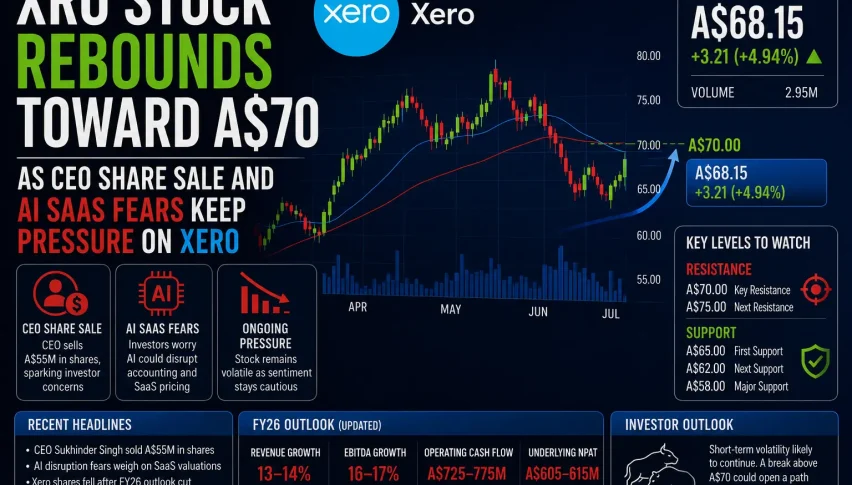
- Xero shares rebounded to A$69.83 after a sharp selloff, but investor sentiment remains cautious due to governance concerns and CEO share-sale issues.
- CEO Sukhinder Singh Cassidy sold her remaining shares, raising scrutiny over executive compensation and alignment with shareholder interests.
- The company faces pressure from potential AI disruption in the SaaS market, prompting investors to demand proof of its business model's resilience.
- Despite strong revenue growth, Xero's stock remains technically vulnerable, with key resistance levels that need to be surpassed for improved momentum.
Xero shares bounced after a sharp selloff, but investors remain cautious as CEO share-sale concerns, pay scrutiny and AI disruption fears weigh on sentiment.
Xero Recovers Slightly as Governance Concerns Remain in Focus
Xero shares recovered to A$69.83 on Thursday, rising 2.29%, but the move did little to erase recent pressure on the Australian-listed cloud accounting software company.
The stock had fallen sharply earlier in the week after disclosures showed CEO Sukhinder Singh Cassidy sold her remaining ordinary shares. According to supplied reports, Cassidy sold 29,608 shares at A$74 on July 7 for roughly A$2.19 million, with the transaction disclosed on July 13.
Xero said the sale was related to personal tax obligations, but investors still treated it as a governance signal. The reaction was much larger than the sale itself, with the stock losing hundreds of millions of dollars in market value across the following sessions.
That disconnect suggests investors were not worried about mechanical selling pressure. They were reassessing confidence in management alignment.
CEO Still Holds RSUs and Options
The share-sale headline was especially sensitive because Cassidy no longer holds ordinary Xero shares after the transaction.
However, she still retains significant equity-linked exposure through 171,381 restricted stock units and more than 1 million unlisted options. The issue is that those options are currently out of the money, with one block requiring a move above A$72.39 and a larger block requiring a much larger recovery toward A$171.11.
This has made executive compensation a central investor debate.
Xero’s board has previously emphasized performance-linked pay, but shareholders have already shown discomfort. Nearly half of votes opposed the remuneration report at the August 2025 annual meeting. With the next annual meeting approaching on August 27, investors are likely to watch closely for any pay reset or new incentive structure.
If shareholders believe management is being insulated from the same downside they absorbed, sentiment could remain fragile.
AI Pressure Adds to SaaS Concerns
Xero is also being caught in the broader “SaaS apocalypse” debate.
Investors are questioning whether AI automation could disrupt traditional software products, especially subscription-based tools used by small and medium-sized businesses. Xero’s cloud accounting platform remains deeply embedded with customers, but markets are increasingly demanding proof that AI will strengthen rather than weaken its business model.
The company has responded by emphasizing a higher-performance culture and internal execution. Recent reports said Xero introduced an “Opt Out Program” for underperforming staff, offering voluntary severance as an alternative to a 30-day performance improvement plan.
Management has framed this as part of raising the bar as AI changes how work gets done. However, alongside the CEO share sale and pay discussion, the move has reinforced investor focus on culture, cost discipline and execution risk.
Operating Growth Provides Counterweight
The operating story is not entirely negative.
Xero continues to grow revenue strongly. Supplied data shows FY26 revenue rose 31% to NZ$2.75 billion, while adjusted EBITDA increased 18% to NZ$757.4 million. The company remains a key cloud accounting platform for small businesses and advisors across Australia, New Zealand, the U.K., North America and other markets.
TradingView lists Xero with annual revenue of about A$2.45 billion, market capitalization near A$12.08 billion and a trailing P/E ratio near 76.4.
That valuation reflects continued growth expectations, but it also leaves limited room for disappointment. Net income remains relatively modest compared with revenue, and investors want clearer evidence of margin repair and stronger cash generation.
Xero’s Melio Integration and Margin Repair in Focus
Xero’s growth case now depends on more than subscriber expansion.
Investors are watching customer retention, product adoption, pricing quality, AI capability, cost discipline and integration of Melio. The company needs to show that acquisitions and product investments can translate into operating leverage rather than simply higher costs.
If Xero can use AI to improve automation, workflow efficiency and customer value, the current selloff may eventually look excessive. But if AI reduces pricing power or increases competitive pressure, the valuation could remain under pressure.
This is why the stock’s rebound is still being treated cautiously.
XRO Technical Analysis: Short-Term Bounce Meets Resistance
XRO traded at A$69.83 after rebounding from recent lows, but the 4-hour chart remains technically weak.
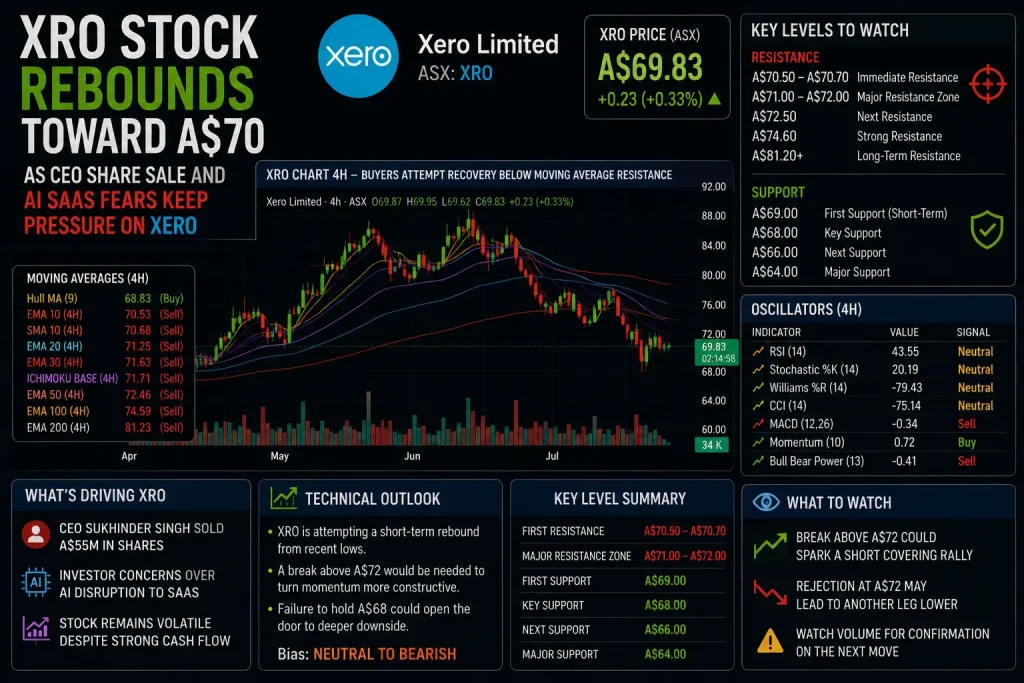
XRO Chart 4H – Buyers Attempt Recovery Below Moving Average Resistance
The stock is still trading below nearly all major moving averages. The 10-period EMA sits near A$70.53, while the 10-period SMA is around A$70.68. These levels form the first immediate resistance zone.
Above that, the 20-period EMA near A$71.25, 30-period EMA near A$71.63 and Ichimoku base line near A$71.71 create a heavier resistance band between A$71 and A$72. A move above that area would be needed to improve short-term momentum.
The 50-period EMA is near A$72.46, while the 100-period EMA stands at A$74.59. Longer-term resistance remains much higher, with the 200-period EMA near A$81.23.
The only clear moving-average support signal comes from the Hull Moving Average near A$68.83, which is currently flashing buy. This suggests buyers are trying to defend the A$68-A$69 region.
Oscillators are mostly neutral but soft. RSI is at 43.55, while Stochastic %K is near 20.19, showing that momentum remains weak but not deeply oversold. MACD is on sell, while Momentum is flashing a buy signal, creating a mixed short-term setup.
Key Levels to Watch
The first support level is A$68.80, followed by A$68.00. A break below that area could expose XRO to A$65, where investors may look for deeper value support.
On the upside, buyers need to reclaim A$70.50 first. A sustained move above A$72 would suggest the recent selloff is stabilizing, while a break above A$74.60 would be a stronger technical recovery signal.
Until Xero moves above the A$71-A$72 resistance zone, rallies may continue to face selling pressure.
Governance Test Comes Before Xero’s Recovery
Xero’s rebound shows some buyers are willing to step in after the recent decline, but confidence has not fully returned.
The company still has a strong cloud accounting franchise, healthy revenue growth and a meaningful opportunity to use AI to improve small-business finance workflows. However, the market is now focused on governance, executive alignment, margin repair and whether AI disruption will help or hurt the SaaS model.
The August 27 annual meeting may become the next major sentiment test, especially if investors scrutinize executive pay structures after the CEO share sale.
For now, XRO remains technically vulnerable below A$72. A move above that level would improve the short-term setup, but a break below A$68 could open the door to deeper downside toward A$65.
- Check out our free forex signals
- Follow the top economic events on FX Leaders economic calendar
- Trade better, discover more Forex Trading Strategies
- Open a FREE Trading Account
- Read our latest reviews on: Avatrade, Exness, HFM and XM

Related Articles



Sidebar rates

Related Posts
 Save
Save