WTI Crude Oil Holds $79 as Middle East Risks Rise; What’s Holding Oil Back?
WTI crude oil trades near $79 as Middle East tensions collide with rising supply and weaker demand. Here's what's really driving oil prices.
Quick overview
- WTI crude oil is trading near $79, influenced by Middle East tensions and rising supply.
- Military tensions, particularly between the U.S. and Iran, are affecting oil shipments through the Strait of Hormuz, but supply and demand dynamics are preventing a significant price spike.
- Despite geopolitical risks, increasing U.S. production and OPEC+ output are stabilizing the market and preventing shortages.
- A breakout above $81.23 could signal further price increases, while maintaining support above $79.19 is crucial for upward momentum.
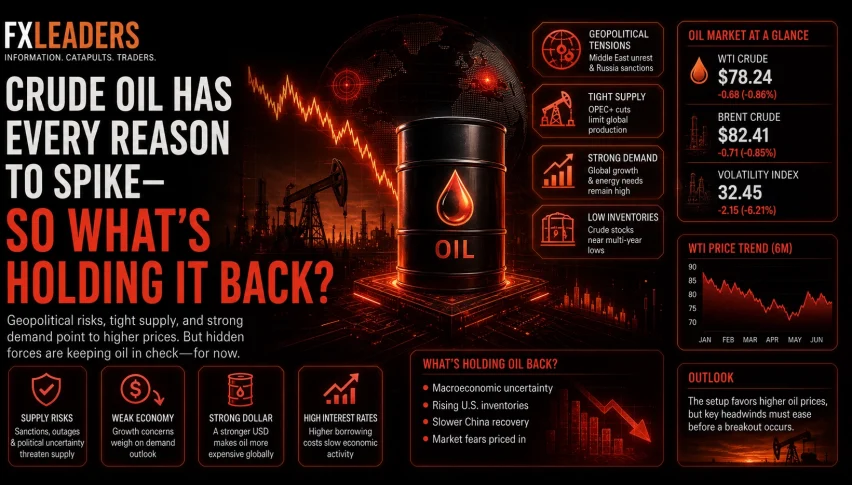
WTI crude oil trades near $79 as Middle East tensions collide with rising supply and weaker demand. Here’s what’s really driving oil prices today. WTI crude is changing hands for $79.40 a barrel, having advanced to a 1-month high last week, but perhaps the most remarkable aspect of this week is not that oil moved higher but rather that it didn’t spike even higher.
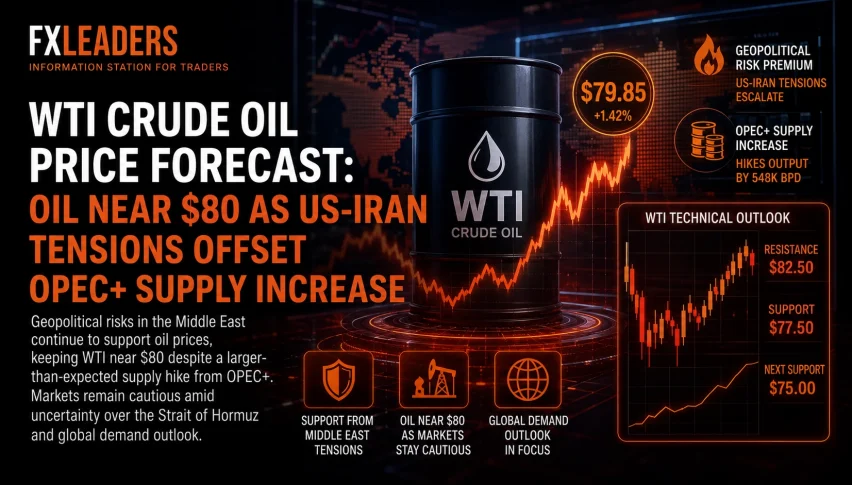
Military tensions between the United States and Iran continue to threaten one of the world’s most important energy corridors, and shipments through the Strait of Hormuz have continued to slow. In a more normal environment, that would be enough for oil to rise significantly. Instead, market participants are relying on increasing supplies and easing demand to counterbalance the risks. That equilibrium is pinning oil closer to $80 per barrel.
The Market Is Watching Ships More Than Headlines
Supply is the biggest oil risk, but only because it depends on ship movement. The biggest risk to oil isn’t another military strike, it is whether crude can continue flowing through the Middle East. The Strait of Hormuz, which accounts for nearly 20 percent of global oil movements, is seeing slower vessel traffic again as the U.S.-Iran situation develops.
Additionally, the Bab el-Mandeb has come under scrutiny again, where more disruption would make shipping to and from the Red Sea even tougher. Still, there hasn’t been that much reaction from market traders because refiners around the world have had to accommodate supply shocks for so many years now.
That could turn if the attacks start damaging export or production terminals, or commercial oil tankers. That’s why oil isn’t rallying faster. While geopolitics is giving support to oil, supply is keeping it from spiking higher.
Why Oil Isn’t Rallying Faster
Latest U.S. data showed crude oil fell by 1.7 million barrels last week, and gasoline fell at a time of year where demand tends to increase. U.S. crude is producing at a little under 13.9 million barrels a day, refineries are at a utilization rate above 96 percent, and oil continues being exported as buyers in other parts of the world search for crude supplies.
OPEC+ is slowly increasing production again, with another increase to come in August, while lower demand forecasts around the world suggest higher prices are starting to hurt consumption.
Combined, that’s stopping concerns about geopolitical risks in the Middle East from turning into a major supply shortage. The market doesn’t question that there is enough oil. It questions how easily that oil gets where it needs to go.
One Shipping Route Could Decide Oil’s Next Move
There has been no sign yet of oil shortages, as the International Energy Agency reported an increase to global inventories in June. Much of that inventory is floating on ships, while landbased storage is dropping. That leaves supplies more exposed if shipping routes get more disrupted.
As long as the Strait of Hormuz remains open, traders will likely treat any rally from geopolitical concerns as short-lived, but a bigger disruption for shipments out of the Gulf would shift that perspective and prompt a more serious review of supplies around the world.
WTI Crude Oil Forecast: $79.20 Support Holds as Triangle Tightens
On the 2-hour time frame, WTI is currently hovering around $79.28, maintaining stability just above the support at $79.19 after rallying off of a swing low at $72.63 last month. It remains stuck below the descending trendline, with a tighter triangle forming, hinting at the prospect of a breakout soon.
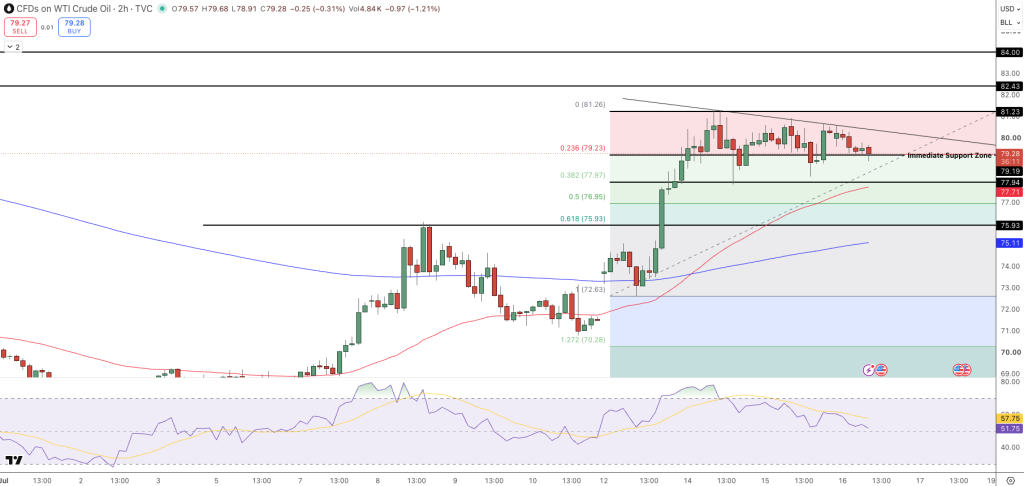
The price is consolidating above the 23.6% Fibonacci level at $79.23. Additionally, the 50-period EMA at $77.71, which is also trending upward from below the price, supports a medium-term positive sentiment.
The 200-period EMA at $75.11, still far below today’s price, further corroborates the larger, sustained uptrend. Momentum has lost some momentum, with the RSI nearing 52, implying buyers are stepping back without fully abandoning the rally.
A breakout above the descending trendline and $81.23, could push price toward $82.43. If support is lost at $79.19, WTI would likely fall towards $77.97 and $76.95, where new buying might be triggered. As long as prices stay above the 50 EMA, the technicals continue to support a bullish outlook for now.
What you need to know about oil price forecasts.
-
Oil is currently finding support from geopolitical tensions in the Middle East, but it is being held back from rallying hard by rising production.
-
The primary driver of crude prices today is continued trade through the Strait of Hormuz.
-
Continued higher production from the United States and increasing output from OPEC+ are countering some of the risks from the geopolitical situation in the Middle East.
-
A move higher above $81.23 could indicate another leg to the upside, while $79.19 has to hold as a base for WTI to move higher.
- Check out our free forex signals
- Follow the top economic events on FX Leaders economic calendar
- Trade better, discover more Forex Trading Strategies
- Open a FREE Trading Account
- Read our latest reviews on: Avatrade, Exness, HFM and XM

Related Articles

Sidebar rates

Related Posts
 Save
SaveAva

