Bitcoin Price Forecast: BTC Falls Below $64K; Is Wall Street Quietly Losing Confidence?
Bitcoin price isn't moving the way most traders hoped for it. Since reclaiming more than $59,000 back at the start of the month...

Quick overview
- Bitcoin's price has struggled to maintain momentum, falling below $64,000 despite positive developments in spot Bitcoin ETFs and softening US inflation.
- ETF inflows have rebounded recently, but demand is not as strong as it was earlier in 2024, raising concerns about future price support.
- The current market dynamics are heavily influenced by macroeconomic factors, including rising oil prices and Federal Reserve policies, rather than Bitcoin-specific news.
- Bitcoin mining faces increasing challenges due to rising energy costs, which may lead to greater selling pressure from miners in the coming months.
Bitcoin price isn’t moving the way most traders hoped for it. Since reclaiming more than $59,000 back at the start of the month, BTC has fallen back below the $64,000 level despite spot Bitcoin ETFs flipping positive once again and US inflation softening. Normally, these factors would have been more than enough to support another rally.
Instead, BTC is once again acting like a macro asset, with investors placing more focus on surging oil prices, Federal Reserve policy and institutional liquidity than specific Bitcoin news. The market no longer questions if Bitcoin has value long-term. Instead the market wants to know if there is enough money coming into the market today to overcome a growing sell-off by miners, public companies and short-term traders.
Bitcoin ETF Inflows Have Bounced Back
One of the biggest positives for Bitcoin this week has been the return of US spot Bitcoin ETF inflows. After recording a heavy net outflow of $424.7 million on July 13, ETF inflows bounced back with $181.1 million coming in on July 14, followed by $107.7 million on July 15 and $79.1 million on July 16, as noted by Farside Investors. While BlackRock’s iShares Bitcoin Trust once again led the charge, so did Fidelity and others. On the surface, this seems like great progress for BTC’s price.
Spot Bitcoin ETFs in the US have now received more than $51 billion in net inflows since being introduced earlier in 2024, opening the door for the asset class to be available for purchase at almost any brokerage account. But one important point is not lost on this data.
While this data is good, it shows that ETF demand isn’t only flowing in. ETF inflows aren’t like they were in early 2024, when demand outstripped supply week after week. Now the situation is different. Capital moves in and out of funds based on market factors. It’s possible ETF inflows are becoming a larger force for change within Bitcoin’s price.
As recently as last week, Citigroup said its Bitcoin price target for BTC dropped to $82,000 over the next 12 months from $112,000, citing a drop in expected Bitcoin ETF demand. While the inflow was positive for Bitcoin, three consecutive days of buying are insufficient to confirm that the ETF demand that has buoyed Bitcoin in recent years has returned.
Read more: XRP Price Prediction: XRP Slips Toward $1.05; Are ETFs and XRPL Growth Enough to Stop the Slide?
Bitcoin Still Trades as a Risk Asset
Many investors expected Bitcoin to benefit from growing geopolitical conflict. Instead, that hasn’t materialized. The answer to this problem is simple. It’s not that geopolitical conflicts are having no effect on the market. It’s just that investors aren’t focused on the conflict as an asset class itself, but rather the effect the conflict has on inflation and interest rates. Recent tension between the US and Iran has caused oil prices to surge and investors are concerned that inflation could remain sticky over the rest of 2026.
This matters because Bitcoin acts as an asset like a high-growth tech stock more than ever before. Lower interest rates tend to increase liquidity and risk appetites in the market. The opposite is true for higher rates. Though June inflation data showed a lower-than-expected print, now oil prices are expected to boost inflation. Bitcoin could remain under pressure over the next several weeks as long as the Fed keeps rates on the higher side. That is the case even if crypto fundamentals continue to get better.
Corporate Treasury Bitcoin Buying isn’t What It Was
There’s another issue that isn’t getting much attention. Back in 2024 and most of last year, corporate treasury companies were one of Bitcoin’s strongest buyers of the asset. This wasn’t just Bitcoin being purchased from the open market. Companies were raising debt to increase their holdings in BTC. That practice is slowing down.
MicroStrategy, now the largest corporate holder of the cryptocurrency, has sold $218 million worth of its Bitcoin in 2026 so far to meet debt obligations for preferred shares. The company has also announced an authorization to sell up to $1.25 billion more of BTC under its revised debt capital program.
This doesn’t mean MicroStrategy is becoming bearish on the asset. Far from it. But it is clear that MicroStrategy is being more cautious when it comes to capital allocation. Smaller treasury companies are finding it hard to buy more of the asset.
Most Bitcoin corporate treasury companies’ shares now trade for less than the price of their Bitcoin. It’s much less attractive for these companies to issue equity to buy more of the asset. This was the case over the bull market. Now, one of Bitcoin’s biggest buyers of the asset in the past has dried up somewhat.
Regulatory clarity is getting better, if not fast enough. One area of Bitcoin continues to see progress. That’s in the form of US regulation.
Earlier this year, the US Securities and Exchange Commission said that US laws do apply to digital assets and that Bitcoin remains a digital commodity. This is a relief for many exchanges and custodians that have been waiting for the green light to move into the US.
Unfortunately, broader crypto legislation remains stalled.
The Clarity Act, a bill meant to define the roles of the SEC and Commodity Futures Trading Commission more clearly for the digital asset space, is still waiting in the Senate. Banks remain at odds with the cryptocurrency industry over stablecoin regulation and geopolitical events and the US midterm elections continue to slow the process. As long as it takes, this uncertainty may cause Wall Street to slow down in its push to bring digital assets into the mainstream.
Bitcoin’s Fixed Supply Still Makes It Different
Bitcoin’s fundamental case has not changed. There is a maximum supply of 21 million bitcoin that will ever exist, and it’s becoming increasingly difficult to mine new bitcoin following a reduction in mining reward from 6.25 bitcoin to 3.125 bitcoin after the halving earlier this year. No central bank can print more bitcoin out of thin air to boost the economy or finance government spending.
While that’s a good thing, scarcity on its own isn’t enough to sustain the market. The number of new coins released into the ecosystem needs to continue being purchased fast enough by miners, ETFs, long-term holders and public companies. The last few months have demonstrated that a fixed supply offers little near-term defense as liquidity continues to evaporate.
Miners Facing Another Difficult Quarter
The economics of bitcoin mining have become even more challenging in recent months. As prices of oil continued rallying, so have energy costs, which has increased the price of producing bitcoin.
Mining bitcoin continues to be profitable at current prices but less efficient miners may be forced to liquidate a greater percentage of the newly minted coins they produce in order to cover electricity bills and other operating expenses. If the increase in the cost of energy continues, further selling from miners may add to the supply pressure during the second half of this year.
Bitcoin Fundamental Outlook
Ultimately, bitcoin’s fundamentals remain as strong as ever. Continued adoption of spot bitcoin exchange-traded funds (ETFs), a clearer regulatory environment and its fixed supply of 21 million coins all help to give the digital asset a strong foundation. The current market environment just doesn’t have much to do with bitcoin specifically as it is currently being dictated by the overall macroeconomic climate.
Persistent higher energy prices, hawkish central bank rhetoric, lackluster ETF inflows and reduced public company demand have all hampered bitcoin’s recovery, but once those factors abate, BTC could resume its bull run quickly. Until then, bitcoin will likely be very dependent on whether or not excess liquidity returns to markets rather than moving on its own merits.
Bitcoin Price Forecast: BTC Slips Below $64K as Double Top Puts $61.7K in Focus
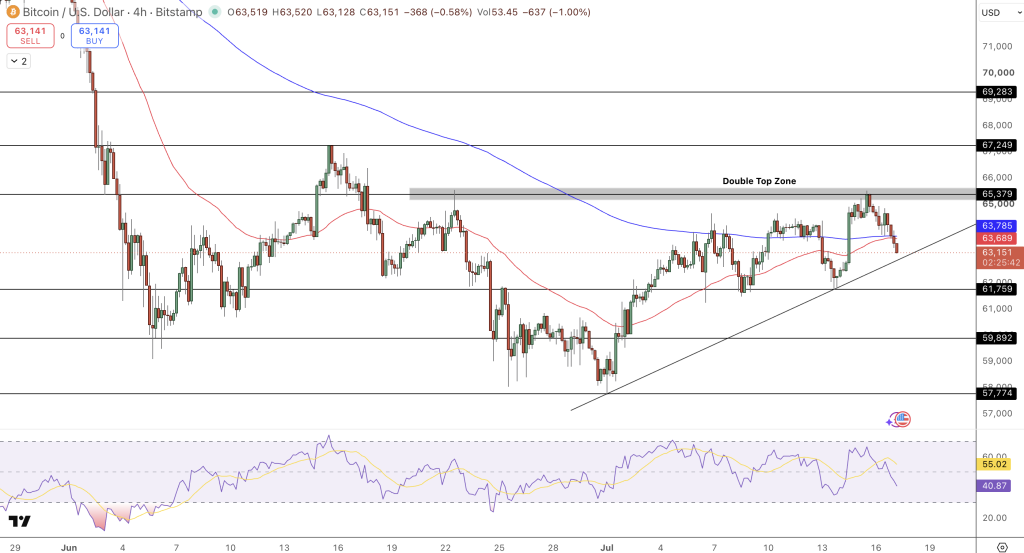
Bitcoin is trading at $63,370. Bitcoin has rejected the $65,380 resistance region, setting up a potential double top structure on the four-hour time frame. Price also fell below both the 50-period exponential moving average (EMA) sitting around $63,700 and the 200-period EMA near $63,800 in the last few hours, while also probing the uptrend line that has been holding since the beginning of July.
As it stands, the $63,000 support region has become an important area to watch.
A break below that level is likely to confirm the bearish scenario and could set the stage for lower prices, first towards $61,760 and potentially another dip towards the $59,890 support region.
For the bulls to invalidate this structure, BTC first needs to reclaim the moving averages and retest the $65,380 high. Should it manage to close above that level, a rally towards the $67,250 level is in the cards.
Finally, the Relative Strength Index (RSI) has fallen to around 43, remaining below the neutral 50 level and indicating that there is still selling pressure building up, although it has yet to fall into the oversold territory. For now, bitcoin looks likely to struggle before recovering above the $65,380 resistance region, after which it can resume its broader uptrend.
- Check out our free forex signals
- Follow the top economic events on FX Leaders economic calendar
- Trade better, discover more Forex Trading Strategies
- Open a FREE Trading Account
- Read our latest reviews on: Avatrade, Exness, HFM and XM

Related Articles


Sidebar rates

Related Posts
 Save
Save