TSMC (TSM) Stock Slips Despite Record Earnings, AI Rally Cools
Despite posting one of the best results of any company in the chip sector, Taiwan Semiconductor Manufacturing Company (NYSE: TSM)...
Quick overview
- TSMC's stock fell nearly 3% despite reporting record revenue and profit, driven by strong AI demand.
- The company raised its 2026 revenue growth outlook to over 40% and increased capital spending to US$60-64 billion.
- Demand for advanced chips and CoWoS packaging continues to exceed supply, indicating a robust market for AI applications.
- Investor concerns seem to stem from profit-taking and valuation issues rather than any decline in TSMC's business fundamentals.
Despite posting one of the best results of any company in the chip sector, Taiwan Semiconductor Manufacturing Company (NYSE: TSMC) fell nearly 3% on July 17. The chipmaker has been at the forefront of this year’s AI rally, which helped drive shares to new all-time highs before investors took some chips off the table following another quarter of strong growth. That reaction has less to do with the quality of the company than it does with whether any of these AI names are in danger of running ahead of themselves. Behind the scenes, things are actually looking even better than before.
Record revenue, record profit, margin expansion and accelerating capital spending all suggest the supply-demand equation for AI-related chips continues to be heavily in demand’s favor.
TSMC Delivers Record Revenue and Profit, AI Demand Remains Strong
TSMC said revenue climbed to US$40.2 billion, or up around 36% year over year, coming in at the top end of previous guidance. Profit climbed to NT$706.6 billion (or around US$22 billion), representing an increase of 77% from the previous year and surpassing analysts’ expectations. Gross profit hit a record 67.7% and operating income was 60.3% as the firm continued to benefit from its dominance in the market. In short, whether it is NVIDIA GPUs, AMD accelerator products, Apple processors or Broadcom networking chips, customers aren’t limited to a single AI winner; they all use the same manufacturer.
AI continues to be the driving force in every segment of TSMC’s operation. “Customer demand is very strong” with a multi-year AI investment cycle still supported by the company’s cloud-based customers in expanding data centers and enterprises spending heavily in generative AI and inference, along with the necessary high-performance computing systems behind it. The company added that other areas such as inference, networking, CPUs and specialized AI processors remain important growth areas. Management noted that demand still exceeds available supply for these advanced chips.
TSMC Raises Full-Year Outlook Again
TSMC said 3-nanometer production continues to be the firm’s largest growth area, and customers are already beginning to test 2-nanometer production. CoWoS advanced packaging is another key revenue source. This process combines AI processors with high-bandwidth memory chips in one chip. AI customers continue to drive demand for the technology, and the advanced packaging technology continues to be a major bottleneck for the industry with TSMC continuing to increase capacity through 2026. Management noted that demand will continue to outstrip supply for both advanced chips and CoWoS products for the foreseeable future.
TSMC also raised its fiscal-year guidance. One of the highlights of this quarterly earnings release was management’s decision to revise upward its full-year outlook. TSMC is now projecting its 2026 revenue to expand by over 40% when measured in U.S. dollars, a significant upgrade from the more than 30% growth rate it had previously anticipated. Furthermore, the company provided a third-quarter revenue guidance range of US$44.6 billion to US$45.8 billion. This outlook suggests yet another record-breaking quarter, notwithstanding the margin guidance being slightly more conservative due to expenses associated with its foreign investments.
Capital Spending Jumps to US$60–64 Billion
Regarding its capital allocation strategy, the firm stressed that it first conducts an independent assessment of long-term AI demand before committing to increased production capacity, a practice designed to mitigate the risk of overcapacity during semiconductor cycles.
On the topic of capital spending, TSMC boosted its 2026 expenditure estimate to US$60 to 64 billion, markedly surpassing the previously announced US$52 to 56 billion forecast. Primarily this capital will be channeled into advanced manufacturing, CoWoS packaging expansion and new facilities in the U.S., Japan and Germany.
Such an increase in capital spending indicates that management views the AI infrastructure spending cycle as being in its nascent phases instead of nearing a zenith. While such higher capital investments will lead to an uptick in depreciation expenses going forward, such moves also bolster TSMC’s edge as the premier semiconductor fabricator in the world.
Why Is TSMC Stock Falling?
At present the stock’s decline seems driven more by investors taking profits than any decline in underlying business fundamentals. After a robust rally that was driven by AI-fuelled optimism, investors are wondering if semiconductor stocks are now priced in for several years of future expansion, and even outstanding results may not be enough in a market that expects perfection.
Additionally, the broader semiconductor sector declined in earnings season as traders exited high performing AI stocks.
In the short term TSMC’s operating performance continues to validate its dominant status. The key question for investors right now is not whether demand is solid but rather how long high-end AI spending can sustain its current trajectory.
TSMC Stock Forecast: Can $250 Support Hold?
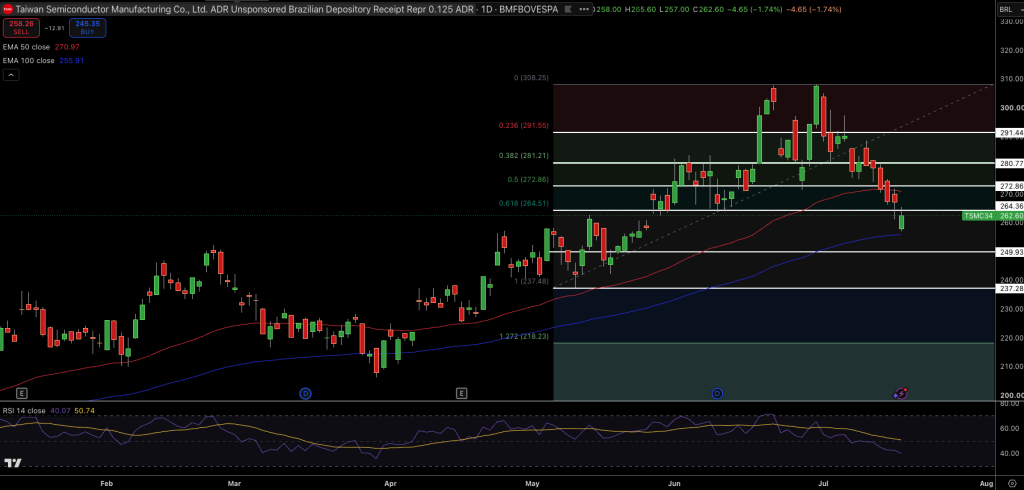
Looking at the stock’s short-term outlook, TSMC has been trending bearish technically given its recent breaking below a key Fibonacci support level and closing below the 50-day Exponential Moving Average (EMA). In its latest price action the stock is hovering around BRL 262.60 with immediate support hovering near BRL 249.93, which is also the level of the 100-day EMA. Should TSMC close decisively below this key zone it can expose a target around BRL 237.28, with a deeper bearish move extending to BRL 218.23.
On the positive side the immediate resistance level sits at BRL 264.36 before BRL 272.86 and BRL 280.77. Bulls will need to push the price back above these points to resume an uptrend. In the meantime the RSI is resting around the 40 level indicating weakening momentum, but not to the point of being oversold. Unless buyers can push TSMC back above the 50-day EMA, the stock will remain technically biased to the downside in the short term in spite of the stellar company fundamentals.
In conclusion, TSMC stock is down roughly 3% on record quarterly earnings. Revenue jumped 36% in Q2 as net income rose an eye-popping 77% to another record. The company also lifted its 2026 revenue growth guidance to over 40% while boosting its capital spending to US$60 to 64 billion for the coming year. Demand for advanced chips and CoWoS packaging for AI applications is outstripping supply. Investors appear concerned by current valuations following the stock’s rally rather than fundamentals, though this is likely just a profit-taking episode.
- Check out our free forex signals
- Follow the top economic events on FX Leaders economic calendar
- Trade better, discover more Forex Trading Strategies
- Open a FREE Trading Account
- Read our latest reviews on: Avatrade, Exness, HFM and XM

Related Articles


Sidebar rates

Related Posts
 Save
Save