Alphabet Stock Rises on ‘Frozen v2’ AI Chip Report as Earnings Put $358 Resistance in Focus
Alphabet stock GOOG rises on reports of a new Gemini AI chip ahead of earnings, with $358 emerging as the key technical resistance.
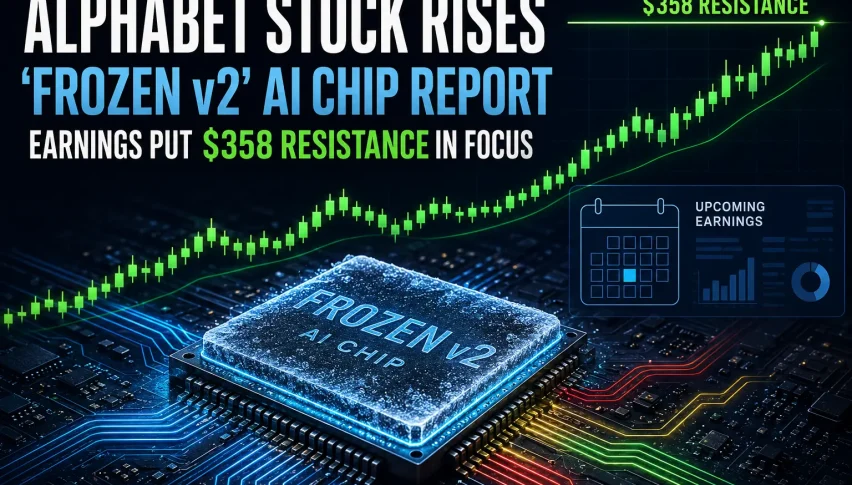
Quick overview
- Alphabet shares rose after reports of Google developing a new AI chip, Frozen v2, aimed at enhancing Gemini's efficiency.
- Investors are focused on the upcoming second-quarter earnings report, seeking reassurance on AI investments translating into cloud growth and profitability.
- The Frozen v2 chip is expected to significantly improve AI processing efficiency, but its financial benefits may not be realized for several years.
- Alphabet's valuation hinges on its ability to convert AI spending into increased cloud revenue and enterprise adoption.
Alphabet shares moved higher Monday after reports that Google is developing a new generation of custom AI chips designed to make Gemini significantly more efficient.
The stock closed at $351.37 before climbing to $353.93 in overnight trading as investors positioned ahead of the company’s second-quarter earnings report on Wednesday.
While the reported chip development boosted sentiment, earnings remain the bigger catalyst. Investors want reassurance that Alphabet’s massive AI investments are translating into stronger cloud growth, improving monetization and sustainable returns.
‘Frozen v2’ Highlights Google’s Full-Stack AI Strategy
According to a report by The Information, Google is developing a specialized inference chip internally known as Frozen v2, designed specifically to run Gemini models more efficiently. Alphabet has not confirmed the project but said it continually researches new hardware innovations and co-designs software and silicon to maximize AI performance.
Unlike Google’s Tensor Processing Units (TPUs), which support a broad range of AI workloads, Frozen v2 would reportedly embed parts of Gemini’s architecture directly into the chip itself.
By hardwiring portions of the model into silicon, Google could significantly reduce memory movement and computational overhead during inference.
Engineers reportedly believe the chip could process six to ten times more AI tokens per unit of power than Google’s latest TPU generation, dramatically improving efficiency for large-scale AI deployments.
The chip is reportedly targeted for deployment around 2028 and is expected to complement, not replace, Google’s TPU roadmap.
AI Compute Has Become Google’s Biggest Bottleneck
The reported project illustrates a broader challenge facing Alphabet.
Demand for AI computing continues to outpace available infrastructure across the industry.
According to reports, Google Cloud has already been forced to limit certain enterprise AI deployments because of internal compute constraints. Earlier this year, Google also secured additional external AI compute capacity as it accelerated Gemini development.
Improving inference efficiency matters because inference, not training, is becoming the largest long-term operating cost for AI companies.
Every AI-powered search result, chatbot response and enterprise workflow requires inference compute.
Reducing the energy and hardware needed for each request could materially improve profitability while expanding Google’s AI capacity without building proportionally more data centers.
Frozen v2 therefore represents more than another chip project.
It reflects Google’s effort to control every layer of the AI stack – from silicon and infrastructure to foundation models, cloud services and consumer applications.
Q2 Earnings Will Be the Bigger Catalyst for GOOG Stock
Despite Monday’s gains, investor attention is firmly focused on Alphabet’s second-quarter earnings due after Wednesday’s market close.
Wall Street expects another quarter of strong cloud growth, supported by accelerating enterprise AI adoption.
Google Cloud has become one of Alphabet’s fastest-growing businesses as customers increasingly deploy Gemini-powered services through Google Cloud Platform.
Investors will also watch:
- Google Cloud revenue growth
- AI infrastructure spending and capital expenditure guidance
- Gemini adoption across Search, Workspace and Cloud
- Search advertising trends
- Management commentary on returns from AI investment
Earlier this year, Alphabet increased its planned 2026 capital expenditure to as much as $190 billion, reflecting aggressive investment in AI infrastructure.
The market generally supports those investments—but only if cloud revenue and AI monetization continue expanding rapidly.
Any indication that AI spending is accelerating faster than revenue could pressure the stock despite otherwise solid earnings.
Competition in AI Continues to Intensify
Alphabet’s AI strategy has improved significantly over the past year, but competition remains fierce.
OpenAI, Anthropic, Meta, Alibaba and several Chinese AI developers continue releasing increasingly capable foundation models.
Reports have also suggested delays affecting Google’s next Gemini Pro release while competition for leading AI researchers remains intense.
Rather than competing solely on model performance, Alphabet increasingly appears focused on efficiency.
Custom hardware gives Google advantages that many competitors cannot easily replicate because it controls its own cloud infrastructure, silicon development and software ecosystem.
That vertical integration could become increasingly valuable as AI inference costs become a larger competitive factor than raw model capability.
GOOG Valuation Still Depends on AI Execution
Alphabet remains one of the world’s largest AI infrastructure investors.
Unlike smaller AI companies, it generates enormous cash flow from Search, YouTube and advertising, allowing it to fund AI expansion without materially weakening its balance sheet.
That financial strength differentiates Google from many competitors.
However, the market increasingly expects measurable returns from those investments.
Alphabet’s valuation now depends not only on continued advertising growth but also on its ability to convert AI spending into higher cloud revenue, stronger enterprise adoption and improved long-term profitability.
Wednesday’s earnings should provide investors with a clearer picture of whether that process is continuing as expected.
Google Cloud Remains Central to the Investment Story
Cloud has become the primary growth engine supporting Alphabet’s AI valuation.
Enterprise customers are rapidly adopting AI services for software development, data analytics, cybersecurity and generative AI applications.
Every additional AI workload increases demand for Google’s cloud infrastructure.
If Frozen v2 eventually delivers the efficiency improvements being discussed, it could lower Google’s operating costs while increasing available compute capacity for enterprise customers.
However, investors are unlikely to receive meaningful financial benefits from the project for several years.
The immediate focus remains Wednesday’s earnings.
Management’s comments regarding Gemini adoption, cloud bookings and AI infrastructure utilization are likely to have a much greater near-term impact on GOOG than hardware expected to arrive later this decade.
GOOG Technical Analysis: $354-$358 Remains the Key Resistance Zone
Alphabet’s 4-hour chart remains technically mixed despite Monday’s rebound.
GOOG is still trading below nearly every major short-term moving average. The 10 EMA sits at $354.46, followed by the 20 EMA at $355.60, 30 EMA at $356.06, 50 EMA at $357.29, VWMA at $357.48, and the Ichimoku baseline near $357.74. Together, these levels create a strong resistance zone between $354 and $358.
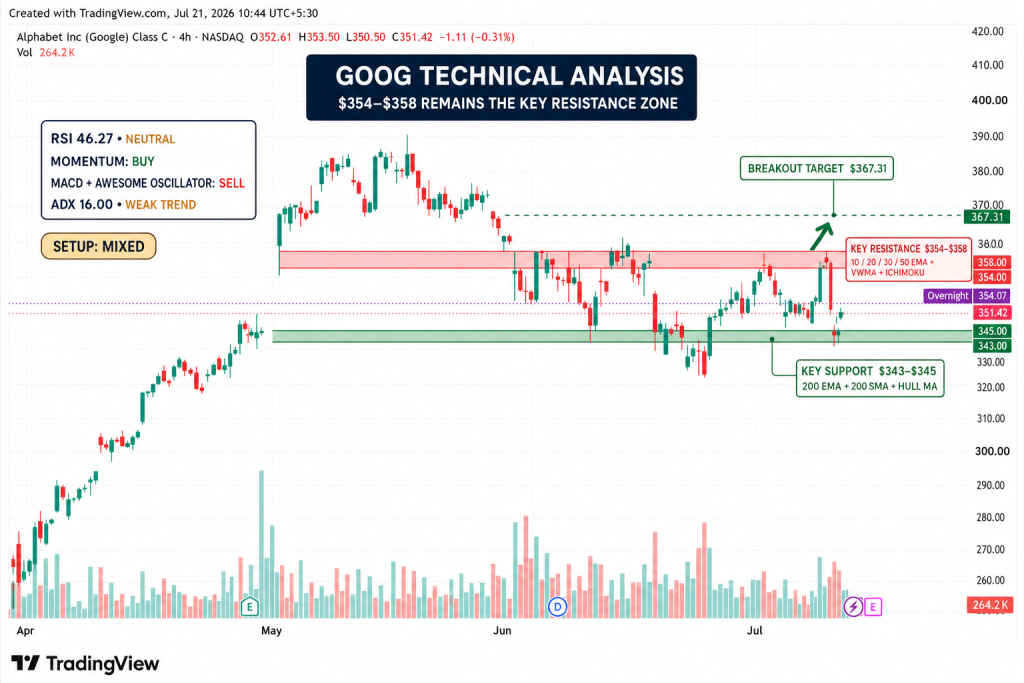
A sustained move above that area would improve short-term momentum and could open the way toward the 100 EMA near $356.68, followed by the 100 SMA around $367.31.
On the downside, the 200 EMA at $345.28, 200 SMA at $342.81, and Hull Moving Average near $344.49 provide the first important support zone. Holding above $343-$345 would keep the broader recovery intact.
Momentum remains mixed. RSI is neutral at 46.27, while Momentum has shifted to a buy signal. However, MACD and the Awesome Oscillator remain on sell signals, and the ADX reading of 16.00 suggests the current trend lacks strong conviction.
What’s Next for Alphabet (GOOG)?
Alphabet enters earnings week with AI once again driving investor sentiment.
The reported Frozen v2 chip reinforces Google’s long-term strategy of optimizing AI through tightly integrated hardware and software. If successful, the technology could improve Gemini’s economics and strengthen Google Cloud’s competitive position.
In the near term, however, earnings matter far more than future chip designs.
Investors will focus on cloud growth, AI monetization, capital spending and management’s outlook for the remainder of 2026.
Technically, GOOG remains below key resistance between $354 and $358. A breakout above that zone would strengthen the bullish case heading into earnings, while a move below $343-$345 would shift attention back toward recent support levels.
For now, Alphabet’s AI ambitions continue to attract investors, but Wednesday’s earnings will determine whether those ambitions are translating into financial performance
- Check out our free forex signals
- Follow the top economic events on FX Leaders economic calendar
- Trade better, discover more Forex Trading Strategies
- Open a FREE Trading Account
- Read our latest reviews on: Avatrade, Exness, HFM and XM

Related Articles



Sidebar rates

Related Posts
 Save
Save