Nokia Stock Jumps 5% Before Earnings as AI Networking Growth Faces a Tough Margin Test
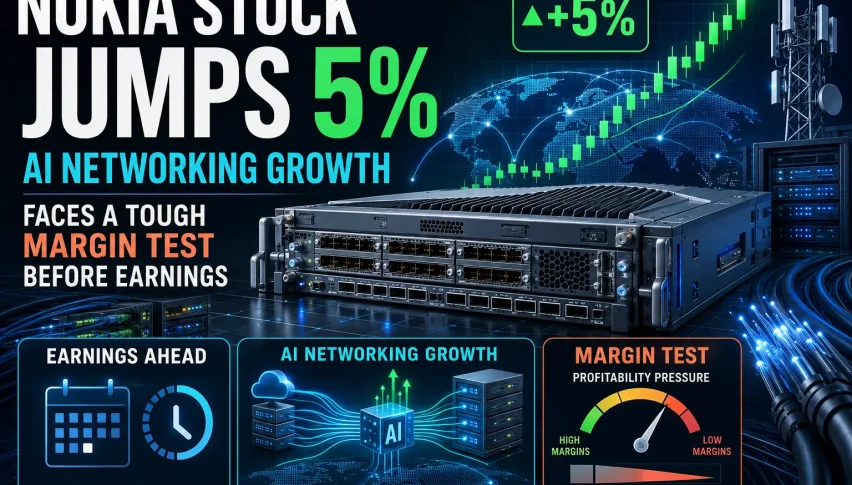
Nokia stock NOK rises 5% before Q2 earnings as AI networking growth puts €9.50 resistance and second-half margins in focus.
Quick overview
- Nokia shares surged 5.25% as investors anticipated strong second-quarter results and recognized the company's growing role in AI infrastructure.
- The upcoming earnings report will reveal whether demand from AI and cloud customers can counterbalance slower spending in traditional telecom sectors.
- Nokia's partnership with Nvidia aims to enhance its AI capabilities, but profitability concerns and rising component costs pose significant challenges.
- Investors are closely monitoring second-half guidance and the company's ability to convert AI demand into sustainable operating profit.
Nokia shares rebounded sharply on Tuesday as investors positioned for the Finnish network equipment maker’s second-quarter results and reassessed its growing exposure to artificial intelligence infrastructure.
The Helsinki-listed stock closed 5.25% higher at €9.386, significantly outperforming the OMX Helsinki benchmark. Nokia’s U.S.-listed ADR also gained more than 5%, snapping a four-session losing streak.
The move recovered part of a steep recent correction but did not erase concerns surrounding profitability, component inflation and the amount of earnings Nokia must generate during the second half of 2026.
Thursday’s report will test whether strong demand from AI and cloud customers can offset slower spending in traditional telecom infrastructure.
Nokia Earnings Put AI Growth in Focus
Nokia is scheduled to release its second-quarter and half-year results on July 23.
Analyst forecasts point to quarterly revenue of approximately €4.8 billion, up from €4.55 billion in the same period last year. Comparable operating profit is expected to reach roughly €380 million, compared with €301 million a year earlier.
Those expectations imply continued sequential improvement after a strong start to the year.
In the first quarter, Nokia reported a 4% increase in net sales and a 54% rise in comparable operating profit to €281 million. The result exceeded market expectations and briefly pushed the stock to its highest level since 2010.
The central question is whether that momentum continued through the June quarter.
Investors will be looking beyond the headline earnings figure toward optical networking growth, AI-related orders, product margins and management’s full-year guidance.
AI and Cloud Sales Are Becoming a Larger Growth Engine for Nokia
Nokia’s transformation is increasingly tied to the infrastructure required to connect AI data centers.
Sales to AI and cloud customers rose 49% during the first quarter, accounting for approximately 8% of group revenue. The company also booked €1 billion in orders from those customers during the period.
Demand has been particularly strong in optical networking, which enables large volumes of data to move quickly between processors, servers and data centers.
Nokia’s Optical Networks business grew 20% in the first quarter, supported by strong orders and customer wins for line systems and pluggable optical products.
That business was strengthened by Nokia’s acquisition of Infinera, which expanded its presence in high-speed optical transport equipment.
As AI models become larger, networking performance is becoming a critical part of data-center infrastructure. Thousands of accelerators must exchange data with minimal delay, creating demand for faster optical connections, routing and switching.
Nokia is attempting to position itself as one of the companies supplying that layer of the AI buildout rather than relying entirely on mature telecom markets.
Nvidia Partnership Strengthens the AI Narrative
Nokia’s AI strategy also includes a major partnership with Nvidia.
Nvidia agreed to invest $1 billion in Nokia in October 2025 as part of a broader collaboration focused on AI-native radio networks, 6G and data-center networking.
The companies are developing AI-RAN systems that combine Nokia’s radio technology with Nvidia’s accelerated computing platforms.
AI-RAN is designed to allow telecom operators to run artificial intelligence workloads and traditional mobile-network functions on shared infrastructure.
Nokia describes the platform as the industry’s first AI-native RAN architecture, with a common software roadmap extending from existing 5G networks toward 6G.
The partnership gives Nokia additional credibility with investors looking for infrastructure companies exposed to AI without relying directly on semiconductor sales.
However, commercial adoption is still developing. Nokia must demonstrate that AI-RAN can become a meaningful revenue source rather than remaining primarily a long-term technology opportunity.
Nokia Faces a Second-Half Margin Challenge
Despite the strong AI narrative, profitability remains the immediate concern.
Early consensus estimates suggest Nokia could generate approximately €657 million in comparable operating profit during the first half of 2026.
To reach the full-year consensus of roughly €2.36 billion, the company would then need to produce around €1.7 billion during the second half.
That would require an estimated second-half operating margin close to 15%, more than double the roughly 7% expected for the first half.
Nokia has historically generated stronger earnings toward the end of the year because of customer spending patterns, project timing and seasonal software revenue.
Still, the required acceleration leaves little room for delays or weaker product mix.
Investors will therefore pay close attention to whether management maintains its full-year comparable operating profit guidance of €2 billion to €2.5 billion.
Nokia said after its first-quarter results that it was tracking above the midpoint of that range, supported by stronger demand in Network Infrastructure.
Rising Component Costs Add Pressure
A second risk comes from rising semiconductor and memory costs.
Ericsson warned last week that surging AI demand was contributing to higher component prices, particularly for memory chips and custom processors used in networking equipment.
The warning sent Ericsson shares sharply lower even though its operating profit slightly exceeded expectations.
Nokia faces many of the same supply-chain pressures.
While the AI boom is creating demand for Nokia’s networking products, it is also increasing competition for the chips and memory needed to manufacture them.
That creates a complicated dynamic: stronger AI infrastructure spending may lift revenue while simultaneously squeezing gross margins.
Management’s comments on component availability, pricing actions and supply contracts could therefore matter more than the second-quarter profit figure itself.
A weaker product mix or faster cost inflation would make the required second-half margin recovery more difficult.
Traditional Telecom Spending Remains Uneven
Nokia’s AI businesses are expanding quickly, but they still represent a relatively small portion of total sales.
The company remains exposed to mobile operators, whose network spending has been uneven following the major global rollout of 5G.
Telecom companies have become more selective with capital expenditure, particularly in markets where earlier 5G investments have yet to generate substantial new revenue.
Nokia has also faced competitive pressure from Ericsson and Huawei in major radio-network contracts.
Its strategic shift toward optical networking, data centers and AI-native networks is designed partly to reduce its dependence on slower traditional carrier spending.
Recent agreements with Deutsche Telekom, TIM Brasil and Telefónica show that AI and network modernization can create new opportunities within the telecom market.
However, those projects must scale quickly enough to offset weaker demand elsewhere.
Valuation Leaves Less Room for Disappointment
Nokia shares have risen significantly over the past year as investors reclassified the company from a slow-growth telecom equipment supplier toward an AI networking beneficiary.
The rally has pushed valuation multiples above their historical averages and closer to enterprise networking companies with larger AI exposure.
That creates a higher bar for earnings.
Strong optical-network growth and AI orders may already be partly reflected in the share price, meaning investors could react negatively to cautious guidance even if the reported quarter meets expectations.
The stock’s recent volatility demonstrates that tension.
Tuesday’s 5% rebound followed a much larger decline during the previous week as traders reduced exposure ahead of earnings.
The Q2 report must show not only that AI demand remains strong but also that Nokia can convert that demand into higher margins and cash flow.
NOK Technical Analysis: €9.50-€10.00 Is the Key Recovery Zone
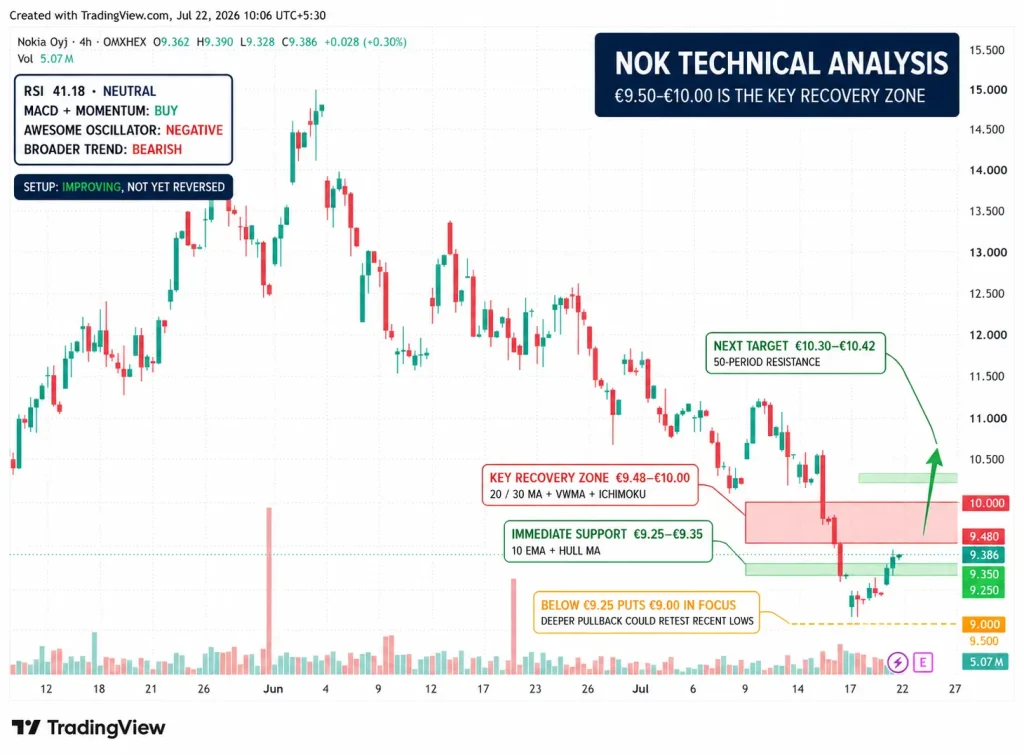
Nokia’s 4-hour chart has improved after the rebound to €9.386, but the broader trend remains under pressure.
The stock has moved above the 10 EMA at €9.255 and the Hull Moving Average near €9.354, creating immediate support around €9.25-€9.35.
The first major resistance sits between €9.48 and €10.00. This area includes the 20-period moving averages, the VWMA at €9.476, the 30-period averages near €9.83-€9.96 and the Ichimoku baseline at €9.939.
A decisive move above €10 would strengthen the rebound and could expose the 50-period resistance zone near €10.30-€10.42.
On the downside, a break below €9.25 would weaken the recovery and put €9.00 back in focus. A deeper pullback could retest the recent lows.
Momentum is improving but remains mixed. MACD and Momentum have shifted to buy signals, while RSI is neutral at 41.18. The Awesome Oscillator remains negative, suggesting the stock has not yet confirmed a broader trend reversal.
What to Watch During Nokia Earnings
Nokia enters its second-quarter report with a stronger AI growth story but a demanding earnings setup.
Optical networking, data-center connectivity and AI-RAN partnerships are giving the company access to faster-growing markets beyond traditional telecom infrastructure.
The first-quarter figures showed that demand is real, with AI and cloud sales rising 49% and orders reaching €1 billion.
Thursday’s challenge is proving that growth can support margins.
Investors will focus on second-half guidance, component costs, optical-network orders and the pace at which Nokia converts AI demand into operating profit.
Technically, €9.50-€10.00 is the key zone. A breakout would strengthen the recovery, while failure to clear it could leave the stock vulnerable to another pullback toward €9.25.
For now, Nokia’s AI transformation is gaining traction—but its earnings must show that the strategy can deliver more than revenue growth.
- Check out our free forex signals
- Follow the top economic events on FX Leaders economic calendar
- Trade better, discover more Forex Trading Strategies
- Open a FREE Trading Account
- Read our latest reviews on: Avatrade, Exness, HFM and XM

Related Articles



Sidebar rates

Related Posts
 Save
SaveAva

