Capital One Earnings Beat as Credit Losses Fall, but COF Stock Falls Below $210
Capital One Financial beats Q2 estimates as interest income rises and credit losses fall, but COF stock remains capped below $210.

Quick overview
- Capital One's second-quarter earnings report showed a net income of $3 billion, driven by higher interest income and improving credit quality.
- Despite positive results, the stock's muted reaction reflects investor concerns about the integration of Discover and its long-term revenue potential.
- Consumer spending remained resilient, with credit card purchase volume increasing by 26% year-over-year, indicating strong consumer activity.
- The integration costs from the Discover and Brex acquisitions continue to pressure expenses, raising questions about future profitability.
Capital One Financial shares traded broadly flat overnight despite a stronger-than-expected second-quarter earnings report that showed higher interest income, resilient consumer spending and improving credit quality.
COF closed at $206.22, down 0.27%, before edging up to $206.75 overnight.
The muted reaction suggests investors were encouraged by the quarter but remain focused on the larger strategic question surrounding Capital One: how quickly the bank can convert its acquisition of Discover into sustainable revenue growth, network economics and cost savings.
The results provided several positive signals. Profit increased, net interest income strengthened and credit losses declined. However, expenses associated with the Discover and Brex integrations remained elevated, limiting enthusiasm after a difficult year for the stock.
Capital One Profit Rises on Higher Interest Income
Capital One reported second-quarter net income of $3 billion, equivalent to $4.73 per diluted common share.
After adjusting for acquisition-related and integration expenses, earnings reached $5.81 per share, compared with $5.48 a year earlier. The company’s investor-relations page confirmed the $3 billion headline profit and $4.73 GAAP EPS result.
Adjusted net income available to common shareholders increased to approximately $3.60 billion, up from $2.77 billion in the comparable period last year.
Net interest income—the difference between what a lender earns on loans and pays on deposits—rose to $12.37 billion, from roughly $10 billion a year earlier.
Non-interest income, which includes interchange revenue, service charges and other customer fees, increased almost 39% to $3.48 billion.
The figures show that Capital One continues to benefit from its large credit card portfolio and the additional scale created by the Discover acquisition.
Credit Quality Was the Strongest Part of the Quarter
Improving consumer credit trends were one of the most important elements of the report.
Capital One’s provision for credit losses fell by approximately $1.1 billion from the previous quarter to $3 billion. The decline reflected lower expected losses and a reserve release as credit performance improved.
The company’s overall net charge-off rate fell by 22 basis points quarter over quarter to 3.23%, while domestic card charge-offs and delinquencies also moved lower.
Capital One’s credit card net charge-off rate declined to 4.71%, from 5.20% a year earlier, providing evidence that borrowers are continuing to make payments despite pressure from elevated living costs.
That matters because Capital One has greater exposure to credit cards and consumer lending than many diversified banks.
Credit card loans typically generate higher interest income, but they also carry greater default risk during periods of economic stress.
The latest figures suggest consumer balance sheets remain more resilient than some investors feared.
Consumer Spending Remains Resilient
Capital One’s earnings also showed continued strength in consumer activity.
Credit card purchase volume reached $253.8 billion, representing a 26% year-over-year increase that included organic growth and the expanded Discover portfolio.
Reuters noted that consumer spending remained resilient during the quarter despite renewed inflation and economic-growth concerns linked to higher energy prices.
Credit card loans increased by $4.9 billion from the previous quarter to $275.4 billion, while auto loans grew by $3.6 billion to $89.3 billion.
Total loans held for investment rose 2% to $457.2 billion.
Loan growth supports future interest income, but investors will continue watching whether increased borrowing eventually leads to higher delinquencies.
For now, declining charge-offs and stable payment behavior indicate that credit conditions remain manageable.
Discover Integration Remains the Main Strategic Story
Capital One completed its acquisition of Discover in 2025, creating one of the largest consumer finance and payments businesses in the United States.
The strategic attraction extends beyond Discover’s card customers.
Unlike most banks, Capital One now owns a payment network, allowing it to capture more of the economics generated whenever customers make purchases.
The company has completed the migration of its debit cards to the Discover network and is now testing Capital One credit cards on that infrastructure.
A wider migration could reduce Capital One’s dependence on Visa and Mastercard and allow it to retain more transaction revenue.
However, moving card volume is technically complex. Capital One must preserve acceptance, security, customer experience and international usability while combining two large technology platforms.
Discover’s network has significant global reach, with hundreds of millions of cards and acceptance across more than 185 countries and territories.
Even so, Visa and Mastercard remain larger and more widely used, making execution critical.
Integration Costs Continue to Pressure Expenses
The benefits of the Discover transaction will take time to emerge fully.
Capital One reported total non-interest expense of approximately $9 billion, up 7% from the first quarter.
That included roughly $494 million in acquisition amortization, $298 million in Discover integration costs and $96 million associated with the Brex integration.
Higher technology, marketing and integration expenses offset part of the quarter’s revenue growth.
Management has argued that the spending is necessary to combine technology systems, migrate customers and build a more integrated payments platform.
Investors, however, want greater evidence that the acquisition will eventually generate meaningful operating leverage.
The bank has previously identified billions of dollars in potential revenue and cost synergies from Discover, but those gains will depend on successful network migration and disciplined expense management.
Brex Adds Another Growth Platform
Capital One completed its acquisition of corporate card and financial technology company Brex in April 2026.
Brex expands Capital One’s exposure to startups, technology companies and business spending, complementing its traditional consumer credit card operation.
The acquisition also brings additional software and expense-management capabilities.
Brex’s results were included in Capital One’s credit card segment during the quarter, although the integration added to near-term expenses.
The combination of Discover and Brex shows Capital One pursuing a broader transformation from a consumer lender into an integrated payments, banking and financial technology company.
That strategy could support long-term growth, but it also increases execution risk while multiple platforms are combined simultaneously.
Why the Capital One Stock Reaction Was Muted
Capital One’s earnings were strong enough to beat expectations, but the stock barely moved.
One explanation is that improving credit quality was already anticipated following positive results from other major U.S. banks.
The sector has generally benefited from resilient borrowers, loan growth and stronger net interest income during the second-quarter earnings season.
Capital One shares have also fallen almost 15% in 2026, suggesting investors remain cautious about integration spending, regulatory risk and the economic outlook.
The results reduced fears of immediate deterioration, but they did not completely resolve questions surrounding Discover’s long-term return on investment.
COF Technical Analysis: $208-$210 Is the Immediate Resistance Zone
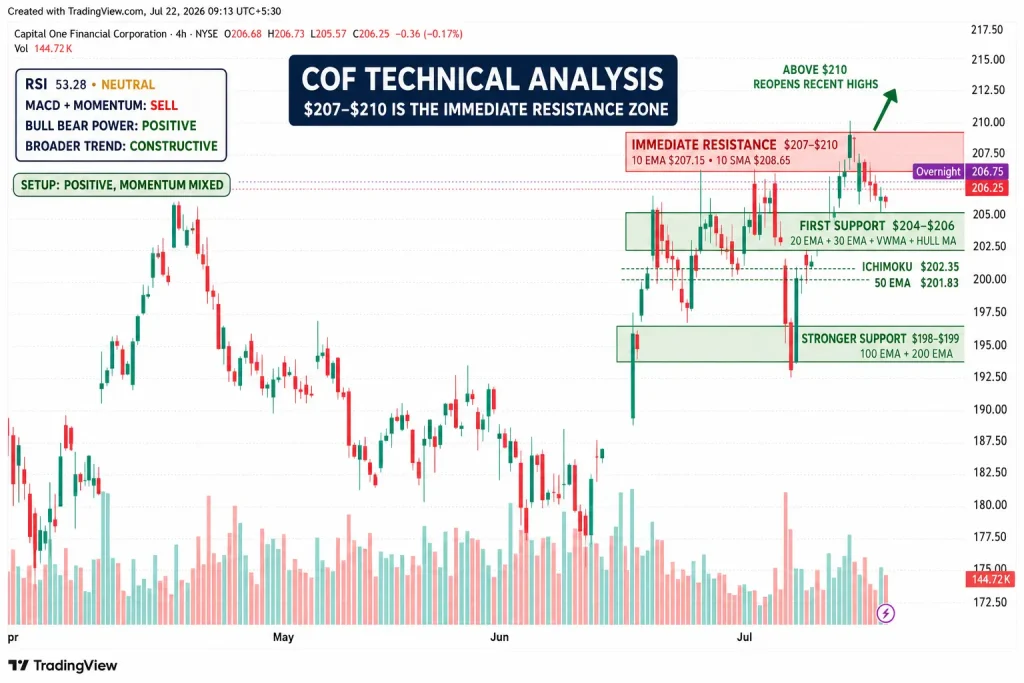
Capital One’s 4-hour chart remains constructive, although momentum has weakened near current levels.
COF is trading above the 20-, 30-, 50-, 100- and 200-period moving averages, keeping the broader short- and medium-term trend positive.
The first support zone sits between $204 and $206, where the 20 EMA, 30 EMA, VWMA and Hull Moving Average converge.
A break below that area could expose the Ichimoku baseline near $202.35, followed by the 50 EMA around $201.83. Stronger support remains near $198-$199, where the 100 and 200 EMAs are located.
On the upside, the immediate hurdle is $207-$210, including the 10 EMA at $207.15 and 10 SMA at $208.65.
A decisive move above $210 would strengthen the bullish setup and could reopen the path toward the recent highs.
Momentum is mixed. RSI remains neutral at 53.28, while MACD and Momentum show sell signals. Bull Bear Power remains positive, indicating buyers are still defending the broader trend despite the short-term slowdown.
What’s Next for Capital One?
Capital One’s second-quarter results showed solid revenue growth, stronger profitability and improving consumer credit performance.
The decline in charge-offs and credit-loss provisions is particularly encouraging because it suggests the company’s large card portfolio remains healthy.
The longer-term catalyst remains the Discover integration.
Successfully moving more Capital One cards onto the Discover network could improve transaction economics, strengthen the company’s competitive position and create a more differentiated payments business.
The risks are higher expenses, operational complexity and the possibility that economic conditions weaken before those benefits fully emerge.
Technically, COF remains above important moving averages but faces resistance near $208-$210.
A breakout would support another move higher, while a loss of $204 could trigger a pullback toward $202 and $198.
For now, the quarter strengthens Capital One’s fundamental position—but investors still want clearer evidence that the Discover transformation can deliver lasting value.
- Check out our free forex signals
- Follow the top economic events on FX Leaders economic calendar
- Trade better, discover more Forex Trading Strategies
- Open a FREE Trading Account
- Read our latest reviews on: Avatrade, Exness, HFM and XM

Related Articles



Sidebar rates

Related Posts
 Save
Save