MSFT Stock Rebounds Toward $386 as Microsoft Earnings Test Azure Growth and $190 Billion AI Spending
Microsoft (MSFT) rebounds toward $386 before earnings as Azure growth, Copilot adoption and $190 billion AI spending face a critical test.
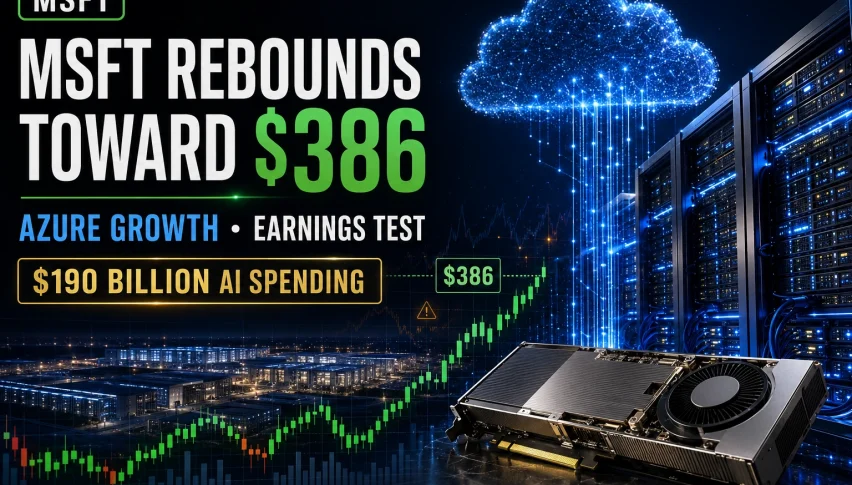
Microsoft stock rose toward $385.68 before its July 29 earnings report, as investors weighed resilient Azure growth and an attractive valuation against enormous AI spending, uncertain Copilot returns and a weak technical structure.
Microsoft Earnings Could Decide Whether MSFT Reclaims $400 or Extends Its 25% Annual Decline
Microsoft stock is attempting to recover before one of its most important earnings reports in years, with investors demanding proof that the company’s enormous artificial intelligence investments can generate sufficient growth.
MSFT finished at $381.70, up only 0.03%, before rising 1.04% to approximately $385.68 in pre-market trading. The modest recovery follows a difficult period in which the stock has lost around 25% over the previous year and remains more than 30% below its record high.
Microsoft will report fiscal fourth-quarter results after the market closes on Wednesday, July 29. Wall Street expects another quarter of double-digit revenue and earnings growth, but the headline numbers may not determine the stock’s direction.
Azure growth, Copilot adoption, capital-expenditure guidance and management’s ability to explain the long-term economics of AI will likely have a much larger influence.
Microsoft Earnings Expectations Remain Demanding
Analysts expect Microsoft to report quarterly revenue of approximately $87.4 billion to $87.6 billion, representing growth of around 14% from the previous year.
Consensus earnings are near $4.21 to $4.24 per share, an increase of approximately 15%.
The expectations reflect continued expansion across Azure, Microsoft 365, security, data platforms and artificial intelligence services.
Microsoft exceeded forecasts in the previous quarter, reporting revenue of approximately $82.9 billion compared with expectations near $81.4 billion. Earnings reached $4.27 per share, above the consensus estimate of roughly $4.06.
That history provides some support ahead of the report. However, the market has become increasingly unwilling to reward earnings beats if they are accompanied by rising costs, weaker margins or disappointing forward guidance.
Microsoft may therefore need to deliver more than another modest beat. Investors want evidence that its AI investments can improve growth without permanently weakening free cash flow.
Azure Growth Must Justify the AI Investment Boom
Azure remains the most important component of Microsoft’s earnings story.
Management previously guided for Azure growth of approximately 39% to 40% in constant currency, broadly consistent with its recent performance.
A result near or above 40% would reinforce the argument that customer demand is absorbing the computing capacity Microsoft has spent heavily to build. It would also suggest that AI services are strengthening Azure’s competitive position against Amazon Web Services and Google Cloud.
However, a slowdown would be difficult for investors to overlook.
Microsoft’s 2026 capital expenditure has been estimated at approximately $190 billion as the company expands data centers, purchases advanced processors and builds the energy and networking infrastructure required for AI.
The spending is intended to create future capacity, but it also raises the financial hurdle. If Azure growth falls short, investors may question whether Microsoft is investing too far ahead of demand.
The company has also faced internal computing constraints, suggesting that available capacity remains tight. That can be interpreted as evidence of strong demand, but it may also limit Microsoft’s ability to serve customers and monetize its growing AI pipeline.
Copilot Monetization Faces a Critical Test
Copilot represents Microsoft’s most visible effort to turn artificial intelligence into a recurring enterprise-software business.
The company has integrated Copilot across Microsoft 365, GitHub, Windows, security products and other business applications. Microsoft 365 Business began embedding Copilot more directly from July 1, shifting the product closer to a standard feature rather than a separate add-on.
That strategy could increase paid adoption and strengthen revenue per customer.
Some estimates suggest Copilot could exceed 25 million paid enterprise seats by the end of 2026 if deployment continues accelerating.
However, investors still lack clarity regarding usage, retention and profitability.
Competition from ChatGPT, Claude, Google Gemini and lower-cost open-weight models has intensified. Customers may also become reluctant to expand AI spending if token consumption produces unpredictable costs.
Microsoft needs to show that Copilot can improve Microsoft 365 growth, deepen customer relationships and support pricing rather than simply create another expensive infrastructure obligation.
General statements about adoption may not be enough. The market is increasingly looking for measurable commercial progress.
Nadella’s AI Bubble Warning Highlights the Risk
Microsoft CEO Satya Nadella has warned that AI could become a speculative bubble unless its benefits spread beyond a narrow group of large technology companies.
His argument focuses on diffusion. AI investment becomes economically sustainable only if the technology produces meaningful gains across smaller businesses, traditional industries and global economies.
This warning is particularly relevant for Microsoft.
The company is one of the largest beneficiaries of AI infrastructure spending, but it is also one of the industry’s biggest investors. Its long-term returns depend on enterprise customers using AI widely enough to justify the data centers and computing systems being built today.
Nadella has also emphasized the importance of trust in American technology and the strength of the broader U.S. software ecosystem.
Cheaper Chinese AI models may increase competitive pressure, but many of those models still run through American cloud platforms. Open-weight systems can also be evaluated, customized and deployed using Azure infrastructure.
That creates an opportunity for Microsoft to benefit even when customers choose models developed elsewhere.
However, lower-cost alternatives could reduce pricing power. Microsoft must demonstrate that security, governance, integration and enterprise trust are valuable enough to protect margins.
High AI Costs Threaten Microsoft’s Free Cash Flow
Capital expenditure will probably generate the most scrutiny during the earnings call.
Microsoft spent approximately $31.9 billion in the previous quarter, while investors are looking for evidence that future spending will become more disciplined.
Some market estimates place the preferred fiscal 2027 quarterly capex level near $22 billion. Guidance substantially above that threshold could renew fears that the AI buildout will remain a “capital black hole.”
The problem is not necessarily that Microsoft is spending too much. The company has a strong balance sheet, substantial operating cash flow and an enormous commercial customer base.
The risk is that infrastructure costs may rise faster than AI revenue.
Advanced chips, electricity, data-center construction and token-based model usage all carry significant expenses. Even if adoption increases, Microsoft must prove that the revenue generated by those workloads produces attractive returns.
A disciplined spending outlook combined with strong Azure growth could ease these concerns. Another major increase in projected capex could overshadow otherwise solid results.
MSFT’s Lower Valuation Offers Some Support
Microsoft’s correction has made the stock considerably less expensive relative to its own history.
At approximately $381.70, MSFT trades near 22.7 times trailing earnings, well below its five-year average multiple of roughly 32.5.
This valuation suggests that investors have already priced in a meaningful degree of disappointment.
Microsoft remains highly profitable, with leading positions in enterprise software, cloud infrastructure, operating systems, developer tools and cybersecurity. Its ecosystem also gives the company several ways to distribute and monetize AI products.
However, a lower valuation does not guarantee an immediate recovery.
If Azure growth disappoints, Copilot adoption remains unclear or capital spending rises again, the market may conclude that the reduced multiple is justified.
MSFT Technical Outlook Remains Bearish Below $390
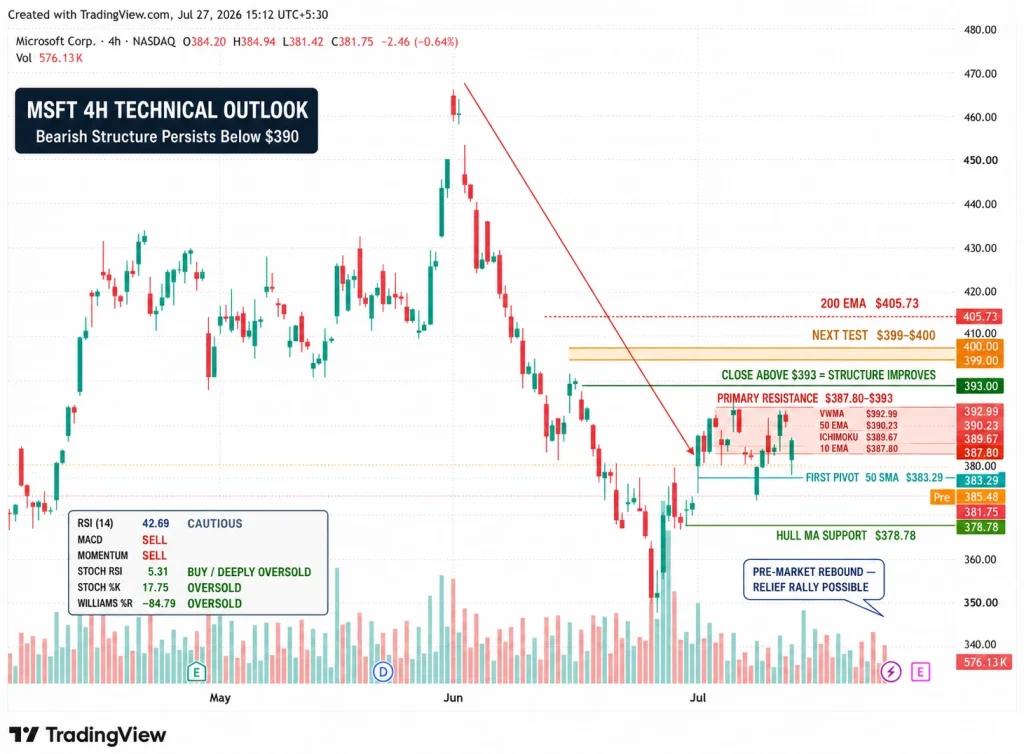
From a technical perspective, Microsoft’s four-hour chart remains weak despite the pre-market rebound.
At $381.70, MSFT is trading below every major simple and exponential moving average. The Hull moving average at $378.78 is the only listed moving average showing a buy signal, suggesting buyers are attempting to form a short-term floor.
The 50-period simple moving average at $383.29 provides the first pivot. The pre-market move to $385.68 has pushed the stock above that level, but stronger resistance is concentrated between approximately $387.80 and $393.
This zone includes the 10-period EMA at $387.80, the Ichimoku baseline at $389.67, the 50-period EMA at $390.23 and the 20-period volume-weighted average near $392.99.
A sustained break above $393 could allow MSFT to challenge the $399–$400 region. The 200-period EMA at $405.73 would then become the next major resistance level.
Momentum remains cautious. The RSI stands at 42.69, while MACD and the Momentum indicator both show sell signals.
However, the Stochastic RSI is deeply depressed at 5.31 and shows a buy signal. Stochastic %K at 17.75 and Williams %R at -84.79 also indicate that the recent pullback is approaching oversold conditions.
This creates the possibility of an earnings-driven relief rally, but the broader trend will remain bearish unless Microsoft recovers $393 and then $400.
Microsoft Faces a Critical AI Return Test
Microsoft enters earnings with a compelling combination of strong fundamentals, depressed sentiment and a demanding strategic challenge.
Azure continues growing near 40%, Copilot has access to one of the world’s largest enterprise customer bases and the stock trades at a substantial discount to its historical valuation.
However, $190 billion of AI spending has changed the standard by which investors judge the company.
Microsoft must show that cloud demand, Copilot adoption and enterprise AI usage can grow quickly enough to support its infrastructure expansion. It must also provide confidence that capital expenditure will not continue rising without a corresponding improvement in cash flow.
For now, the pre-market rebound suggests buyers are willing to defend the stock near $380. A strong earnings report could lift MSFT through $390 and toward $400, while weaker Azure growth or aggressive spending guidance could expose lower support and extend the broader decline.
Microsoft’s AI position remains powerful, but Wednesday’s report will determine whether that advantage is becoming a profitable growth engine or an increasingly expensive promise.
- Check out our free forex signals
- Follow the top economic events on FX Leaders economic calendar
- Trade better, discover more Forex Trading Strategies
- Open a FREE Trading Account
- Read our latest reviews on: Avatrade, Exness, HFM and XM

Related Articles



Sidebar rates

Related Posts
 Save
Save