SNDK Stock Eyes 1,000 After Breaking 1,300 Support as Semiconductor Selloff, Chinese Competition Weigh
SanDisk stock suffered a brutal decline, falling 12% and breaking below $1,300 technical support zone as a broad semiconductor selloff, AI spending concerns, Chinese competition, and pre-earnings caution combined to undermine investor confidence.

SanDisk stock suffered a brutal decline, falling 12% and breaking below $1,300 technical support zone as a broad semiconductor selloff, AI spending concerns, Chinese competition, and pre-earnings caution combined to undermine investor confidence.
SanDisk Stock Crashes Below $1,300 as Memory-Sector Weakness Intensifies
SanDisk shares came under renewed selling pressure, plunging another 12% and breaking below the important $1,300 technical support zone as investors reduced exposure to high-flying semiconductor stocks.
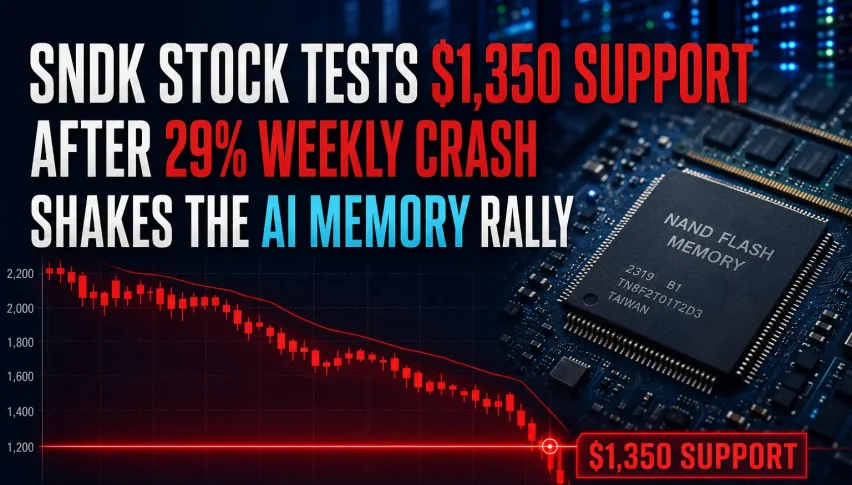
The sharp decline leaves the stock increasingly vulnerable to a move toward the next major technical area around $1,000, particularly as investors prepare for SanDisk’s August 5, 2026 earnings report.
The selloff is part of a broader retreat across the semiconductor industry. Nvidia, AMD, Intel, Arm and other chipmakers have also experienced significant declines as investors reassess the extraordinary valuations attached to the artificial intelligence investment cycle.
Weakness across Korean and Japanese technology stocks has added to the negative sentiment, suggesting that the pressure is becoming increasingly global rather than being isolated to individual companies.
SanDisk Stock Breaks Key Technical Support
The break below $1,300 represents a worrying development for SanDisk shareholders.
The stock had previously benefited from strong expectations surrounding memory demand from AI infrastructure, cloud computing, and data centers. However, the latest selling wave suggests investors are becoming increasingly concerned that the positive expectations surrounding the memory sector may already be reflected in valuations.
A sustained move below $1,300 could encourage additional technical selling, potentially exposing the stock to the $1,000 area.
The timing is particularly uncomfortable with earnings approaching.
Investors will be looking for evidence that strong demand and pricing conditions are translating into sustainable revenue and profit growth. Any disappointing guidance or signs of weakening memory prices could intensify the selloff.
Kimi K3 Raises New Questions About AI Demand
One of the latest concerns affecting the broader technology sector is the emergence of Kimi K3, an open-source AI model developed by China’s Moonshot AI.
The development has intensified debate over whether advanced AI models have genuine competitive moats and whether the enormous infrastructure investments being made today will ultimately generate sufficient returns.
Investors have assumed that increasingly sophisticated AI models would require enormous amounts of computing power, supporting demand for advanced chips and high-performance memory.
However, cheaper and more efficient AI models could challenge that assumption.
If developers can achieve similar results with less computing power, demand for the hardware required to operate AI workloads could eventually grow more slowly than currently expected.
That would not necessarily threaten SanDisk’s business immediately, but it could undermine some of the aggressive growth assumptions supporting the broader semiconductor market.
OpenAI Financing Raises AI Spending Concerns
Another source of uncertainty is the enormous financing requirements behind the AI infrastructure boom.
According to a Wall Street Journal report cited in market discussions, Nvidia is reportedly in talks to provide roughly $250 billion in financing guarantees connected to a massive OpenAI infrastructure project.
The proposed financing would reportedly support a lease for a 10-gigawatt data center project being developed by SoftBank subsidiary SB Energy in southern Ohio.
The overall project could involve more than $500 billion in spending, including computing hardware.
The sheer scale has raised uncomfortable questions about whether the AI infrastructure buildout is becoming increasingly dependent on complex financing structures rather than customer balance sheets and organically generated cash flow.
Some investors may begin questioning whether chipmakers and technology companies are becoming part of a circular ecosystem in which financing ultimately helps create demand for the same hardware being sold.
If concerns over the quality of AI demand increase, semiconductor valuations could face additional pressure.
TSMC Price Increases Offer Limited Relief
One potential positive development for the semiconductor industry is a reported possibility that Taiwan Semiconductor Manufacturing Company could raise contract chip manufacturing prices by up to 10% in 2027, with some products potentially seeing increases of as much as 20%.
The reported increases are linked to higher material costs, semiconductor manufacturing equipment expenses, and the construction of overseas facilities.
Higher prices could indicate that demand for advanced chips remains strong.
This could indirectly benefit SanDisk because AI infrastructure requires high-performance memory to support increasingly complex workloads, particularly during inference.
However, the relationship is not guaranteed.
SanDisk remains exposed to the highly cyclical nature of the memory market, meaning strong AI demand does not automatically eliminate the risk of future oversupply or pricing pressure.
Chinese Competition Creates a Long-Term Threat
China’s rapidly expanding semiconductor industry represents another potential headwind.
ChangXin Memory Technologies, or CXMT, has emerged as an increasingly important player in the DRAM market and continues expanding its production capabilities.
Reports that Apple is testing CXMT memory chips for products sold in China have raised concerns about the potential rise of domestic Chinese memory suppliers.
Nio has also reportedly invested $23.3 million in CXMT, highlighting the growing support behind China’s semiconductor ambitions.
The immediate impact on SanDisk may be limited, but the longer-term implications could be more significant.
If Chinese manufacturers continue improving their technology and expanding capacity, global memory pricing could eventually come under pressure.
Technical Reversal Signals Weakening Momentum
SanDisk’s recent price action has significantly weakened its technical outlook.
After reaching an all-time high near $2,354, the stock has experienced an aggressive correction, breaking below several important support levels before testing the $1,300 area for a second time today and eventually breaking below it.
SNDK Chart Daily – Will the 50 SMA Turn Into Resistance Now

With selling pressure accelerating, traders pushed the price below the $1,300 region and the 100-day moving average in green, which acted as support before, was broken Now the SNDK stock is heading toward the next support zone at $1,000.
Memory Cycle Risks Return
The latest selloff also highlights the cyclical nature of the memory industry.
AI infrastructure, cloud computing, and enterprise storage have strengthened demand expectations and supported optimism around memory pricing.
But memory markets have historically experienced boom-and-bust cycles.
When prices rise and supply becomes constrained, manufacturers typically increase production capacity. If new supply eventually grows faster than demand, prices can reverse sharply and margins can deteriorate.
That risk remains particularly relevant as manufacturers invest aggressively to capture the expected growth from AI.
The key question is whether AI represents a genuine structural shift in memory demand or whether the industry is once again moving toward an unsustainable supply expansion.
SanDisk Advances Its Technology, but Risks Remain
SanDisk continues to make progress in advanced memory technology despite the deteriorating market sentiment.
The company and long-term partner Kioxia have advanced production of tenth-generation 3D NAND flash memory at the Fab2 facility within Japan’s Kitakami manufacturing complex.
The technology is aimed at supporting enterprise computing, hyperscale cloud infrastructure, AI applications, and next-generation data centers.
The development incorporates CMOS directly Bonded to Array architecture, designed to improve performance, power efficiency, and storage density.
However, technological progress alone may not protect the stock from a broader sector downturn.
SanDisk now faces a difficult combination of high expectations, cyclical memory risks, expanding global capacity, Chinese competition, and uncertainty over the sustainability of AI infrastructure spending.
With shares breaking below $1,300, the technical picture has deteriorated significantly. Unless buyers quickly reclaim that level, the stock could remain vulnerable to further selling toward $1,000 as investors await earnings for clearer evidence that the memory boom can support the company’s elevated expectations.
- Check out our free forex signals
- Follow the top economic events on FX Leaders economic calendar
- Trade better, discover more Forex Trading Strategies
- Open a FREE Trading Account
- Read our latest reviews on: Avatrade, Exness, HFM and XM

Related Articles
Sidebar rates

Related Posts
 Save
Save