NVDA Stock Falls Below $200 as $250 Billion OpenAI Plan Revives AI Financing Fears
Nvidia stock NVDA falls below $200 as a possible $250 billion OpenAI guarantee fuels circular-financing fears despite new AI partnerships.
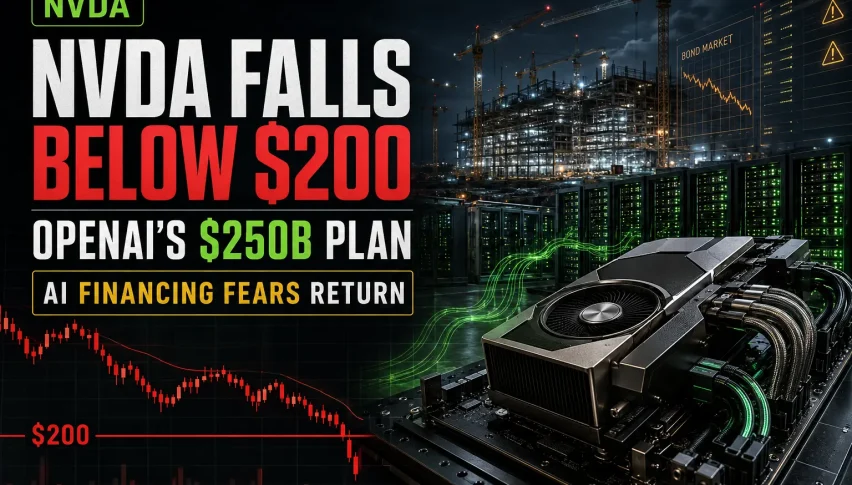
Nvidia stock fell nearly 5% below $200 as concerns over a possible $250 billion OpenAI financing guarantee overshadowed new partnerships and continued demand for its Vera Rubin AI systems.
Nvidia Stock Extends Decline as OpenAI Exposure and Chinese Competition Pressure AI Shares
Nvidia shares came under heavy selling pressure on Monday as investors questioned whether the company’s increasingly large investments across the artificial intelligence ecosystem are supporting genuine demand or creating circular financing risks.
NVDA fell $10.33, or 4.99%, to $196.51 before sliding another 0.70% to approximately $195.11 in overnight trading. The decline pushed Nvidia below the psychological $200 level and weighed on the broader semiconductor sector.
AMD fell more than 5%, while memory and semiconductor-equipment stocks also retreated as concerns surrounding AI infrastructure spending spread across the industry.
The immediate catalyst was a report that Nvidia could provide approximately $250 billion in financial guarantees supporting OpenAI’s planned data-center project in Ohio.
The proposal would strengthen one of Nvidia’s most important customer relationships. However, its enormous scale has raised questions about whether the chipmaker is taking on excessive financial exposure to ensure that AI companies can continue buying its processors.
Nvidia’s $250 Billion OpenAI Plan Raises New Questions
Nvidia is reportedly in discussions to guarantee financing connected to a 10-gigawatt data-center project being developed for OpenAI in Piketon, Ohio.
The facility, being built by SoftBank subsidiary SB Energy, could cost more than $500 billion when infrastructure and computing equipment are included. The proposed Nvidia guarantee would reportedly cover approximately $250 billion associated with OpenAI’s lease obligations.
The chips installed inside the facility could be worth an additional $350 billion, creating an even larger potential commercial relationship.
For Nvidia, the opportunity is significant.
A 10-gigawatt project would require millions of advanced processors, networking products and related systems. The first phase is expected to use Nvidia’s next-generation Vera Rubin platform, potentially creating years of demand.
However, the structure of the possible agreement has unsettled investors.
OpenAI remains unprofitable and depends on enormous amounts of external capital to fund its infrastructure ambitions. If Nvidia guarantees the financing that allows OpenAI to purchase Nvidia systems, the distinction between independent customer demand and supplier-supported demand becomes less clear.
Circular Financing Concerns Pressure Nvidia
Critics have compared the expanding network of AI investments to circular financing arrangements seen during the dot-com boom.
Nvidia invests in artificial intelligence developers and infrastructure companies. Those businesses then use the capital to lease computing capacity or purchase systems containing Nvidia chips, allowing the money to return to Nvidia as revenue.
Supporters argue that this is a normal feature of an emerging technology ecosystem. Strategic investment can help customers scale more quickly, create new markets and increase demand for the underlying infrastructure.
However, the size of Nvidia’s commitments makes the issue more difficult to dismiss.
In 2025, Nvidia said it could invest as much as $100 billion in OpenAI as the company deployed at least 10 gigawatts of Nvidia systems. Nvidia reportedly committed another $30 billion in early 2026, and the proposed $250 billion guarantee would increase the relationship substantially.
The concern is not that OpenAI lacks demand for computing power. The concern is whether its revenue and cash flow can ultimately support infrastructure obligations extending across many years.
If AI developers cannot monetize their products quickly enough, suppliers and financial backers could be left absorbing more risk than investors previously expected.
Safe Superintelligence Deal Extends Nvidia’s Investment Strategy
Nvidia also announced a long-term partnership and investment in Safe Superintelligence, the AI laboratory founded by former OpenAI co-founder Ilya Sutskever.
Under the agreement, Safe Superintelligence will receive access to Nvidia’s Vera Rubin platform, increasing the laboratory’s available computing capacity by approximately tenfold.
The companies will also collaborate on current and future Nvidia systems, with Safe Superintelligence contributing research insights that could influence the development of new computing platforms.
The relationship strengthens Nvidia’s connection to one of the industry’s most closely watched research laboratories.
Safe Superintelligence raised $2 billion in 2025 at a reported valuation of $32 billion despite remaining primarily focused on research rather than commercial products.
That creates both opportunity and risk.
If the laboratory produces important breakthroughs, Nvidia could benefit as an investor, technology partner and infrastructure supplier. However, another investment in a pre-revenue AI developer reinforces concerns that Nvidia is deploying capital to cultivate customers whose independent ability to finance computing remains uncertain.
Naver Investment Expands Sovereign AI Opportunity
Nvidia’s planned $1 billion investment in South Korean internet company Naver provides another example of its ecosystem strategy.
The proposed transaction would give Nvidia an approximately 4.5% stake in Naver, making it the company’s third-largest shareholder.
Naver, Nvidia and Brookfield plan to expand sovereign AI infrastructure serving customers in South Korea and the United States. Their initial Nvidia DSX AI factory is expected to grow from 55 megawatts to approximately 200 megawatts by 2028.
Sovereign AI has become an important growth market as governments and companies seek to operate artificial intelligence systems under their own data, security and regulatory requirements.
Unlike an early-stage research laboratory, Naver has established internet, cloud and data-center operations. That could make the partnership commercially more diversified.
Nevertheless, the pattern remains similar: Nvidia supplies the computing platform while also providing capital to accelerate the infrastructure using its products.
China Competition Adds Pressure to the AI Trade
The selloff has also been intensified by growing concern about China’s progress in artificial intelligence and semiconductor manufacturing.
Lower-cost Chinese open-source models, including Kimi K3, have raised questions about whether future AI workloads will require as much high-end computing capacity as markets currently expect.
More efficient models do not necessarily reduce total chip demand. Lower inference costs can encourage broader adoption and create additional usage.
However, the possibility that capable models can be developed and operated with fewer resources challenges the assumption that computing requirements will rise indefinitely at their current pace.
Reports of progress in Chinese lithography equipment have added another source of uncertainty. Domestic production of advanced semiconductor tools could eventually reduce China’s reliance on Western suppliers and strengthen its broader chip ecosystem.
Rising Chinese competition may take years to affect Nvidia’s leadership, but the market is becoming less willing to ignore the risk.
Political Resistance Threatens Data-Center Expansion
Nvidia’s growth also depends on the industry’s ability to build enormous data centers.
These projects require substantial electricity, water, land and grid infrastructure. Local resistance has increased as communities question whether the economic benefits justify higher energy demand and environmental costs.
New York has introduced a temporary moratorium on some large data-center construction, while politicians in several other states have proposed restrictions or changes to tax incentives.
The Ohio project’s planned 10-gigawatt scale illustrates the challenge. Facilities of this size require energy infrastructure comparable to that used by entire cities.
Political resistance is unlikely to stop global AI investment completely. However, construction delays, tighter regulations and higher power costs could slow the rate at which customers deploy Nvidia systems.
NVDA Technical Outlook Weakens Below $200
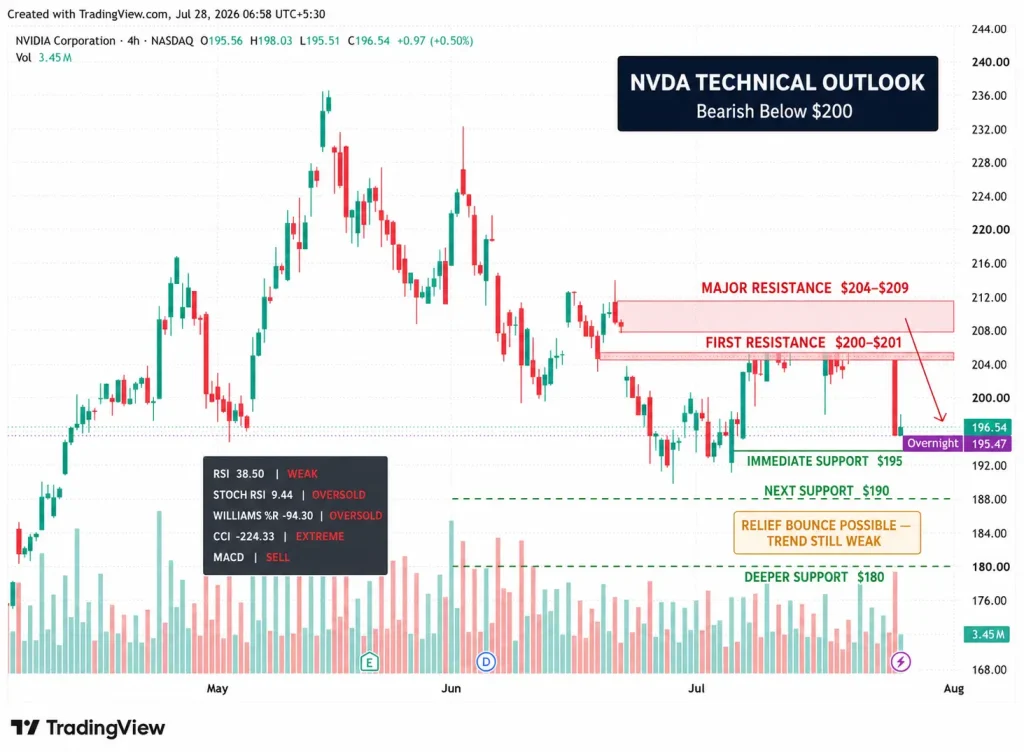
From a technical perspective, Nvidia’s four-hour chart has deteriorated sharply.
At $196.51, NVDA is trading below every listed simple and exponential moving average. The 200-period simple moving average at $199.90 and the 200-period EMA at $201.22 now form the first major resistance zone.
The Hull moving average at $198.74 reinforces the psychological $200 level.
A sustained recovery above $201 could allow buyers to challenge the 50-period simple moving average at $202.71. Stronger resistance is concentrated between approximately $204 and $209, where the short-term averages, Ichimoku baseline and 100-period simple moving average are located.
Until Nvidia recovers this cluster, rebounds may continue attracting sellers.
Momentum indicators show that the decline is becoming stretched. The RSI stands at 38.50, while Stochastic %K is close to oversold territory at 20.38.
Williams %R has fallen to -94.30 and shows a buy signal, while the Stochastic RSI stands at just 9.44. The Commodity Channel Index has dropped to -224.33, another indication of extreme short-term weakness.
However, MACD remains on a sell signal, and Bull Bear Power is deeply negative. These readings suggest that a relief rebound is possible without confirming that the correction has ended.
The $195 region represents immediate support. A decisive break below it could expose $190, followed by a deeper test near $180. On the upside, Nvidia must first reclaim $200–$201 and then $205 before the four-hour structure begins to improve.
Nvidia’s AI Ecosystem Strategy Faces a Critical Test
Nvidia remains the dominant provider of the computing systems powering the artificial intelligence boom.
Its Vera Rubin platform is entering production, leading AI laboratories continue seeking access to its systems, and sovereign AI projects provide another potentially enormous market.
However, the company’s expanding role as supplier, investor and financial supporter is changing its risk profile.
A possible $250 billion OpenAI guarantee would provide visibility into future demand, but it could also expose Nvidia more directly to its customers’ ability to monetize AI services and meet long-term obligations.
For now, the break below $200 shows that investors want greater clarity.
Oversold indicators may support a short-term rebound, but NVDA must recover the $200–$205 region before buyers regain technical control. Until then, financing concerns, Chinese competition and political resistance to data-center construction could continue overshadowing Nvidia’s powerful long-term growth story.
- Check out our free forex signals
- Follow the top economic events on FX Leaders economic calendar
- Trade better, discover more Forex Trading Strategies
- Open a FREE Trading Account
- Read our latest reviews on: Avatrade, Exness, HFM and XM

Related Articles
Sidebar rates

Related Posts
 Save
Save