QBTS Stock Surges 20% as AT&T’s 240X Speedup Signals Real Quantum Computing Demand
D-Wave Quantum stock QBTS surges 20% as AT&T expands quantum computing after a network task ran 240 times faster than before.

D-Wave Quantum shares jumped more than 20% to $19.51 after AT&T expanded its use of the company’s technology, although an extreme valuation and continuing losses keep the outlook highly speculative.
QBTS Stock Reclaims $19 as AT&T Expands Quantum Computing Across Network Operations
D-Wave Quantum stock recorded one of its strongest sessions in months after AT&T expanded an existing partnership designed to apply quantum computing to complex telecommunications-network problems.
QBTS climbed $3.30, or 20.36%, to close at $19.51 after trading as high as approximately $19.54. Shares subsequently slipped 2% to around $19.12 in overnight trading as some investors took profits following the powerful rally.
The move reflects growing optimism that D-Wave is beginning to demonstrate practical commercial applications for quantum computing rather than relying entirely on long-term research promises.
In an initial test, D-Wave’s technology reduced the processing time for an AT&T network-optimization workload from roughly one hour to less than 15 seconds.
That represents an acceleration of approximately 240 times and could allow AT&T to make network decisions while conditions remain relevant.
However, D-Wave’s commercial progress must still be weighed against its limited revenue, continuing losses and exceptionally high price-to-sales ratio.
AT&T Test Delivers a 240X Speed Improvement
AT&T operates an enormous and constantly changing telecommunications network serving millions of customers and connected devices.
The company must regularly solve optimization problems involving traffic routing, network congestion, equipment deployment, outage response and the allocation of limited resources.
Traditional computing systems can require considerable time to analyze these problems. In some cases, the network may change before the calculation is complete, reducing the practical value of the result.
D-Wave’s annealing quantum system was able to reduce one optimization workload from about 60 minutes to less than 15 seconds.
This result is particularly important because quantum-computing companies have often struggled to demonstrate a clear advantage in commercially relevant settings.
Laboratory benchmarks may show technical progress, but investors and customers increasingly want evidence that quantum systems can improve actual business operations.
The AT&T result provides a more tangible proof point. It suggests that D-Wave’s technology could perform useful work within one of the world’s largest and most complicated communications networks.
AT&T Expands D-Wave Across Network Operations
The initial test encouraged AT&T to broaden the use of D-Wave’s quantum platform.
The telecommunications company plans to explore applications including outage detection and response, network construction planning, technician routing, traffic management, load balancing and spectrum allocation.
These operations involve large numbers of possible combinations and constantly changing constraints, making them potentially suitable for quantum annealing.
Faster optimization could help AT&T reduce customer downtime, use network capacity more efficiently and respond more quickly when equipment fails or traffic patterns change.
AT&T is already using artificial intelligence agents to diagnose network problems. Integrating D-Wave’s optimization technology into those systems could allow AI applications to make decisions using results that would otherwise take too long to calculate.
This combination of quantum computing and agentic AI could become an important part of D-Wave’s commercial strategy.
Rather than attempting to replace classical computing, the company can position its technology as a specialized accelerator for the most difficult optimization stages within larger enterprise workflows.
Quantum Annealing Gives D-Wave a Near-Term Advantage
D-Wave differs from several major quantum-computing competitors because it has concentrated heavily on quantum annealing.
Annealing systems are designed for optimization problems involving many possible combinations and constraints. Potential applications include scheduling, logistics, resource allocation, manufacturing and network management.
Gate-model quantum computers, which companies such as IBM and Rigetti are also developing, could eventually support a wider range of calculations. However, fault-tolerant gate-model systems remain difficult to build and may require further technological breakthroughs.
D-Wave’s annealing platform is already commercially available through its cloud-based quantum-computing service.
The company says more than 100 commercial, government and research organizations use its systems. Previous customer projects have included workforce scheduling, manufacturing, defense and telecommunications optimization.
D-Wave is also developing gate-model technology following its expansion back into that part of the market. AT&T is evaluating the company’s future gate-model systems for possible quantum-security and communications applications.
This dual-platform approach could broaden D-Wave’s addressable market, but it will also require significant research spending and careful execution.
QBTS Stock’s Nasdaq Transfer Adds Visibility
The AT&T announcement coincided with D-Wave’s debut on the Nasdaq following the voluntary transfer of its common-stock listing.
CEO Alan Baratz and the company’s management team marked the move by ringing the Nasdaq opening bell.
The transfer does not directly change D-Wave’s financial position or underlying technology. However, Nasdaq is closely associated with high-growth technology companies, and the move may improve visibility among investors focused on quantum computing and artificial intelligence.
Other quantum stocks also rallied following the AT&T announcement.
Rigetti Computing, IonQ and Infleqtion recorded strong gains as investors interpreted the agreement as a broader signal that commercial quantum adoption may be accelerating.
Nevertheless, the sector remains extremely volatile. Many quantum-computing companies are valued primarily on future potential rather than present earnings, making their share prices highly sensitive to partnerships, government funding and technical announcements.
Wall Street Sees Commercial Traction but Warns of Risk
Several analysts have responded positively to D-Wave’s expanding commercial activity.
Benchmark analyst Gary Mobley has maintained a Buy rating and a $30 price target, implying more than 50% upside from the $19.51 closing price.
The bullish argument is that D-Wave is producing practical results today while many competitors remain focused mainly on research roadmaps.
The company also has remaining performance obligations that may provide greater visibility into future revenue. D-Wave is expected to begin recognizing revenue from a previously announced $10 million contract, potentially supporting growth over the next several quarters.
However, even supportive analysts acknowledge the risks.
Quantum computing remains an early-stage industry with competing architectures and uncertain timelines. A technical breakthrough by a rival could change the competitive landscape quickly.
Investors may therefore continue treating QBTS as part of a diversified quantum-computing strategy rather than assuming one platform will dominate the market.
D-Wave’s Extreme Valuation Leaves Little Room for Disappointment
D-Wave’s valuation represents the largest obstacle to the bullish case.
The company has a market capitalization of approximately $7.23 billion despite generating only a small amount of annual revenue.
Its indicated price-to-sales ratio is around 478, while trailing earnings remain negative. Basic earnings per share stand near a loss of $1.13, and the company does not pay a dividend.
A valuation at this level assumes years of exceptional growth.
The AT&T expansion is an important commercial endorsement, but it has not yet been disclosed as a large system sale or a contract capable of materially transforming D-Wave’s near-term financial performance.
D-Wave must convert technical demonstrations into recurring cloud usage, professional-service revenue and additional system contracts.
If commercial adoption develops more slowly than expected, the stock could experience a substantial valuation correction even if the underlying technology continues improving.
Q2 Earnings Become the Next Major Test
D-Wave is expected to report second-quarter results on August 6.
Wall Street revenue estimates reportedly range from approximately $3 million to $6.6 million, reflecting the small and uneven nature of the company’s current sales base.
Investors will focus on bookings, remaining performance obligations, cash usage and evidence that customer pilots are advancing toward larger commercial deployments.
Any financial detail concerning the AT&T relationship could also attract attention.
A stronger backlog and rising quantum-computing-as-a-service usage would support the argument that D-Wave’s technology is moving into production.
Weak bookings or accelerating losses could quickly remind investors of the gap between the company’s market value and current revenue.
QBTS Technical Analysis: $20 Becomes the Critical Level
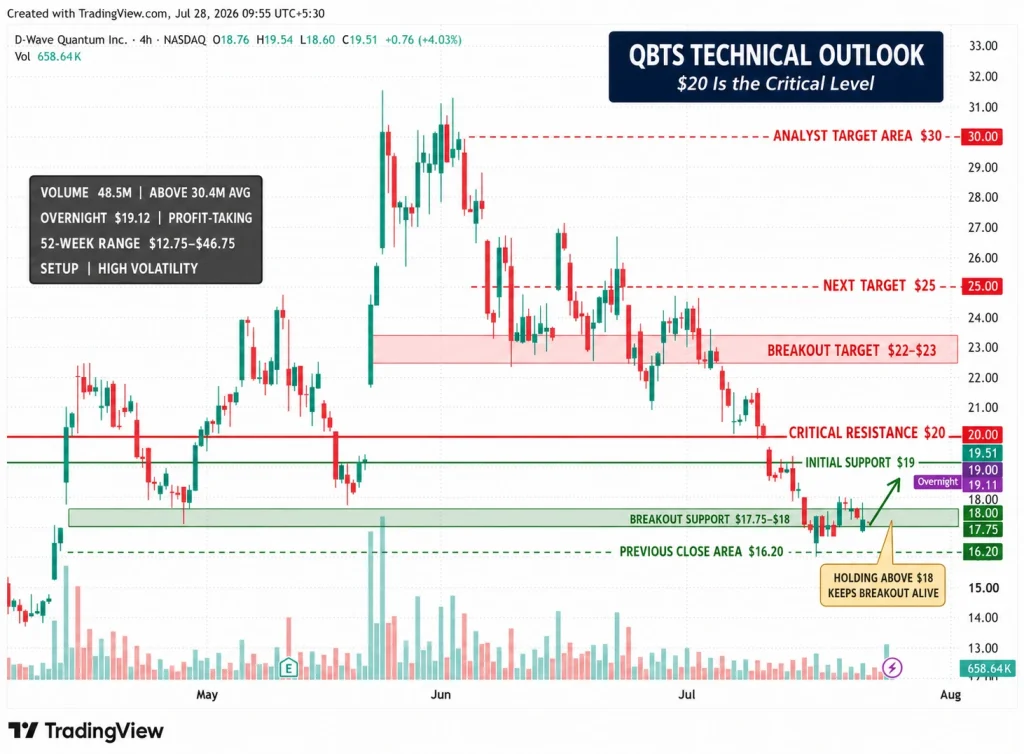
From a technical perspective, D-Wave’s 20% rally has transformed the immediate outlook but has not eliminated volatility.
The stock reached $19.54 before closing at $19.51, placing it directly below the psychological $20 resistance level.
A sustained break above $20 could strengthen momentum and open the way toward the $22–$23 region. Beyond that, $25 would become the next major psychological target, followed by the analyst target area near $30.
However, the overnight retreat to $19.12 suggests some traders are already taking profits.
Initial support sits near $19, followed by the session’s breakout region around $17.75–$18. A break below that zone could expose the previous closing area near $16.20.
The stock remains far below its 52-week high of approximately $46.75, showing how much damage the earlier correction caused. At the same time, it remains above its 52-week low near $12.75.
Trading volume reached approximately 48.5 million shares, well above the average near 30.4 million. That increased participation strengthens the significance of the breakout, but it also confirms that QBTS remains a highly speculative and volatile stock.
Holding above $18 would suggest the AT&T announcement has established a higher support zone. Failure to hold that level could turn the rally into another temporary spike.
D-Wave Quantum Faces a Commercialization Test
D-Wave’s expanded relationship with AT&T represents one of the clearest examples of quantum computing producing a potentially valuable result for a major enterprise.
Reducing a real network-optimization task from one hour to less than 15 seconds provides a compelling demonstration of what quantum annealing can accomplish.
The agreement could lead to broader use across network planning, outage management and traffic optimization while strengthening D-Wave’s credibility with other large companies.
However, the stock’s valuation already assumes a substantial commercial breakthrough.
For now, QBTS has technical momentum and an important new customer endorsement. A sustained move above $20 could extend the recovery, while a return below $18 would weaken the breakout.
D-Wave has shown that its quantum technology can solve a practical problem. Its next challenge is proving that such results can become a large, recurring and profitable business.
- Check out our free forex signals
- Follow the top economic events on FX Leaders economic calendar
- Trade better, discover more Forex Trading Strategies
- Open a FREE Trading Account
- Read our latest reviews on: Avatrade, Exness, HFM and XM

Related Articles


Sidebar rates

Related Posts
 Save
Save